Showing posts with label Journals on Biomedical Science Journals on Medical Informatics Regenerative Medicine Biomedical Journal Articles Journal of Biomedical Research and Review. Show all posts

Tuesday, August 6, 2024

Can the Following Strategy Generate a Definitive Anti-Covid Vaccine?


Can the Following Strategy Generate a Definitive Anti-Covid Vaccine?

Opinion

Following the spread of the different Viral Variants of COVID-19 [1-5] which seems unstoppable, perhaps a strategy could be implemented for the production of a DEFINITIVE vaccine capable of neutralizing the Virus despite the presence of variants. A few days ago I appreciated the good news that researchers published about the vaccine with the covid N protein in mice [6]. This confirms that multiple targets such as antigens allow to overcome the appearance of variants. Howewver, vaccination experiments on animals in the laboratory, as a preclinical model, are valid but it must be careful in extrapolating them to humans. The mice used are often of the same age and genetically “IMBRED”; that is, their immune system is not genetically polymorphic, they live in very controlled conditions and are often the same age. The human immune system, on the other hand, is different in that it is subject to many parameters and is regulated by multiple polymorphisms which, as is well known, induce considerable variability as is widely demonstrated in daily practice: in timing, in dose; in effectiveness; in duration etc. Starting from these considerations, to generate a Definitive Vaccine, a valid procedure could be the following: all Healed and Asymptomatic patients, after infection with the different viral variants, have generated antibodies, contained in their blood, against all the antigenic components of the WHOLE VIRUS, including the Spike protein which represents only the most attackable antigen but not the only one [7]. That is, antibodies directed towards the protein sequences of viral antigens which physiologically cannot be subject to mutations are present.

Moreover the pool of antibodies taken from cured and asymptomatic patients, after infection with all viral variants, can be also used as probe to identify phylogenetic common antigenic epitopes present in all coronaviruses in addition to the specific ones induced by single variants. The conserved epitopes [8,9] allow generating immunity that is not only cross-protective over coronaviruses but also relatively resistant to ongoing Covid evolution. In addition, this strategy could be applied to fight soon future pandemics by using the available first sera from haeled and asymptomatics patients. Synthetic peptides (small molecules of 25 Amino acids), which sequences reflect the selected epitopes, recognized by the pool of sera from selected patients, allows the possibility of producing large quantities of vaccine at relatively low cost and easy handling in the transport and storage chain and methods of administration like nasal spray, sublingual absorption as well as intramuscular.

Methods

Immunoaffinity Chromatography to purify synthetic peptides recognized by human antibodies. Synthetic peptides of 25 Amino Acids reflect the protein sequences of SPIKE, N and M antigens of Covid. The peptides retained in the column and then eluted after washing can be used as vaccine in preclinical models to test anti variants-Covid efficacy.


For more Articles on: https://biomedres01.blogspot.com/

Thursday, March 14, 2024

Hesitancy in Administering Gelatin-Containing Vaccines to Alpha-Gal Sensitized Patients


Hesitancy in Administering Gelatin-Containing Vaccines to Alpha-Gal Sensitized Patients

Introduction

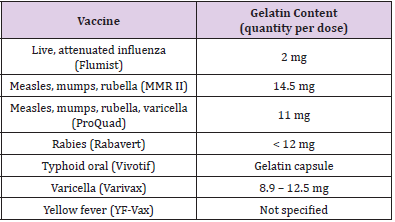
Alpha-gal syndrome is a recently discovered disorder of sensitization to the carbohydrate galactose-α-1,3-galactose (alphagal) following a bite from the Lone Star tick. This can result in an IgE-mediated hypersensitivity reaction to non-primate mammalian meat [2,3] typically developing 3-8 hours following red meat ingestion. Alpha-gal can also be found in gelatin products [1], which gives rise to the question of whether gelatin-containing vaccines, such as the MMR, Varivax, Zostavax, and some influenza (Table 1), can be safely administered to patients sensitized to alpha-gal. Primary care physicians have been observed to be hesitant to administer gelatin-based vaccines to patients with diagnosed alpha-gal meat allergy. Concerns for adverse reactions to vaccines, in general, have resulted in a disconcerting 30% of the US population who have refused vaccination for themselves or their family members.

biomedres-openaccess-journal-bjstr

Table 1: Gelatin content of vaccines licensed in the United States, 2019.

Methods

Our own records were first studied. Both a search of the Vaccine Adverse Event Reporting System (VAERS) database and a physician survey in an area endemic to the Lone Star tick were employed to access the magnitude of the problem afterwards. The VAERS database was utilized to study the analyzable incidence of hypersensitivity reactions to the MMR, Varivax, and Zostavax vaccines in reference to geographic location from 2000-2020. Pediatricians from an endemic area of Long Island, NY area were questioned regarding the incidence of allergic reactions observed to the gelatin-containing vaccines observed in more than 650 patients known to be sensitized to alpha-gal.

Results

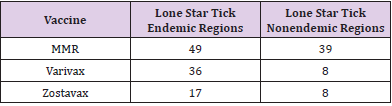
The VAERS results (Table 2) show more vaccine reactions in states endemic to the Lone Star tick, but insufficient information did not permit statistical analysis. Among pediatricians surveyed from the endemic area with a patient population of more than 650 patients sensitized to alpha-gal, there were no noted reactions to the vaccines in the sensitized patients other than the 2 following cases. An observation of an immediate IgE reaction to gelatin-containing vaccines was observed in two patients. The first patient was an adult male who gave a longstanding history of suspected allergic reactions to meat and dairy and required an MMR vaccine at 38 years of age. Within 40 minutes of vaccination, he developed acute onset of cough, chest and throat tightness, and difficulty breathing and speaking. He required emergency room management and 2 doses of epinephrine for resolution. His alpha-gal IgE was noted to be 57.4 kU/L. The second patient had a history of severe gastrointestinal symptoms with dairy and meat, dating back to around 5 years of age. While in the pediatrician’s office following vaccination with Varivax, she developed acute anaphylaxis requiring treatment with epinephrine. She was subsequently tested for alpha-gal allergy and her alpha-gal IgE level was noted to be 10.5 kU/L.

biomedres-openaccess-journal-bjstr

Table 2: VAERS database reactions to vaccines in reference to geographic location (2000-2020).

Discussion

Data obtained in this study did not support a markedly increased risk of IgE-mediated hypersensitivity reactions in alphagal sensitized patients which is consistent with the observation that many such patients have received gelatin-based vaccines without incident [1]. There is often hesitancy to give gelatin-containing vaccines (Table 1) due to concern for allergic reactions, however the risk of not receiving a particular vaccine may outweigh the possible risk of allergic reaction which is amenable to mitigation. As the world is presented with the development of the COVID-19 vaccines, there is significant scrutiny on every individual aspect of the various vaccines. As more pharmaceutical companies formulate their own versions, some may contain gelatin and the question of whether it is safe to administer these vaccines in alpha-gal sensitized patients will likely arise. The risks of measles, influenza, and COVID-19 infection likely outweigh the possible risk of a controllable IgE-mediated hypersensitivity reaction to a gelatincontaining COVID-19 vaccine. Vaccines should be considered by their physicians in individuals at-risk or hesitant patients, with practiced precautionary measures taken when indicated [4].


For more Articles on: https://biomedres01.blogspot.com/
Isolation and Identification of Bacteria Associated with Hawked Suya Meat: A Case Study of Bokkos Local Government Area, Plateau State, Nigeria

  Isolation and Identification of Bacteria Associated with Hawked Suya Meat: A Case Study of Bokkos Local Government Area, Plateau State, Ni...