Showing posts with label journals on neuro imaging journals on regenarative diseases Journals on vaccination Journals on Infectious diseases Addiction science and clinical pathology Journals on Psychology. Show all posts

Wednesday, September 22, 2021

Vaginal Gossypiboma In A 3Year Old Female Child- A Case Report and Literature Review


Vaginal Gossypiboma In A 3Year Old Female Child- A Case Report and Literature Review


Introduction

Retained surgical sponges are seldom reported due to medicolegal implications. Awareness of this problem is not only mandatory for the surgeons but is crucial for the radiologists so as to make prompt and accurate diagnosis in such cases. A gossypiboma, textiloma [1] or cottonoid are the common terms used to describe such foreign objects (a mass of cotton matrix or a sponge) that are left behind in a body cavity during a surgical procedure. The manifestations and complications of gossypibomas are variable, hence diagnosis can be difficult and patient morbidity is significant [1]. The incidence of retained surgical instruments is estimated at 1 in 100-3000 of all surgical interventions and 1 in 1000-1500 for all intrabdominal operations [2-4].

Case Report

We report the case of a 3-year-old female child who presented to the outpatient walk in clinic at our institution with a history of a vaginal mass noted by her parents for for 6 months. She underwent surgical resection of the mass by a surgeon at an outside facility. Histopathology was consistent with vaginal embryonal rhabdomyosarcoma. She was admitted to our institution and on baseline work up, a residual mass was identified on the MRI pelvis. Completion surgery followed by brachytherapy was the proposed treatment after Multidisciplinary Tumor Board discussion. She underwent repeat resection of the residual mass (which was resected in two fragments according to the operative report) followed by brachytherapy. Further chemotherapy was planned and given according to low risk regimen of rhabdomyosarcoma. The child subsequently presented after 4 months after chemo with vaginal discharge. Repeat MR imaging demonstrated a heterogeneous abnormality in the region of vaginal vault and upper half of the vagina which was thought to represent thick inspissated serosanguinous secretions secondary to radiation related vaginal stenosis versus noncontiguous tumor recurrence (Figure 1).
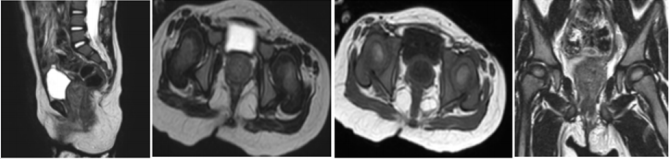
Figure 1: Sagittal(a) and axial (b) T2W images showing heterogenous mass like signal changes in vaginal canal thought to be secretions or disease. Similar changes noted on axial (c) and coronal (d) T1WI. It finally proved to be a gossypiboma on vaginoscopy/ pathology.

Examination under anesthesia was suggested. Cyst vaginoscopy was performed. On per operative findings a large foreign body was seen in vagina with minor ulcerations. No residual thickening of vaginal wall and no evidence of any residual tumor was seen. Removal of the foreign body was performed, which turned out to be surgical gauze. Post procedure imaging showed complete removal of gauze (Figure 2). Histopathology suggested a gossypiboma which was left inside at the time of brachytherapy.

Figure 2: Sagittal (a) and axial (b)T2W images showing normal vaginal canal after removal of the gossypiboma. Post contrast sagittal (c) and coronal (d) T1WI Fat Sat show normal signal without any abnormal enhancing lesion or disease recurrence.

Discussion

Several cases of retention of surgical gauze after surgical procedures have been reported in literature; however, many remain unreported due to fear of litigation [1]. Forgotten gauze has been known to migrate to several hollow intra-abdominal organs such as intestine, stomach, and thoracic cavity [1-11]. Different foreign bodies have been forgotten, transported, or left accidentally in the adult vagina over a period of time. Such objects included tampons, bottle caps, sex toys, and sometimes dangerous substances like batteries and illicit drugs [3]. To our knowledge, a case of a vaginal gossipiboma in a pediatric patient is a rare occurrence. Pathologically, two types of foreign-body reaction can occur. The first is an aseptic fibrinous response that creates adhesions and encapsulation. The second response is exudative in nature and leads to abscess formation with or without secondary bacterial invasion [6]. In an experimental animal study to evaluate the process of migration of gossypiboma; four stages ware described.

These are foreign-body reaction, secondary infection, mass formation, and remodeling. Plain radiography and computed tomography (CT) can diagnose most cases of gossypiboma. However, MRI is useful in differentiating a foreign body from an abscess [1,3,9,12,13]. Malignant transformation has been reported following long-standing irritation from gossypiboma resulting in hematoma, granulomatous inflammation, abscess formation cystic masses, and/or neoplasm [12,13]. The treatment options for gossypiboma depend on the size, location, complications, and facilities available; ranging from laparoscopic retrieval to open surgery [14-16]. Uncomplicated gossypiboma can be retrieved laparoscopically. However, migration to hollow organs requires exploration, removal of the foreign body, followed by resection, and/or repair of the perforated organs, toileting, and sometimes drainage of the cavity.

Conclusion

The radiologist should almost always consider the possibility of a retained sponge in imaging of every postoperative case including the pediatric patient population. This is even more important in patients with unusual presentations and or radiological imaging findings. A high degree of suspicion is important for preoperative diagnosis. Despite the use of radio-opaque sponges and thorough sponge counting, this dreaded mishap still occurs. Although human errors cannot be completely abolished, continuous medical training and strict adherence to regulations should reduce the incidence to a minimum.

For more Articles:  https://biomedres01.blogspot.com/

Thursday, September 16, 2021

Relationship Between the Demographic Variables and Prevalence of Depression Among the University Students


Relationship Between the Demographic Variables and Prevalence of Depression Among the University Students 

Introduction

Depression is a complex disorder [1]. Depression is affecting badly student’s motivation, concentration, feelings of self-worth, mood and these days it is becoming a very common problem in students of any age, gender, socio economic status, ethnicity and year level nationality (Andrews & Wilding 2004). i.e., without the cultural boundaries. Depressions have severe impacts on the student’s academic performance and social functioning within the university environment. [2-5] Competitions for higher merits in jobs, exams, inability to cope, helplessness, increased psychological pressure, mental tension and too much work load made the educational process a stressful process. While studying at the university there are many situations and interpersonal instances that gave rise to the feeling of hopelessness, sorrow, or being alone, i.e., the onset of depression, such as the family environment, the socialization setting, and the discrimination against gender.

Researchers like [6-8] have stressed that educational processes can lead to prevailing the depression in the jobs and later life. Interpersonal relationships can be one of the causes of the Depression; relationships within the family e.g., the impact of depressed parents can have an effect on their children as well, the social environment, interactions between genders. This poor interpersonal relationship leads to the feeling of lack of control and having a high risk of conflict, rejection, and low self-esteem which ultimately leads to the depression. Similarly, the family and social class, income and living in hostel have impact on a depressed individual (Hammen & Brennan 2001) [9,10]. Students facing and managing financial problems have increased risk of depression (Andrews & Wilding 2004). Gender discrimination in the society has also a relationship with the prevailing of the depression. Female students must face increased expectations to conform to the standards set forth by society and culture.

Rationale of the Study

As the Depression in students is a common problem, the role of demographic variables in prevalence of the depression is still unclear. The present study investigated the differences in depression level of students based on demographic variables.

Methodology

Objectives

The will examine the effect of age, economic status, and living arrangement (accommodation) on the depression level of students.

Operational Definitions of Variables

Demographic Variables: The demographic variables for the present study will be gender (male students and female students), Socioeconomic status will be measured by the monthly income of the parents in two categories i.e., how are getting s.15000/= P.M will be labelled as Low Income Group and having more than Rs.15000/= will be labelled as High income group, and those who are studying in the university and living at home will be labelled as Day Scholars and those who are residing at the Hostels will be labelled as Borders.

Depression: Depression for the present study will be measured through Depression Anxiety Stress Scale (DASS), Lovibond & Lovibond (1995). High scores on the scale will display high depression among students and low scores will display low depression.

Hypotheses:

a) Higher levels of depression would be found for females as compared to the males.

b) Students of the low-income parents would be having more levels of depression as compared to the higher level of the depression.

c) High levels of depression would be found for students living in the hostels as compared to the Boarders

Procedure

The students of the three leading universities of Rawalpindi & Islamabad were taken as the sample of the study, a sample of the N=80 (both male n=40 and female n=40) out which n=20 in the both samples were living in the hostels and n=20 in the both samples were boarder students. Students during the study hours were give the DASS based on the convenient sampling. DASS (Depression Anxiety Scale) and a bio data sheet for recording Demographic variables (Age, Gender, Boarder or day scholar and Family income) were used as the instruments in the study. The DASS 21 is a set of three self-report scales i.e., Depression Scale, Anxiety Scale, Stress Scale designed to measure the negative emotional states of depression, anxiety and stress. T Test was performed for Statistical Analysis for determining the association between socio demographic variables and scores on DASS.

Results & Discussion

The following table shows the relationship between the demographic variable and the scores on the DASS i.e., the levels of the depression on the DASS (Tables 1-3).

Table 1: Show Mean, Standard Deviation and t values for male and female students the results show significant mean differences on the scores of DASS with respect to Gender. Females have higher scores (M=20.22, t= 7.80, df=78, P<.01) as compared to male students (M = 27.97, t= 5.10, df=78, P<.01).

Df = 78, P<.01

Table 2: Show Mean, Standard Deviation and t values among students of the different financial backgrounds. The results show significant mean differences on the scores of DASS with respect to Gender. Students of low-income parents have higher scores (M=32.33, t= 4.48, df=78, P<.01) as compared to students of high-income parents (M = 33.33, t= 7.80, df=78, P<.01).

Df = 78, P<.01

Table 3: Show Mean, Standard Deviation and t values among Day Scholar and Boarder students. The results show significant mean differences on the scores of DASS with respect to living in hostel and home. Boarders have higher scores (M=28.88, t= 5.20, df=78, P<.01) as Day Scholars compared to students of high-income parents (M = 34.11, t= 5.20, df=298, P<.01).

Df = 78, P<.01

Discussion

The results of the first analyses indicated that depression levels were affected by different demographic characteristics Hypotheses demographic variables significantly associated with depression levels included gender, employment status and boarding. Female students experienced significantly higher levels of depression than males, our results are consistent with literature cited on gender differences and depression [2,3]. The tendency for females to experience higher levels of depression has, in the past, been explained by differences in sex roles (Baron & Matsuyama 1988), differences between the genders in coping or differences between the genders in reaction to stressors [11].

The level of satisfaction with financial position and accommodation were important variables influencing student depression. Students with the higher levels of financial satisfaction had lowers scores on the DASS as compared to students not satisfied with their financial position our study is in line with Andrews & Wilding, 2004 [12-16]. This outcome indicates the importance of financial burden in determining the wellbeing of students. Study proved that those students who were unhappy living in the boarding displayed comparatively higher levels of depression [17,18]. Dissatisfaction with a living arrangement is a significant stressor for the students.

For more Articles: https://biomedres01.blogspot.com/


On the Poaching of and the Threats Facing the Chukar Partridge (Alectoris Chukar J.E. Gray, 1830) in Palestine

  On the Poaching of and the Threats Facing the Chukar Partridge ( Alectoris Chukar J.E. Gray, 1830) in Palestine Introduction Palestine ...