Showing posts with label Physical medicine and Rehabilation. Show all posts

Wednesday, December 15, 2021

Trombophilic Screening in Young Adults with Myocardial Infarction: Utility or Futility?


Trombophilic Screening in Young Adults with Myocardial Infarction: Utility or Futility?

Introduction
It is widely accepted that several cardiovascular Risk Factors (RFs) contribute to the occurrence of Myocardial Infarction (MI) and most of them are frequently encountered in elderly population. However, occasionally MI can affect young subjects who do not present the abovementioned RFs. In these setting, thrombophilic mechanisms are often called into question to justify MI etiology. Thrombophilia describes an inherited or acquired condition which can increase the risk of venous or arterial thrombosis. The utility of testing for thrombophilia to guide prevention and treatment decisions is controversial [1], especially in patients with arterial thrombosis. Nevertheless, in the 1980s and 1990s thrombophilia testing became common in unselected patients and their relatives [2]. Even today, thrombophilia testes are frequently performed, particularly in young patients, with a not indifferent impact for health spending.

Thrombophlic Disorders

The most studied thrombophilic disorders in young patients with MI are: Factor V Leiden (FVL) and Factor II (FII) G20210A mutation. The relationship between FVL and risk of MI has led to conflicting results, therefore the association appears stronger in young subjects. A study by Butt et al. [3] showed that FVL was higher exclusively in MI patients younger than or equal to 50 years, with 3.9- fold higher prevalence in young patients than in patients older than 50 years and 2.7-fold higher than in age matched control subjects. A systematic review showed that FVL does not significantly correlate with MI (OR 1.26, 95% CI 0.94 to 1.67), but the decision to include in the study young patients (<55 years) contributed to make the association significant (OR 1.29, 95% CI 1.03 to 1.61) [4]. A meta-analysis showed that FVL was not associated with MI but correlation was stronger in patients younger than 55 years of age affected by MI, ischemic stroke or complicated Peripheral Vascular Occlusive Disease (PVD) (OR, 1.37; 95% CI, 0.96–1.97) [5]. However, the large Italian Atherosclerosis Thrombosis and Vascular Biology Study found no evidence for an association between FVL and MI at age younger than 45 years [6].

Even the relationship between the FII G20210A mutation and risk of MI is controversial but this association appears more solid in young population. Furthermore, Butt et al found that the prevalence of FII G20210A was higher in MI patients than in controls (OR 3.3, 95% CI 2.6-4), particularly in younger than 51 years (5.6- fold higher than in age-matched control subjects) [3]. A study by Rallidis et al. showed that FII G20210A was more frequent in ST Elevation Myocardial Infarction (STEMI) patients ≤ 35 years of age than in controls (OR 2.2, 95% CI 1.1-4.2) and the risk increased substantially in presence of smoking as a RF [7]. Another study indicated that the FII G20210A was the only genetic prothrombotic RF associated with the risk of developing MI under the age of 36 years [8]. Finally, in the meta-analysis of Kim and Becker, the relationship between MI and FII G20210A was slightly stronger than the association with FVL (OR 1.28; 95% CI, 0.94 to 1.73) and it seemed to become stronger in subjects younger than 55 years of age with MI, ischemic stroke or complicated PVD (OR, 1.66; 95% CI, 1.13–2.46) [5]. However, the large Atherosclerosis Thrombosis and Vascular Biology Study among survivors of MI at age younger than 45 years did not confirm this association [6].

Merely some case reports reported Protein C (PC), Protein S (PS) e Antithrombin (AT) III deficiencies in young patients with MI. Unfortunately, very few studies have investigated these thrombophilic disorders in a large population. Two studies by Rallidis et al found no difference in AT, PC, and PS plasma levels between patients with STEMI or MI under the age of 36 years and the controls [7,8]. Therefore, evidence for an association between deficiency of these factors and the risk of MI are inadequate.

Extensive evidence support the hypothesis that the Antiphospholipid (APL) syndrome is associated with risk of MI [9,10]. Since the diagnosis of the APL syndrome is possible if it is present at least one clinical criterion and one laboratory criterion [11], in our opinion, it is justified search for APL antibodies in young patients with MI without other cardiovascular RFs.

Conclusion
In conclusion, evidence about the relationship between thrombophilia and juvenile MI are still inadequate. FII G20210A and FVL are the only thrombophilic disorders that showed an association with MI in young patients although with some controversial results. Neverthless, some randomized trials conducted in patients with hyperhomocysteinemia (considered a RF for atherosclerosis) showed that reducing serum homocysteine levels through B vitamins administration in patients with cardiovascular diseases does not modify prognosis [12,13]. Therefore, association is not synonymous of RF.

As long as some valuable trials do not demonstrate the efficacy of different therapeutic strategy (like using of anticoagulant or prolonged double anti-aggregation) in improving prognosis of MI in young population with positive thrombophilic screening, thrombophilic testing in these patients will be worthless and expensive. As things stand today, in patients with juvenil MI the only useful test that seems to be worth performing is APL antibodies test, even if MI is not a frequent event in APL syndrome [11-13].

For more Articles on : https://biomedres01.blogspot.com/

Monday, December 13, 2021

Analysis of Obstetric Risk Factors in the Progression of Cerebral Palsy According to Data from Maternity Clinics in Almaty

Analysis of Obstetric Risk Factors in the Progression of Cerebral Palsy According to Data from Maternity Clinics in Almaty

Introduction
Cerebral palsy (CP) is a group of stable disorders of motor development and maintenance of postures leading to motor defects caused by non-progressive damage and / or abnormalities of the developing brain in the fetus or newborn child [1]. According to the population studies from around the world cerebral palsy cases range from 1.5 to more than 4 per 1000 live births or children of a certain age range. The overall prevalence of the birth of children with cerebral palsy is approximately 2 per 1000 live births [2-4]. In Kazakhstan, cerebral palsy holds the leading position in the structure of childhood disability (from 30% to 70%). According to statistics, more than 44 thousand disabled children are registered, of which over 10 thousand children are diagnosed with cerebral palsy. Data on the frequency of cerebral palsy fluctuate widely with an average of 2.0-5.9 per 1000 births and is largely determined by the level of development of society [5].

Discussions about the root cause of cerebral palsy do not stop until now. Obstetricians from all over the world have repeatedly experienced significant pressure due to the fact that great importance in the progression of cerebral palsy was attached to the complicated course of childbirth and birth trauma, which led to an increase in lawsuits and a massive outflow of doctors. However, at the moment it has been proven that there are many reasons for the development of cerebral palsy, and it is almost impossible to single out one of them as the main one. All these causes lead to brain damage - periventricular leukomalacia and all scientists agree that cerebral palsy develops in association with it [6]. The main goal in the treatment of cerebral palsy is its timely diagnosis, prevention and early rehabilitation. Our study is devoted to the study of obstetric risk factors in the progression of cerebral palsy in a megacity based on the example of Almaty (Kazakhstan) with a population of over 1.5 million people.

Objective

Is to establish the role of the pathology of pregnancy and childbirth in the development of cerebral palsy.

Materials and Research Methods

In order to study the peculiarities of the course of pregnancy and childbirth in mothers of children with cerebral palsy, we carried out retrospective analysis of the features of the ante, intra and postnatal period of 150 patients with cerebral palsy (main group) and 150 healthy children (control group). A medical card consisting of several blocks of questions was filled out for each patient, with 220 general questions (age, nationality, place of work, etc.), obstetric part (77 questions) with ante and intranatal risk factors; neonatal and pediatric questions as well. For comparison, a similar survey was conducted among healthy children and their parents.

Statistical Analyses

Statistical processing of the results was carried out using MS Excel 2016, MS Access (for data entry) and SPSS 20 versions; a DBMS based on MS Access was used for data entry. The program has a convenient interface and allows you to protect the entered data from operator errors. Logical errors are detected when checking the quality of input forms. The data entered into the database are processed using modern methods of variation statistics. Primary statistical data processing was carried out to determine the frequency (in percent) of the occurrence of suspected cerebral palsy risk factors in general in the group under study, in the context of clinical diagnosis, in subgroups on the basis of fetus maturity and in terms of the development of cerebral palsy. Statistical processing showed average relative values (in percentage) with their standard error, which in turn makes it possible to judge by Student’s t-test. It is known that the use of the sampling set and Student’s t-test allows us to conclude that the differences between the mean values are significant. At the same time Student’s test refers to parametric criteria and parametric criteria, as a rule, are more powerful than non-parametric. Differences between the compared average values were considered significant when the error probability is equal to or less than 0.05 (p <0.05). The control group was selected by random sampling in the maternity clinics of the city.

The Results of the Study

In our study there were statistically more boys in the main group compared to girls (56.7 ± 4.0% versus 40.7 ± 4.0%, p = 0.01). All mothers of children with cerebral palsy were in active reproductive age, in contrast to the control group, where the number of women over 35 years old was 66.6 ± 3.9% versus 14 ± 2.8, p = 0.001. According to our research mothers of children with cerebral palsy got sick more often than mothers of healthy children. So, thrombocytopenia (41.3 ± 4.0%), chronic arterial hypertension (37.3 ± 3.9%), hemorrhagic vasculitis, diabetes mellitus, thyroid pathology, cardiac rhythm disturbance, myocardiodystrophy, myocarditis, APS-syndrome (33.3 ± 3.8%) and heart defects (4 ± 1.6%) were found only in the main group. Women from the control group did not suffer from such diseases. Thus, patients from the main group had a low health index which correspondingly affected the complicated course of pregnancy. Mothers of children suffering from cerebral palsy had a statistically significant history of the first early abortion (86 ± 2.8% vs. 48.7 ± 4.1%, p = 0.001). However, mothers of healthy children are proved to interrupt pregnancy more often. So, 4 ± 1.6% of women only in the main group had three or more abortions in past medical history against 46 ± 4.1% of the mothers in the control group, p = 0.001. Mothers of sick children in the past medical history were statistically more likely to have a dead fetus (40.6 ± 4.0%, p = 0.001) or preterm delivery (33.3 ± 3.8%, p = 0.001). Despite the fact that more than half of the women (66.7%) had one or another type of infertility in the main group, the methods of assisted reproductive technologies were not used, infertility was cured by conservative means. The combination of complicated obstetric history and a large number of extragenital diseases led to a burdened course of pregnancy. Pregnancy in women of the main group was statistically significantly more often complicated by the threat of abortion (70.6 ± 3.7% vs. 2.7 ± 1.3%, p = 0.001).

Despite the clinical picture of threatened abortion and / or retrochorial hematoma, preserving therapy (progestins) were taken by 8 ± 2.2% of pregnant women only. The lack of adequate therapy led to preterm delivery. In 1/3 of the women of the main group, pregnancy was complicated by arterial hypertension caused by pregnancy (33.3 ± 3.8%, p = 0.001), and in 44.7% by preeclampsia (p = 0.001). A significant number of hypertensive complications of pregnancy may be associated with both extragenital diseases and the lack of prophylaxis; no woman took folic acid in the first trimester of pregnancy, and only 3.3 ± 1.5% of pregnant women in the main group received calcium supplements in the first trimester. The pathology of the membranes (multi- or low-water) prevailed 3.2 times in the main group (10.7 ± 2.5% versus 3.3 ± 1.5%, p = 0.01).

The infectious factor has played its role in our study. Up to 12 weeks of gestation, i.e., during the aniage of main organs and systems 1/3 of patients in the main group had ARVI or ARD (33.3 ± 3.8%, p = 0.001), and 45.3% suffered from these diseases in the second trimester (45.3 ± 4.1% versus 0.7 ± 0.7%, p = 0.001). The exacerbation of chronic diseases, such as chronic pyelonephritis and tonsillitis complicated the course of pregnancy, but the difference was statistically significant only with exacerbation of chronic tonsillitis (4 ± 1.6%, p = 0.01). Carriage of genital infections (TORCH) was found in the main group almost 4 times more often than in the control group (10.7 ± 2.5% vs. 2.7 ± 1.3%, p = 0.01).

And sexually transmitted infections during pregnancy in the main group were almost 14 times higher than in the main group (18 ± 3.1% versus 1.3 ± 0.9%, p = 0.001). Complicated course of pregnancy in patients of the main group worsened by complicated childbirth. 52.1% of mothers with children suffering from cerebral palsy had preterm delivery whereas this number in the control group is 6.7% (p = 0.001) only. In 35.4% of cases (control group 0%), preterm delivery occurred up to 34 weeks in patients of the main group, but only 14% of patients received prophylaxis of RDS with dexamethasone. A significant role in addition to prematurity belongs to body weight at birth. Thus, children with extremely low body weight from 500 to 999 grams requiring prolonged nursing and respiratory support, with an immaturity of all organs and systems in the main group were 3 times more than in the control group (6 ± 1.9% vs. 2 ± 1.1%), as well as with very low body mass from 1000 to 1499 grams almost 3 times more (6 ± 1.9% against 2.1 ± 1.2%). Estimation of children on the Apgar scale, which reflects the state of the child at birth and the effectiveness of the resuscitation was also statistically different from healthy children. Thus, in the first minute of life 5.3% of children in the main group received 0 against 0 children in the control group (p = 0.01) and 1 point was received by 75.3% of children in the main group (p = 0.001). 74.7% of children in the main group (p = 0.001) received a score of 1 point during the first 5 minutes of life, whereas in the control group there were no children born in a state of severe asphyxia. In 3.3% of cases in the main group the protracted labor was observed for more than 18 hours, which led to the worsening of infection and possible injury. Also, in 3.3% of cases rapid delivery was observed in less than 4 hours, which is extremely traumatic for both the mother and the fetus. In the main group, 2% of children with birth trauma and 14% (p = 0.001) with a cervical spine injury were noted, whereas there were no similar diagnoses in the control group. In the main group, prenatal rupture of membranes of 45.3% was significantly more frequent against 0 (p = 0.001).

In 6.7% (control group 0%) of cases there was induction of labor with amniotomy and the same number of cases of labor induction with oxytocin (p = 0.001). As a consequence of hypertensive complications of pregnancy and those who did not receive appropriate prophylaxis, 7.3% (control group 0%, p =0.001) of patients were diagnosed with premature detachment of a normally located placenta, which worsened the fetal condition and 26% (control 4.7%, p = 0.001) delivery was performed by cesarean section. The placenta is the main organ of communication between the mother and the child in the antenatal period and its histological study provides answers to many questions. All pregnancy complications, both infectious and hypertensive, affect the state of the placenta. In 3.3% (control 0%, p = 0.05) cases the inflammatory changes in the placenta were detected and decompensated and subcompensated placental insufficiency in 14.6% of cases, whereas in the control group only 0.7% of the compensated form of placental insufficiency was detected ( p = 0.001).

Conclusion
Thus, cerebral palsy as a disease does not have a major or leading risk factor for its development. But a combination of several, rather frequent factors leads to disastrous results. The combination of preterm delivery with hypertensive complications of pregnancy, aggravated obstetric and extragenital history, intrauterine infection, all together leads to periventricular leukomalacia of the fetus and newborn brain, the development and aggravation of which after birth leads to the manifestation of cerebral palsy. And, perhaps, more thorough pregravid preparation, improvement of preventive measures, strict control over their health and careful attitude to pregnancy will lead to a decrease in cerebral palsy as a disabling disease. Allocation of risk factors is of great importance in the early rehabilitation of children with a high risk of developing cerebral palsy, as well as promptly initiated prevention and rehabilitation will undoubtedly level out the symptoms of the disease and ensure quick adaptation in the society.

For more Articles on : https://biomedres01.blogspot.com/

Wednesday, December 8, 2021

Risk Factors Associated with Early Pregnancy and Attention Deficit Disorders

Risk Factors Associated with Early Pregnancy and Attention Deficit Disorders

Introduction
Adolescence is a period of development and growth during which people establish their sense of individual identity, modification of the personal scheme, adaptation to more mature intellectual capacities, to the demands of society, internalization of a personal value system and preparation for adult roles. It is established between the ages of 10-19 years. Adolescent pregnancy is a major concern of the Cuban Health System [1,2]. The problem of pregnancy in adolescence does not have a specific cause but is multifactorial. Several authors highlight in this group, biological and psychosocial risk factors [3,4]. Motherhood in adolescents means risk to your health and that of your child. The pregnant woman may develop hypertensive disease of pregnancy, urinary or vaginal infections and preterm delivery. In newborns, complications are related, among others, to low birth weight, prematurity and lead to neurological damage [5-8].

Attention deficit disorder is a relatively new name for a pathology described since the 16th century. With specific therapy since 1955. It was a disorder that initially only arose in children, as it is a common disease that affects 7 percent of school children but is currently considered to be evolving into adulthood [9]. The fundamental symptoms are effect of attention, nervousness, impulsivity, difficulty in planning, among others. It is a clinical entity that often has a comorbid behavior with affective disorders, substance use, learning disorders among others. Currently the treatment includes both psychotherapeutic and pharmacological aspects, both having the same level of importance [8]. Because of its impact on both children and adults, it is currently a topic of great interest on which many studies are conducted worldwide. This research was carried out with the objective of identifying the reproductive risk factors in women with a history of early motherhood and who currently have their children diagnosed with attention deficit disorders.

Method
Descriptive, longitudinal and prospective study with a quantumqualitative approach. The universe was made up of 24 women. with antecedent of early maternity and children with diagnosis of TDH with file from April 2017 to 2018 for the treatment with Methylphenidate. The study was conducted with a sample of 20 patients from the municipality of San José de las Lajas. Mayabeque during February to May 2018.

Inclusion Criteria

a) Willingness to participate in the study.

b) Women with a history of teenage pregnancy, children under treatment with Methylphenidate due to a diagnosis of ADD, living in the municipality of San José de las Lajas, Urban Area (Table 1).

Table 1: Age and schooling during pregnancy. San José de las Lajas Mayabeque February - May 2018. P=0,3292.

Exclusion Criteria

a) Express wish to refuse to participate in the study.

b) Do not obtain reliable maternal or newborn data.

Bioethical Aspects

Communication to the Scientific Council of the institution. All people were treated equally, regardless of their physical condition and cultural level. No disclosure and confidentiality of the name of the patients involved in the study. The data is used for scientific purposes, presentation at events and its publication

Techniques and Procedures:

The data is Obtained From:

a) Analysis of the current records (April 2017-2018) of children treated with methylphenidate in the main municipal pharmacy San José de las Lajas, Mayabeque.

b) Obstetric and pediatric history in the doctor’s offices of the Luis Augusto Turcios Lima and Rafael Echezarreta Mulkay polyclinics family, San José de las Lajas, Mayabeque.

c) Interview and questionnaire to the mothers.

Statistical Processing

a) For the Quantitative Approach: Use of data base Microsoft Excel Office 2007.

b) Use of elements of Descriptive Statistics: calculation of absolute frequency (FA) and relative (%) and

c) Inferential Statistics: Pearson’s Chi-square test by using the program for analysis Epidemiological data tabulated, version 3.1 (EPIDAT). The results are expressed in tables.

d) Qualitative Approach: By means of questions: Semi-structured interview, information necessary for the investigation was collected. The registration process to conserve them was done through notes and recordings. The union of both approaches allowed deepening on the subject investigated.

Results
During late adolescence, gestation occurred in 90% (between 17-19 years) with an educational level of Basic Secondary Education by 50%. It was obtained during the interview that 100% did not continue studies and that currently 60% are housewives.

Regarding Marital Status: 2 were single mothers (10%) and 90% of pregnant women were accompanied. Currently 100% are separated from the parents. Among the risk factors, it was observed that they presented a history of psychiatric disorders or psychological disorders 3 women (15%) and poor socioeconomic conditions and biological factors (history of chronic arterial hypertension) in 20% respectively (Table 2). It should be noted that the association of biological factors and poor socioeconomic conditions were related in 75%. It is appreciated that hypertensive disorders were represented by Preeclampsia/Eclampsia in 15%, anemia, placenta previa and alteration of the amniotic fluid (oligohydramnios) in 10% and 1 pregnant woman (5%) presented urinary tract infection. It is appreciated that hypertensive disorders were represented by Preeclampsia/Eclampsia in 15%, anemia, placenta previa and alteration of the amniotic fluid (oligohydramnios) in 10% and 1 pregnant woman (5%) presented urinary tract infection. It is significant that 90% at term with adequate weight for gestational age, 2 newborns were preterm and low birth weight (10%).

Table 2: Marital status at the time of pregnancy and current relationship with the father figure. San José de las Lajas Mayabeque February - May 2018.

Discussion

The recognition of the risk posed by teenage pregnancy is a real problem, a cause of concern for dissimilar health professionals dedicated to its study [9]. Among the variables analyzed are age, since adolescence is a stage in which the organism is under biological, social and psychological transformations (Table 3). These changes favor alterations during pregnancy, with the likelihood that they are closer to the gynecological age and therefore in early or middle adolescence [10]. One of the characteristics of couple relationships during adolescence is the instability of couples, favoring concealed and unplanned pregnancies (Table 4), which increases the likelihood of single mothers, with frequent breakups in couples’ relationships and in this research it demonstrates. There are studies that suggest that this favors conflict and / or hostility in the parent-child interaction and associates with the aggressive behavior of these children and becomes more aggravated during adolescence [1-3,11]. This stage of life coincides with the school, going through the continuity of study, which is truncated, school dropout is frequent, due to early pregnancy, in fact in the research no woman continued the professional improvement after pregnancy (Table 5).

Table 3: Preconceptional risk factors: Bio-psycho-social during pregnancy. San José de las Lajas Mayabeque February - May 2018.

Table 4: Associated diseases that complicated the pregnancy. San José de las Lajas Mayabeque February - May 2018.

Table 5: Delivery routes and APGAR score in newborns. San José de las Lajas Mayabeque February - May 2018. p= 0,0022.

It corresponds to other research in pregnant adolescents, where early pregnancy affects their educational process, frustrating in most cases their life projects. The low educational level and the abandonment of the studies are very imbricated because one leads to the other [12]. People with low educational level generally do not react in a rational and logical way to situations that are characteristic of the crisis of the stages of the family’s life cycle, and in the adolescent it is increased by not being able to make adequate decisions, in which they can be present feelings of insecurity and uncertainty aggravating psychological or psychiatric disorders that could have as background [13]. Among the non-neurobiological factors involved in the origin of ADD, psychosocial risk factors have been described that would influence the development of emotional and cognitive control capacity (Table 6). Problems in the family relationship are more frequent in families of children with ADD. This can be a consequence or a risk factor by itself [14].

Table 6: Birth weight and gestational age of the neonates. San José de las Lajas Mayabeque February - May 2018.

Note: Yacht Correction: 0.0012

The present study does not correspond to investigations carried out where newborns predominate with intrauterine and preterm growth restriction. Yes, it was present conditions that may contribute to intrauterine ischemic hypoxia as hypertensive disorders during pregnancy, corresponding with studies suggesting that the adverse effect of hypoxia and ischemia on prenatal brain development can lead to functional problems, such as ADD14- twenty [15-19]. Other studies indicate that the absence of a parent and the improper performance of roles in the case of adolescents are also predisposing factors that favor the early and timely diagnosis of neurodevelopmental disorders and by associating with psychosocial and environmental factors such as Inadequate socioeconomic situation or psychosocial stress of the family due to disorganization crisis, attention deficit disorders may arise [20-25].

Conclusion
Reproductive risk factors in the preconceptional stage, such as obstetric and perinatal risks, may favor the development of ADD in early pregnancy, whether these are bio-socio-economic factors.

For more Articles on : https://biomedres01.blogspot.com/

Monday, May 10, 2021

Effects of 12-Week Cognitive and Exercise Interventions on Physical, Cognitive Function and Health-Related QOL in Elders With MCI


Effects of 12-Week Cognitive and Exercise Interventions on Physical, Cognitive Function and Health-Related QOL in Elders With MCI

Introduction

Mild Cognitive Impairment (MCI) is an intermediate state between the cognitive changes of normal aging and dementia. Seniors with MCI are at the high-risk group for progressing dementia-a rate of 10 to 15 % per year compared with 1% to 2 % per year among the general population [1,2]. Given that this cohort is at high risk of developing dementia and lowering quality of life, it is important to identify effective intervention and appropriate place for them to perform the intervention to manage the cognitive decline and maintain the quality of life in the community level. In the Fratiglioni et al. [3] (2004)’s general model of dementia occurrence, the occurrence of dementia considers the effect of different risk and protective factors acting at different times during the life course of an individual. After 60’s, the protective factors for dementia include vibrant social network, mental activities, and physical activity.

Evidence suggests that cognitive function in older adults may be affected by the social network including social integration [4] and social support [3,5,6]. Some studies have indicated that people who experience more significant levels of social interaction and support have better mental health outcomes [7,8]. Further, there is more evidence of the effects of leisure activities on health and survival, especially physical activities and physical exercises [9]. Physical activity as the non-pharmacological treatment for MCI and dementia have received considerable attention. Evidence shows that estimated 17.7% of Alzheimer disease cases could be prevented through physical activity [10] and the Higher one physically active, the lower the incidence of MCI and dementia [1,11].

Community senior centre offers a wider variety of programs and services including meals, nutrition program, information and assistance, fitness and wellness program. Evidence suggests that cognitive function in older adults may be affected by modifiable risk and protective factors including smoking, poor diet, level of physical activity, cognitive stimulation and social relationship [3,6,7]. However, A few studies reported the effect of the combination of physical, cognitive intervention and social network. Further, the role of community senior centre as a hub of prevention of dementia has not been investigated. The local community senior centre must be a good place to prevent elderly from dementia by providing wellstructured cognitive program, physical activity, and social network. Therefore, the purpose of this study is to investigate the effect of a structured cognitive, physical activity and social network on physical and cognitive function, depression, QOL in MCI and normal cognitive elders.

Materials and Methods

Subjects

Pre-post design with subgroup analyses was conducted to compare elders with normal to with MCI. Subjects were recruited from 30 local community senior centres. Individuals were considered eligible if they

a) Were at least 65 years old;

b) Were able to participate senior centre program;

c) Were able to communicate;

d) Were able to maintain ADL or slight impairment IADL, and

e) Complete written consent form.

Procedures

Participants were assessed by the EQ-5D (EuroQOL five dimension) [12] questionnaire, self-rated health, MMSE-K, Geriatric Depression Scale short form in Korean version (GDS-SFK), and 2-minute step test. EQ-5D consists of five dimensions including self-care, mobility, usual activities, pain/discomfort and anxiety/ depression, each of which offered three possible responses: no problems/ some or moderate problems/ extreme problems (EQ5D, 2016). The answers to each EQ-5D dimensions were collapsed into a two-tier variable: In each EQ-5D dimension, “no problem” was considered as normal, whereas “some problems” or “severe problems” were considered problematic. Self-rated health was assessed by asking “would you say your general health now is excellent, good, fair or poor” and coded it as that excellent = 1 and poor = 4. Cognitive function was measured with Mini-Mental State Examination-Korean version [13]. Depression was measured with Geriatric Depression Scale (GDS) short form and categorized.

The Geriatric Depression Scale-Short form in Korean version (GDS-SFK) [14] was used to index depressive symptoms. The GDS-SF K included 15 items with yes/no format. Five positive items (e.g., “Are you satisfied with your life?”_ and ten negative items (e.g., “Do you feel that your life is empty?”. The total score was calculated counting the number of responses that suggest probable depression. The 2-minute step test is a measure of aerobic endurance. It is the number of times in 2 minutes that a person can step in place, raising the knees to a height halfway between the patella and iliac crest [15].

Intervention

The multicomponent intervention consists of physical activity, cognitive training, nutrition education and social activity. Physical activity was based on ‘15-minute plus’ exercise manual [16,17]. The intervention is held in the group format; each group has 8-25 participants. The intervention is held in once a week, 120 minutes per session for 12 weeks.

Data analysis

Descriptive statistics were used to evaluate the distribution of age, sex, BMI, MMSE and EQ-5D dimension. Chi-square and independent sample t-test were conducted to conducted to compare the baseline data between normal and MCI group. Prepost-test comparison was made by paired sample t-test. 2x2 repeated measure ANCOVA was conducted to see differences between time x group interaction. IBM SPSS statistics version 20.0 (IBM Corporation, Armonk, NY, USA) was used for all the analyses. Values p<0.05 were considered statistically significant.

Results

General Characteristics of Study Population

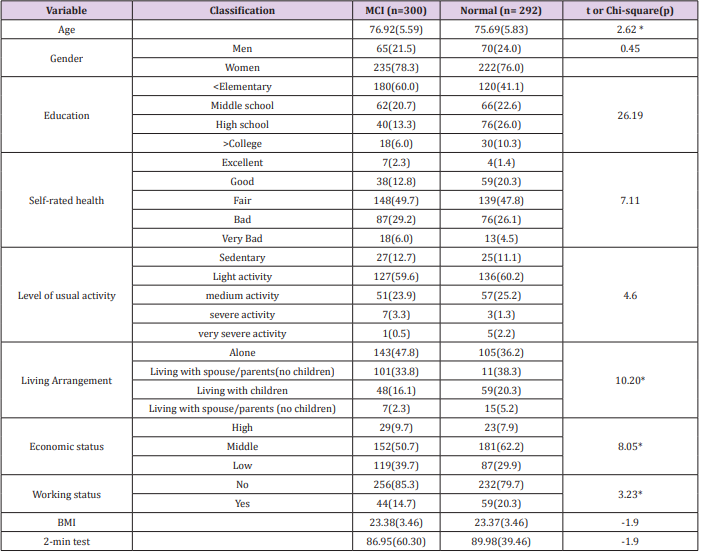
The general characteristics of participants were shown in Table 1. The study population included 300 MCI and 292 normal cognitive elders. The average age of study population was 77.32 years (SD: 5.39, ranging: 65-93). The mean age of normal and MCI was 76.92 and 75.69years, respectively. There was a significant difference in mean age (t=2.62, p<0.05), living arrangement (F= 10.20, p<.05), economic status (F=8.05, p<.05) and working status (F=3.23, p<.05) between MCI and normal group. Elders with MCI were more likely than normal elders to live alone (p<.05), have lower economic status (p<.05) and less work (p<.05).

Table 1: General characteristics of study population (n=592).

Note: * p< 05.

Intervention Effects

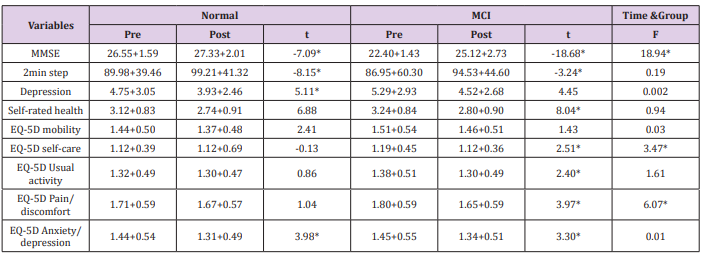
The effects of the intervention were shown in Table 2. After 12 weeks of intervention, in normal group, variables were significantly improved: MMSE (t=-7.09, p<.05), 2-min step (t=-8.15, p<.05), Depression (t=5.11, p<.05), EQ5D Anxiety/depression (t=3.98, p<.05). In addition, similar with normal group, variables in MCI group were significantly improved as well: MMSE (t=18.68, p<.05), 2-min step (t=3.24, p<.05), all EQ5D subdivision except mobility (p<.05). Further, there was a significant difference between the normal subjects and MCI in MMSE (F=18.94, p<.05), EQ-5D selfcare (F=3.47, p<.05), EQ-5D Pain/discomfort (F=6.07, p<.05).

Table 2: Effects of 12-week combined cognitive and exercise interventions on physical, cognitive function and health-related QOL.

Note: F: ANCOVA controlling for age, economic status, living arrangement, working status; * p<.05.

Discussion

In this study, we described the effects of combined cognitive and exercise interventions for people with cognitive impairment and cognitively healthy elderly in the community-based senior centre settings. In the results, we found that MCI patients in the intervention group demonstrated greater post-program improvement in cognitive function than cognitively normal elderly in community integration. Further, MCI patients showed greater post-program improvements in health-related QOL, especially selfcare and pain.

These results were like previous research by Ding et al. [18] and Li et al. [19]. Ding et al. [18] show MCI patients had the significant improvement in EQ5D pain compared with that of normal cognitive elders. Further, patients with MCI improved significantly overall cognition by cognitive intervention such as MMSE, self-rated memory problem, ADL, QOL [19].

Individuals with MCI demonstrate impaired performance in daily activities. People with cognitive impairment need to sustain their cognitive capacities and their abilities to perform activities of daily living as high a level as possible. Therefore, developing an intervention that is designed to maintain independence and stimulus cognitive function for individuals at risk for dementia is critical. The results of this study show us that progression to dementia may be slowed by the potential intervention that is designed to slow decline in disability for individuals at risk for dementia due to MCI. Further, this study provides information about the feasibility of community senior centre conducting a potential intervention for people with MCI. The feasibility of the project includes recruitment, the ability of this population to undertake and remain safely engage in the intervention and the sustainability and responsiveness of the outcomes. Progression to dementia may be slowed due to the link between engagement in normal cognitive elders with various activities stimulating cognitive as well as physical function. In this study, senior centre seems the good place where to give people with MCI and their family members an opportunity to interact with other seniors and develop meaningful social connection between the cognitive normal senior members that would reach across the barriers of age, disabilities, and abilities. Increasing meaningful social involvement in senior centre enhance potentially neurocognitive and emotional health. Individuals with MCI retain the capacity to problem solve and develop effective strategies to manage daily activities.

Thus, an intervention held with cognitive normal elder, which help individuals with MCI develop effective strategies in the course of daily activities may delay disability and may slow progression to dementia. Senior cantered multi-component intervention may have lower direct and indirect medical costs by fewer hospital and physician visits, and formal and informal caregivers service. Making a senior centre more dementia friendly place through participation is another challenge. The mechanisms of action should be further explored as a potential intervention to slow the decline in daily activities for individual with MCI. Findings from this study are informative but should be interpreted with caution. This study lacks a randomized trial, which decreased the methodological rigor.

However, these findings suggest factors that should be considered in future studies that examine non-pharmacological intervention for individual with MCI. Despite this limitation, the results of this study is meaning by demonstrating that the findings could be replicated in the similar setting. Further, this study provides the effectiveness of multi-component intervention and evidence of mixing people with MCI with normal cognitive elders in the community senior centre. Therefore, this study adds to the knowledge base about approaches for building dementia friendly communities and reducing dementia stigma.

ConclusionA twelve-week combined physical and cognitive intervention improve both physical function, cognitive function and HRQOL among both cognitive normal and MCI elders and imparted cognitive benefits in seniors with MCI.


More BJSTR Articles: https://biomedres01.blogspot.com

Friday, May 7, 2021

Nutraceuticals: Nutritionally Functional Foods – an Overview

Nutraceuticals: Nutritionally Functional Foods – an Overview 

Introduction

The term Nutraceuticals was derived from ‘Nutrition’ (a nourishing food or food component) and ‘Pharmaceuticals’ (a medical drug). “Nutraceutical” is a term coined by Dr. Stephen De Felice in 1989, founder and chairman of the Foundation for Innovation in Medicine (FIM) [1,2]. Nutraceutical defined as – according to Dr. Stephen De Felice - a “food, or parts of a food, that provide medical or health benefits including the prevention and treatment of disease” [3,4]. Nutraceuticals range from isolated nutrients, dietary supplements, and specific diets to genetically engineered “designer” food, herbal products, and processed foods such as cereals, soups, and beverages [5]. Nutraceuticals are continuously developed and have quickly spread worldwide [6]. The global nutraceutical market is, according to the recent BCC research analysis, expanding at a compound annual growth rate (CAGR) of 7.5%, would reach US $285.0 billion by 2021 from US $198.7 billion in 2016 [7-10].

Benefits of Nutraceuticals

Nutraceuticals may offer many benefits:

a) May increase the health value of our diet.

b) May help us live longer.

c) May help us to avoid particular medical conditions.

d) May have a psychological benefit from doing something for one self.

e) May be perceived to be more “natural” than traditional medicine and less likely to produce unpleasant side effects.

f) May present food for populations with special needs (e.g. nutrient-dense foods for the elderly).

g) May easily be available and economically affordable [11].

The nutraceutical products are recognized and produce health benefits such as to reduce the risk of cancer and heart disease and also to prevent or treat hypertension, high cholesterol, excessive weight, osteoporosis, diabetes, arthritis, digestive upsets and constipation, not to mention headaches [12-14]. Nutraceuticals are available in concentrated forms as pills, capsules, powders and tinctures either as a single substance or as combination preparations.

Nutraceutical Categories

Nutraceutical is a broad term. There are many types of products that fall under the category of nutraceuticals [15]:

Dietary Supplement Including

a. Nutrients such as vitamins, minerals, amino acids and fatty acids and antioxidants.

b. Herbals: Herbs or botanical products as concentrates and extracts.

c. Phytochemicals are polyphenols, isoflavonoids, anthocyanidins, phytoestrogens, terpenoids, carotenoids, limonoids, phytosterols, glucosinolates, and polysaccharides.

d. Probiotics are live microbial feed supplement for improving its intestinal microbial balance. Lactobacillus bacteria and bifidobacteria are most important and probiotics.

e. Prebiotics: A fermented dietary ingredient that allows specific changes both in the composition and/or the activity of the gastrointestinal microbiota that exchange benefits upon the host wellbeing and health.

f. Nutraceutical Enzymes.

g. Dietary Fibers includes non-starchy polysaccharides such as cellulose, hemicelluloses, gum and pectin, lignin and resistant dextrins.

Functional Food/ Fortified Nutraceutical

It constitutes fortified food from added nutrients or ingredients. For examples- Milk enriched with Vit. D, Orange juice fortified with calcium, Cereals flour added with fiber and folic acid.

Farmaceuticals/ Recombinant Nutraceuticals

Farmaceuticals is made of two words Farm and Pharmaceuticals. Medically valuable compounds from modified agricultural crops. Uses biotechnological methods usually.

Medicinal Food

The medicinal foods are formulated to be consumed under the supervision of a physician, and which are designed for the specific dietary management of a specific disease or conditions for distinctive nutritional requirements, and are established by the medical evaluation.

Negative Sides of Nutraceuticals

Nutraceuticals are used to accomplish desirable therapeutic outcomes with reduced side effects, has met with great monetary success. Health claims on nutraceuticals will alert the consumers as a part of an overall healthy diet and reduce the risk of certain diseases. Academic, scientific and regulatory organizations will consider ways to establish the scientific basis to support claims for the functional components of nutraceuticals. For nutraceutical industries, two challenges are faced; regulatory credibility and uncertain claims in labelling. The lack of quality control is an area of concern for nutraceuticals. Absence of quality control will increase the risk to the consumer and also results in a total lack of driving force to conduct an adequate research that shows the potential benefits of nutraceuticals or ensures their safety. The safety of nutraceuticals must be assured, and all the claims must be substantiated, truthful and non-misleading. Clinical research on specific nutraceutical products would help substantiate the potential medical or health values of these products. As a result, patients and health care professionals would know the facts about the benefit and the safety of the products being taken [16-18].

Conclusion

Nutraceuticals has shown their health benefits and disease prevention capability, which should be taken according to their acceptable recommended intake. Nutraceuticals can provide substantial health benefits especially in the prevention and/or treatment of acute and chronic human diseases, thereby promoting optimal health, longevity and quality of life. But its development depends on its quality, safety, long-term adverse effects, and toxicity as well as supplementation studies and clinical trials in humans. Development of better characterized and research proven products will help enhance consumer confidence in nutraceutical products in the world.


More BJSTR Articles: https://biomedres01.blogspot.com

Tuesday, March 2, 2021

Blue Food Contain a Specific Substance that Prolong Life (Blueberries)

Blue Food Contain a Specific Substance that Prolong Life (Blueberries)


Editorial
Blueberries (Cyanococcus) are perennial flowering plants with blue– or purple–colored berries. Compound in blueberries can have a surprisingly significant anti-aging effect, making them the perfect fruit to consume for longevity, anthocyanins in blueberries that give them their blue color and their impressive antioxidant benefits, but the compound responsible for their extraordinary ant-aging effects is known as pterostilbene – and blueberries are the only place you can get it. Blueberries contain 15 different anthocyanins. anthocyanins reduce oxidative stress in the body, they also extend our lifespan by reducing long-term damage to the body’s systems. Anthocyanin in blueberries having anti-diabetic effect.
a) Contributing to overall health and fighting off disease-causing free radicals
b) Supporting immune health
c) Supporting brain health
d) Increasing good cholesterol levels (HLD)
e) Lowering blood pressure
f) Protecting against certain forms of cancer
g) Protecting against diabetes
Warding off colds and flu. Blueberry extract extended the mean lifespan of fruit flies by 10 percent. The blueberry extract worked by increasing the expression of genes that increased lifespan and decreasing the expression of genes that sped up the aging process. Blueberries abundant in many nutrients. Blueberries are a rich source of polyphenols, which include anthocyanin bioactive com pounds. Epidemiological evidence indicates that incorporating blueberries into the diet may lower the risk of developing type II diabetes. The improvements in glucose tolerance after blueberry consumption were assessed by glucose tolerance test. Blueberries offer a natural “healthy package” of diverse bioactive compounds that contribute to its many health benefits. Nutritional interventions containing polyphenolics, such as berry fruits, may prove to be a valuable asset in strengthening the brain against the ravages of time as they could retard or prevent the development of age-related neurodegenerative diseases, may even prevent or delay the onset of diseases such as Alzheimer’s disease, because they can reduce oxidative stress and inflammation super imposed upon a stressvulnerable aging brain (Table 1)

Table 1: Nutritional value of Blueberries (Amount per 100 gram).
biomedres-openaccess-journal-bjstr

Effects of Metformin on Colorectal Carcinogenesis-https://biomedres01.blogspot.com/2021/03/effects-of-metformin-on-colorectal.html

More BJSTR Articles : https://biomedres01.blogspot.com

Friday, February 26, 2021

Resveratrol Play as Anti-Heat Stressor

Resveratrol Play as Anti-Heat Stressor


Opinion
A natural botanical polyphenolic compound, resveratrol (3,5,4’-trihydroxy-trans- stilbene) was reported to have anti-oxidation, anti-tumor, anti-inflammatory, neuro-protection and cardiovascular protection effects [1] Numerous studies have shown that resveratrol effectively eliminated reactive oxygen species (ROS), reduced DNA fragmentation, and enhanced the regulatory effects on growth factors and anti-inflammatory cytokines [1]. Resveratrol was considered to be important bioactive compound in monomers, and it has shown strong antioxidant capacity including scavenging free oxygen and lipid radicals [2]. Resveratrol is able to inhibit the formation of glutathione disulfide and keep glutathione in a reduced state, thereby inhibiting free radicals [3]. It has also been shown that resveratrol and its derivatives have activities of antimicrobial (bacterial), and anti-proliferation of cancer cells [4]. In recent study, resveratrol was shown to protect DNA damage against oxidative damage [5].
It has been reported that some plant polyphenols can also be used as anti-stress additives of livestock and poultry to alleviate tissue damage caused by heat stress [6,7]. Heat stress causes an imbalance in physiological status, a general reduction of the antioxidant system, and a reduction in the immunological function of chickens [8]. The research team leading by Dr. Jianhua He conducted a series of trial with broiler chicken to verify the anti-heat stress effect of resveratrol [1,9,10]. The resveratrol (≥98% purity) they used to be extracted from Polygonum cuspidatum at Hunan Engineering and Technology Center for Natural Products. He [9] reported that Resveratrol supplementation improved average daily gain (p = 0.001) and decreased (p < 0.05) rectal temperature from d 3 when compared with heat-stressed (maintain room temperature at 34℃ for 8h from 9:00 to 17:00) birds fed diet without resveratrol. In addition, supplementation with resveratrol at 350 or 500 mg/kg lowered (p < 0.05) the contents of corticosterone, adrenocorticotropic hormone (which are highly related to heat stress); it also decreased the content of triglycerides, uric acid, malonaldehyde, and activities of aspartate aminotransferase, alanine aminotransferase, and lactate dehydrogenase, increased (p < 0.05) the levels of triiodothyronine, the ratio of triiodothyronine to thyroxine, total protein, glutathione, and activities of alkaline phosphatase, total superoxide dismutase, catalase, and glutathione peroxidase, the above results suggested that dietary resveratrol supplementation could improve the growth performance by positively regulating serum metabolic parameters and alleviating tissue oxidant damage of broilers under heat stress. The results provided by Liu [10] also showed that dietary supplemented with resveratrol improved growth performance, feed intake and body weight gain of blackboned chickens during heat stress period, while feed conversion ratio was decreased. And it reduced oxidative stress in heat-stressed black-boned chickens by increasing serum growth hormone concentrations and modulating the genes expression of heat shock protein in organs of the immune system. She also found that dietary supplementation with 400mg/kg of resveratrol improved the villus morphology, increased the numbers of goblet cells and lymphocytes, attenuated the mRNA overexpression of HSP70, HSP90 and NF-κB on the 6th, 10th and 15th days of heat stress (maintain room temperature at 34℃ for 8h from 9:00 to 17:00)(P <0.05), activated the expression of EGF (P <0.05) in the jejunal mucosa.
Resveratrol reduced protein expression of HSP70, HSP90 and NF-κB in the jejunal villus after 15-days heat stress, increased EGF expression from the lamina propria toward the epithelial cells of the villus. These results suggest that dietary resveratrol offers a potential nutritional strategy to improve intestinal morphology and alleviate jejunum mucosa injuries by modulating the mRNA and protein expression of HSPs, epithelial growth factor and transcription factor in black-boned chickens subjected to circular heat stress. Liu [1] found that Resveratrol attenuated the heat stress-induced overexpression of Hsp27, Hsp70, and Hsp90 mRNA in the bursa of Fabricius and spleen and increased the low expression of Hsp27 and Hsp90 mRNA in thymus upon heat stress. Preliminary studies also have indicated some benefits of resveratrol supplementation to alleviate negative effect of heat stress, and increased SOD, GSHPx and CAT enzyme activities in mice [11], quail [7] during heat stress exposure. Das [11] also observed that resveratrol is able to resist the body organ dysfunction induced by heat stress. Sahin [7] reported that resveratrol can inhibit the high-levels of HSP70/90, NF-κB proteins in quail liver during heat stress. In conclusion, dietary supplementation of resveratrol could alleviate the heat-stress effect of broiler by reduced oxidative stress and its recovery effect of intestinal damage caused by heat stress. It was suggested that eat resveratrol containing herbs or food may play benefit effect for Human in tropic area.

Correlation of Normal Peripheral Oxygen Saturation with Tea Likeliness-https://biomedres01.blogspot.com/2021/02/correlation-of-normal-peripheral-oxygen.html

More BJSTR Articles : https://biomedres01.blogspot.com

Thursday, February 25, 2021

The Effectiveness of Polarized Polychromatic NonCoherent (BIOPTRON) Light in the Management of Acute Lateral Elbow Tendinopathy: A Case Report

The Effectiveness of Polarized Polychromatic NonCoherent (BIOPTRON) Light in the Management of Acute Lateral Elbow Tendinopathy: A Case Report


Introduction
Lateral elbow tendinopathy (LET) commonly referred to as tennis elbow and / or lateral epicondylitis is the most common tendinopathy in the elbow area. Pain and decreased function are the main symptoms of LET [1]. Diagnosis is simple. The symptoms are reproduced by
a) Gripping activities;
b) Palpation on the site of pain (facet of the lateral epicondyle); and
c) Clinical tests such as resisted middle-finger extension and/ or cozen’s test [1].
The management of LET is usually conservative. A plethora of physiotherapy modalities have been recommended for the management of LET. The effectiveness of the recom mended physiotherapy treatments has been investigated in chronic LET. Chronic LET is failed healing tendon response or degenerative rather than inflammatory [2]. To our knowledge, there have been no studies to find out the effectiveness of physiotherapy modalities in acute LET. More recently, physiotherapists can use a new modality called polarized polychromatic non-coherent (BIOPTRON) light. However, the evidence of the Bioptron light in the management of LET, acute or chronic, is minimal. Therefore, the objective of the present report is to find out the effect of Bioptron light in acute LET.

Case Report
Ms. V., a 23- year-old female complained of acute pain (less than 48 hours) in the lateral aspect of her right elbow, of her dominant hand. The pain was on the facet of the lateral epicondyle. She played tennis for about 4 hours, 36 hours ago. She experienced pain about 6 hours after completing the tennis practice. Since then, she complained of constant pain. She was not able to sleep. She did not receive any NSAIDs. She did not have any other symptoms or any problems in peripheral joints or in the spine. In the cozen’s test (extension of the wrist with the elbow in extension) the power was 1 on the Oxford scale and there was pain over the facet of the lateral epicondyle of the humerus, 9/10 on the VAS. Resisted extension of the middle finger was painful (9/10 on the VAS) on the facet and the power was 1 on the Oxford scale. The reported pain of the patient in the handgrip dynamometer test was 9/10 on the VAS.

All the other movements (passive, active and under resistance movements of the elbow, wrist and neck) were pain free, with full range of motion and strength. Finally, the pain was reproduced by palpation over the common extensor tendon on the facet of the lateral epicondyle of the humerus. The patient received Bioptron light therapy. A Bioptron 2 device administered Bioptron light therapy. Bioptron light therapy was administered to three locations for 6min in each location (i.e. 18 min in total) [3]. The probe of the Bioptron 2 was held at a 90oangle 5-10cm above the clean bare skin of the lateral condyle (1) from the upper surface (anterior) with the elbow in extension and the forearm in supination and (2) from the lateral surface with the elbow in 900 of flexion and the forearm in pronation. In addition, the probe of Bioptron 2 was held at a 900angle 5-10cm above the clean bare skin of the bellies of the extensor’s muscles of the wrist with the elbow in 900 of flexion and the forearm in mid-position of pronation - supination.

The emission of light was administered in 1-min steps and controlled by an integrated soft-start/soft-stop electronic switch. When the treatment with Bioptron 2 was over, there was a characteristic sound (beep tone). Treatment was delivered twice a day (morning and afternoon) for five consecutive days providing ten sessions in total. Function and pain were measured in the present study. The patient was evaluated before and after the treatment period. Pain and function were measured on a visual analogue scale (VAS), a valid and sensitive approach of the LET [4]. In addition, pain-free grip strength was used to measure function as described in previous trial [5]. Finally, pain and function were measured using the Patient-Rated Tennis Elbow Evaluation (PRTEE). The PRTEE questionnaire, provides a very quick (it takes less than 5 min to complete), easy, and standardized quantitative description of pain and functional disability in patients with LET. It has been translated and culturally adapted into Greek [6].

Results
Pain on VAS was 9, function on VAS was 1, pain-free grip strength was 18lb and the score of the PRTEE questionnaire was 94 at the initial evaluation. At the end of the treatment (session 10), there was a decline in pain on VAS of 6 units, a rise in function on VAS of 6 units, a rise in pain-free grip strength of 35 units and a decline in the score of the PRTEE questionnaire of 74 units (Table 1).

Table 1: Pain, function, pain-free grip strength and PRTEE questionnaire over the 24 h before each evaluation.
biomedres-openaccess-journal-bjstr

Discussion
The present case report has looked at the effect of Bioptron light in a patient experiencing acute LET and its findings have demonstrated significant improvements in terms of pain and disability. The results obtained from this case report are novel; as to date, similar studies have not been conducted. The most common physiotherapy treatment for LET is a supervised or in clinic exercise program [2,7]. However, the patient with acute LET was not able to perform an exercise program due to pain. The patient was advised by the clinician to follow an exercise program after completing the Bioptron light treatment. Like Low Level Laser Light (LLLL), Bioptron light is also a low-power light source but differ from LLLL in that Bioptron light is incoherent and polychromatic rather than coherent and monochromatic [8]. Moreover, Bioptron light combines infrared light at a wavelength of 700–3400nm and visible light at a wavelength of 480-700nm [8]. In contrast, LLLL contains either infrared or visible light at one specific wavelength [8].

Several drawbacks have impaired the usefulness of LLLL in comparison to Bioptron light, such as high risk, required user skills, the small diameter of the laser beam, which allows only a limited area to be treated and high cost [8]. Both the infrared and visible parts of the electromagnetic spectrum of Bioptron light can explain its mechanism of action [8]. It is probable that Bioptron light has biostimulative effects improves the blood supply and accelerates the cellular mechanisms [8], but more research is needed to investigate how this occurs. Since pain relief and improvements in function were noted in the present case study on a short term, it is proposed that Bioptron light may potentially have promoted an anti-inflammatory effect in the soft tissues [8]. However, to understand the potential changes to the tissues in response to Bioptron light therapy, future studies should consider employing outcome assessments that can monitor the changes in deeper tissues. The present case study was the first report to examine the effectiveness of Bioptron light on acute LET.

Previous research assessed the effectiveness of Bioptron light on chronic conditions such as LET [3,9] and carpal tunnel syndrome [10,11]. However, acute and chronic conditions are two different conditions and the results are not comparable. In addition, one controlled study assessed the effectiveness of Bioptron light in acute ankle sprains [12], but ankle sprain is a ligament injury whereas LET is a tendon injury. Therefore, ligament injury and tendon injury are two different conditions and the results are not comparable. The previously reported trials found that a course of Bioptron light may improve patients’ symptoms. The findings of these trials encourage the design of future well-designed RCTs that might produce strong evidence for the effectiveness of Bioptron light on sports / musculoskeletal injuries. A course of Bioptron light treatment was applied in the present study based on manufacturers’ claims [13]. It is a dose-response modality and the optimal treatment dose has obviously not yet been discovered.

Future studies are needed to standardize Bioptron light parameters in the management of LET (acute, chronic and calcific) and on other sports / musculoskeletal conditions. Although the positive effects of such a treatment approach in acute LET have been reported in the present study, its study design limits the generalization of these results. Future well-designed trials are needed to confirm the results of this case report establishing the effectiveness of such a treatment approach in the management of LET (acute, chronic and calcific). In addition, structural changes in the tendons related to the treatment interventions are needed to investigate. Further research is needed to establish the cost-effectiveness of such treatment, because reduced cost is an important issue for the recommendation of any given treatment and the possible mechanism of action of this treatment approach [8].

Conclusions
A course of Bioptron light treatment had reduced the pain and improved the function in a patient with acute LET at the end of the treatment. Further well-designed trials to confirm the results of the present case study are needed.

Can Aerobic Training Restore the Vascular Dysfunction Induced by Intrauterine Growth Restriction? Evidences from Experimental Studies-https://biomedres01.blogspot.com/2021/02/can-aerobic-training-restore-vascular.html

More BJSTR Articles : https://biomedres01.blogspot.com

Saturday, February 20, 2021

Epicoccum Species as Potent Factories for the Production of Compounds of Industrial, Medical, and Biological Control Applications

Epicoccum Species as Potent Factories for the Production of Compounds of Industrial, Medical, and Biological Control Applications


Introduction
Discovering new applications for currently known bioactive metabolites and/ or exploring novel biologically active metabolites are of critical need nowadays due to the current increasing dilemma of microbial resistance to available and used antibiotics and therapeutic agents, beside the emergence of new life threatening diseases. These problems have encouraged scientists to look for unconventional sources in order to find novel compounds. Fungi are promising sources for a wide variety of vital metabolites such as alkaloids, flavonoids, phenols, steroids and terpenoids [1-3]. Fungi capacity to synthesize variety of new bioactive metabolites forced researchers to explore these avenues. Epicoccum is an ascomycotic, endophytic fungus that is commonly isolated from different sources in moderate frequencies [4-6]. E. nigrum is famous for its successful applications in the bio-control of many phyto-pathogens [7-13], also for its ability to produce diverse classes of chemically, structurally, and biologically diverse secondary metabolites [13-17]. The aim of this review is to provide information about secondary metabolites of Epicoccum and their promising and current applications. Highlighting the importance of rich sources of biologically active compounds can contribute in encouraging searching for novel sources of potent compounds to face current needs for antimicrobial agents to overcome microbial antibiotic resistance, and to discover drugs for existing life-threating diseases.

Secondary Metabolites of Epicoccum Species
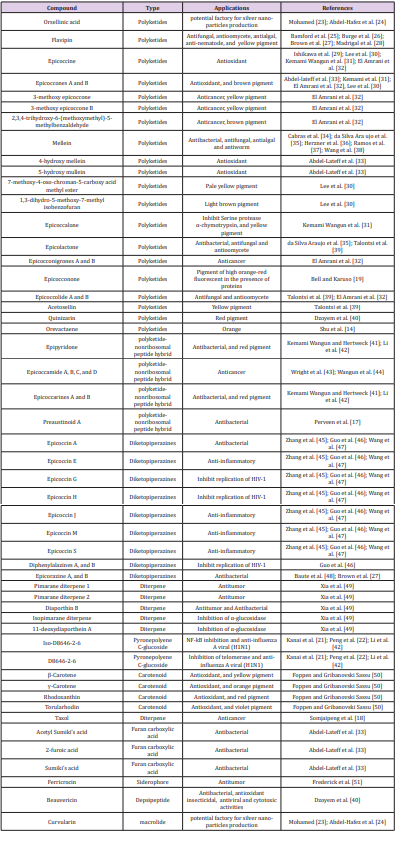
Epicoccum Sp. produces variety of secondary metabolites such as polyketides, polyketide hybrids, diketopiperazines, Siderophores, Carotenoid, and others (Table 1). Majority of these compounds exert promising biological activities such as antioxidant, antimicrobial, anticancer, in addition to potential industrial applications of pigments produced from E. nigrum as a likely safe, nontoxic, and non-pathogenic fungus. Among the important biologically active compounds produced by Epicoccum spp., the anticancer drug, taxol [18]. Also, epicocconone which is known commercially as fluorophore and is used in cell staining and in gel electrophoresis for protein detection [19,20], D8646-2-6 which is a telomerase inhibitor [21,22], in addition to many potential factories for silver nano-particles production such as Orsellinic acid and Curvularin.

Table 1: some secondary metabolites produced by Epicoccum species and their biotechnological applications.
biomedres-openaccess-journal-bjstr
Epicoccum Spp. As Biocontrol Agents
Epicoccum spp. have proven to be a potent biocontrol agents against many phytopathgenic fungi, specially Botrytis cinerea waxflower [23], Claviceps africana in sorghum [24], Pythium spp. infecting cotton [9], Rhizoctonia solani infecting potato plants [25], and Sclerotinia sclerotiorum in sunflower [26], Phytophthora infestans [27], phytoplasma in apple trees [28] and Monilinia spp. in peaches and nectarines [29-33] and against other plant pathogenic fungi [10,11,34,35].The action mechanisms exhibited by E. nigrum as a biocontrol agent varies from reducing host stem disease severity index, and growing along the fungal pathogen hyphae and inducing its lysis [36], or through causing degradation of the pathogen protoplast, malformation in its hyphae, and leakage of cytoplasm [37]. The polyketide, Flavipin, produced by many Epicoccum Sp is the reason causing growth inhibition of numerous phytopathogenic fungi [25,28,38-41]. On the other hand, Epicolactone isolated from E. nigrum has antifungal activity and can induce root growth [42- 57]. All those studies support using Epicoccum species in different host plants as a safe biological control agent and encourage deep investigations for further understanding of the physiological and molecular aspects of this interaction [57-62].

Conclusion
Emerging of microbial resistance, spread of life-threatening diseases, and biological control of pathogens destroying economically important crops, are serious problems that encourage scientists to search for unconventional sources for novel compounds with biological activities. Fungi are promising sources for such compounds due to their ability to produce assortment of secondary metabolites that could be, if truly investigated, the solution for currently serious problems. Epicoccum is one of the pioneer fungi in this field with proven potent ability as promising biotechnological tool to produce industrially, and biologically diverse metabolites.

THI: Is it a Reliable Measure to Assess Cattle Thermal Stress in Silvopastoral Systems in a Subtropical/ Temperate climate?-https://biomedres01.blogspot.com/2021/02/thi-is-it-reliable-measure-to-assess.html

More BJSTR Articles : https://biomedres01.blogspot.com

Isolation and Identification of Bacteria Associated with Hawked Suya Meat: A Case Study of Bokkos Local Government Area, Plateau State, Nigeria

  Isolation and Identification of Bacteria Associated with Hawked Suya Meat: A Case Study of Bokkos Local Government Area, Plateau State, Ni...