Showing posts with label Journals on Regenerative Diseases Journals on Neuro Imaging Open Access Medical Journal Biomedical Open Access Journals Biomedical Journal Articles. Show all posts

Tuesday, July 19, 2022

Spontaneous Resolution of a Traumatic Cataract in Cerebral Palsy Libyan Patient


Spontaneous Resolution of a Traumatic Cataract in Cerebral Palsy Libyan Patient


Introduction

The rate of surgery in eastern Mediterranean countries remains low. The provision of widespread cataract surgery delivered in a timely fashion before individuals are visually impaired by this condition may result for a reduction of blindness and visual loss. A related disturbing issue is the frequency with which ophthalmic surgery results in intra operative or postoperative complications. In several eastern Mediterranean countries, the rate of complications following cataract surgery remains high. The recent introduction of new techniques for cataract surgery, including phacoemulsification, has been started by ophthalmologists in eastern Mediterranean countries. Despite these advances, less than 20% of the cataract surgery in eastern Mediterranean countries is phacoemulsification. This is because of lack of resources in certain areas for cold and emergency cases, the presence of corneal scars, and advanced mature cataracts [1].

History

An 10-year-old male came as emergency case to ophthalmology clinic in a teaching Alwahda Derna hospital with trauma right eye by spoon food accidentally by his sister for evaluation of a possible open globe and management. The boy complained of pain, was taken to the local emergency treatment center for evaluation. A slit lamp examination failed to reveal a foreign body. Early the next morning he awoke with worsening pain. On examination by ophthalmologist noted a small corneal laceration 2 to 3mm at 8 to 9-Oclock and lenticular change (cataract).

a) Past Ocular History: No prior ocular injury, surgery, or illness.

b) Past Medical History: known case of cerebral palsy

c) Medications: *tobradex ophthalmic drops, 4x/day, in the right eye.

*Tobradex eyey ointment, twice daily

*Pilocarpin eye drops, three time daily (although the incision was small but taken this decision to prevent iris prolapse through the incision)

*Vegamox eye drops,,,, five time daily

d) Family and Social History: Noncontributory

e) Exam, Ocular:

• Motility: Normal; no restrictions

• Slit lamp examination

• 2.5 mm diameter full- thickness stellate corneal laceration (Seidel negative)

• Anterior chamber - deep

• Anterior capsular no tear

• Posterior rosette-shaped subcapsular cataract

• Dilated fundus exam (DFE): was difficult because cataracts changes of the lens

• Ultrasound …. Noforeign body. No vitreous hemorrhage, the posterior lens capsule appeared to be intact.

Follow up after three days, a rosette-shaped PCC was observed while the anterior capsule and lens nucleus were still same picture and the small corneal lacerated wound healed and pilocarpin stopped. The lens of the left eye was normal. Within another 3 days, the PCC increased in density and covered the whole pupillary area. Fundoscopic examination of the right eye were difficult to perform secondary to the cataract, however, no gross abnormalities were noted .Options for management of the cataract, including cataract surgery, were discussed with the patient’s father. Considering his age and his general condition, we agreed upon conservative observation. The patient returned for follow-up every 3 week and waited for an appropriate time for surgery. At the two-month follow-up, we observed that the size of the PCC began to decrease. Five months later, only a faint imprint of the original cataract remained. Based on the patient’s age and special his satiation and difficulty to surgical intervention, the patient received conservative management and follow-up. Interestingly, Surprisingly, the cataract gradually spontaneously resolved with time over the following 5 months and the fundus appear clear and restored red reflex (Figures 1 & 2).

Figure 1:

Figure 2:

Conclusion

several critical factors taken in consideration when treatment traumatic cataract in pediatric such as:

a) General condition of patient

b) Age

c) The availability and extent of the possibility of performing the operation

d) Visual development and the preservation of accommodative potential.

e) Type and extend of trauma

To optimize treatment in pediatric traumatic cataract, conservative management with lens preservation is important to consider in young, traumatic cataract patients where invasive surgical intervention may not be required.

Discussion

Although in traumatic cataract, cataract extraction, usually in combination with intraocular lens implantation, is required for vision correction [2,3]. Spontaneous resolution of posterior cortical cataract (PCC) has been reported previously in cases where the cataract is caused by uncontrolled acute hyperglycemia [4] In the case of traumatic cataracts, spontaneous reversal of PCC mainly occurs with mild or limited ocular injury, such as mild blunt contusion or small intralenticular foreign body [5,6]. or transient feathering of the lens after intraocular gas tamponade [7]. In severe open-globe ocular injury cases, spontaneous resolution of extensive dense PCC is rare [8], However, if the lenticular capsule damage is limited, the proliferative lens epithelium can reseal the wound without progressive cataract formation, and in rare cases, allow cataract resolution [5]. The lens epithelium and fiber cells become damaged during injury, disrupting the integrity and permeability of the lenticular capsule. This leads to an influx of aqueous humor into the lens lamella, causing it to swell and irreversibly opacify secondary to the denaturation of lens proteins [9].

Rapidly developing traumatic cataract is a common manifestation in ocular injury cases, such as intra lenticular foreign body, contusive injury and open-globe ocular injury. Brini A. et al. inferred that the resorption of small superficial lens opacities may occur in a pseudo-lysosomal fashion [10]. Neumayer T. et al. observed the changes and disappearance of lens vacuoles within 4 weeks in PCC patients, which might partially explain PCC spontaneous regression [11]. Paradoxically, in our case, cataract density was worst at the posterior cortex and not the anterior part of lens. Previous reports indicate that in blunt ocular trauma, posterior capsular rupture is more likely to appear in children and young adults [12,13] Wolter proposed that the absence of a sclerotic nucleus and strong zonular fibers in children and teenagers may allow the force of impact to transmit to the posterior part of lens [14]. In open-globe injury cases, cataract formation results from direct impact, and the location of the most dense opacity commonly indicates the point of greatest impact [3,11].

We hypothesize that in this open-globe injury case, the PCC is secondary to indirect shock waves stemming from impact. In young cataract patients, treatment options are more debated and require further consideration. It is known that the critical period of eye development ranges from 2 to 6 months of age, and emmetropization is generally achieved by 9 years of age [15]. To avoid amblyopia, some ophthalmologists recommend early surgical intervention for pediatric ocular traumatic cataracts, and in simple PCC cases without corneal or retinal injury, cataract extraction with intraocular lens implantation can restore excellent visual acuity [2,16]. However, in young patients, cataract extraction also results in the loss of accommodation. For children, loss of accommodation and physiologic hyperopic reserve might affect the progress of emmetropization [17]. For teenagers, this loss of accommodation aggravates asthenopia during near work in daily life.

Trauma is a cause of monocular blindness in the developed world, although few studies have addressed the problem of trauma in rural areas. The aetiology of ocular injury in rural areas is likely to differ from that in urban areas and is worthy of investigation [18]. Any strategy for prevention requires knowledge of the cause of injury, which may enable more appropriate targeting of resources towards preventing such injuries. Eye trauma represents a large, potentially preventable burden on both victims and society as a whole [19]. Importantly, conservative observation may greatly benefit the young patient by avoiding unnecessary invasive surgical intervention, and its complication and subsequent loss of vision.

For more Articles on : https://biomedres01.blogspot.com/


Thursday, July 14, 2022

Cardiovascular Pathology in Women Who Received Radioactive Iodine Exposure During Pregnancy as a Result of the Chernobyl Accident


Cardiovascular Pathology in Women Who Received Radioactive Iodine Exposure During Pregnancy as a Result of the Chernobyl Accident


Introduction

It is well known that the growth of the incidence of oncological diseases in the irradiated population is associated with the effect of ionizing radiation. This was especially evident after the accident at the Chernobyl nuclear power plant. As a result of the release of a large amount of radioactive iodine into the environment, the incidence of thyroid cancer in children began to increase within 5 years in Belarus [1], and then the incidence of this oncopathology has begun to increase among adults as well [2]. Meanwhile, it is very interesting to clarify the question of whether radiation exposure is associated with non-oncological, i.e. general somatic pathology. For a long time, this connection was denied or correlations were found in case of relatively high doses of radiation only [3]. Such studies were carried out on victims of the atomic bombings in Hiroshima and Nagasaki [4]. These studies indicated the existence of a certain relationship between population exposure and growth of non-cancer morbidity in patients [5]. Particularly relevant is the issue about human exposure to low doses of radiation, within a few hundred mGy or tens of mSv.

This issue is also a priority in prospective studies of the United Nations Scientific Committee on the Effects of Atomic Radiation (UNSCEAR). It is necessary to find out which organs and systems of the human body can be exposed to small doses of radiation and what non-oncological pathology may subsequently take place. This kind of research is important for all groups of the population, while pregnant women represent a special group. The fact is that this period of life is characterized by special functional features. The hormonal background changes sharply, the function of many body systems is being rebuilt to maintain homeostasis and the functions of the developing child’s body. All those changes are accompanied by a significant restructuring of the mother’s body. During this period of time, pregnant women can be much more sensitive to the effects of environmental factors, including radiation. The period of pregnancy is accompanied by complex changes in the function of the thyroid gland (TG), which can affect the body of the fetus, and subsequently the child. The organism of mother herself cannot be left aside. In the literature, there are very scanty data on the effect of the radiation factor on pregnant women.

The purpose of this work was to analyze the incidence of cardiovascular diseases (CVD) in women over the past 30 years after the Chernobyl accident. Only those women who were pregnant in April 1986 and as a result of the accident received doses to the thyroid gland due to the incorporation of I-131 and then continued to live in territories contaminated by radionuclides were included in this study.

Materials and Methods

The cohort of women who received radiation as a result of the Chernobyl accident (April-May 1986) and who were during this period at various stages of pregnancy was formed according to the data of the local authorities of the Stolin district of the Brest region, obtained by direct measurements of the exposure dose rate (April-June 1986) over the area of the thyroid gland in various categories of the population. The search for those persons and their identification was carried out in the databases of the State Register of persons affected by the Chernobyl accident, which had medical documentation. We designated this group as the main one. A total of 221 women were included in it. The calculated absorbed doses by the thyroid gland due to radioactive iodine (I-131) were provided by the head of the laboratory for reconstructing radiation doses to the population of the State Research Center of the Federal Medical Biophysical Center named after V.I. A.I. Burnazyan FMBA of Russia Doctor of Technical Sciences, Shinkarev S.M. Doses were calculated using a semi-empirical 2004 iteration model. In addition, for some cases, the doses absorbed by the thyroid gland were calculated according to the data of radiometric, so-called “direct” measurements of the exposure dose rate over the area of this organ location, carried out from April 26 to June 30, 1986 [6].

Since pregnant women after the “iodine strike” (exposure to I-131) continued to live in the area contaminated with radionuclides, the analysis also took into account the effective doses from radioactive Cs-137, which contaminated the area. The indicated total doses (1986-2016) were calculated using the RESRAD-ONSITE software, version 7.2 (Enviromental Science Division of Argonne National Laboratory, USA). The density of the surface activity of the soil of the Stolin district for Cesium-137 was provided by the State Institution “Republican Center for Hydrometeorology, Control of Radioactive Contamination and Environmental Monitoring”. In the structure of the total dose, external, inhalational and internal irradiation was taken into account. The diet included: whole milk products - 100 kg, meat products - 91 kg, plant products - 163 kg.

A cohort for comparison included women from the same Stolin district of the Brest region, whose pregnancy occurred later, i.e. in 1987. Due to the short half-life of I-131 (8 days) after a year, i.e. in 1987, there was almost no radioactive iodine in the environment and it did not affect pregnant women. However, the same living conditions on the territory of the Stolin district, the same radiation exposure from the contaminated area, their social status and age served as good conditions for choosing them as a control group. The cohort for comparison included 40 women. The morbidity data were obtained from the State Register of Persons Affected by the Chernobyl Accident. The work took into account only the primary morbidity. Statistical data processing was carried out using the applied computer programs Statistics 10.0 (StatSoft. Inc, USA) and SigmaPlot 12.5 (Systat Software Inc., Germany). This study was approved by the Ethics Commission of the Belarusian Association of Physicians (10.12.2020).

Results

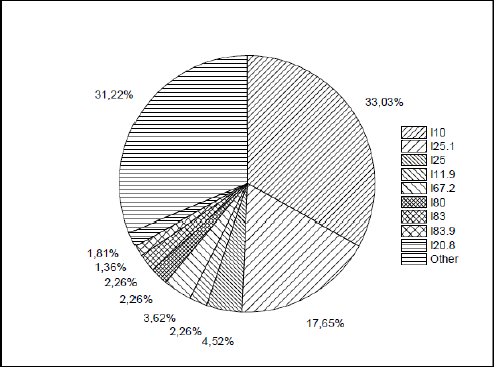
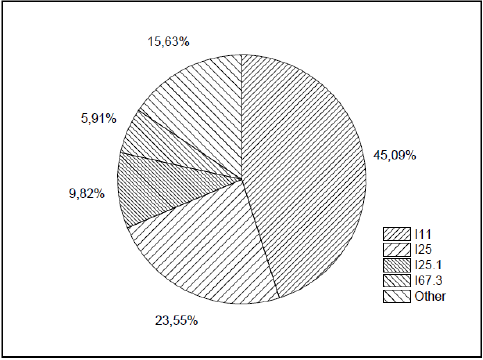
Figure 1 shows the incidence of diseases of the cardiovascular system (CVS) in a cohort of women whose thyroid gland incorporated radioactive iodine (I-131) during pregnancy. In the first place among all pathologies there is essential (primary) hypertension (I10 - 33.0%). Atherosclerotic heart disease was approximately two times less common (I25.1 - 17.7%). Chronic ischemic disease (I25) and hypertensive heart disease (with predominant heart disease) without (congestive) heart failure (I11.9) occurred in women with the same frequency of 4.2% and 2.3%, respectively. Other types of pathology were significantly less pronounced, such as various forms of angina pectoris, as well as of vascular diseases. A completely different picture of the morbidity structure was observed in the control group, i.e. in women who were pregnant later and did not fall under the “iodine strike” at the end of April-May 1986 (Figure 2). As stated earlier, by this time I-131 had practically completely decayed.

Figure 1: The incidence of diseases in the cohort of women who received exposure to radioactive iodine during pregnancy.

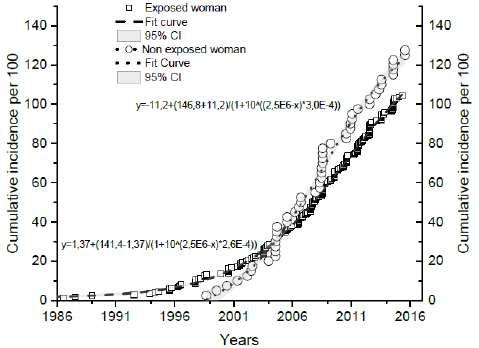
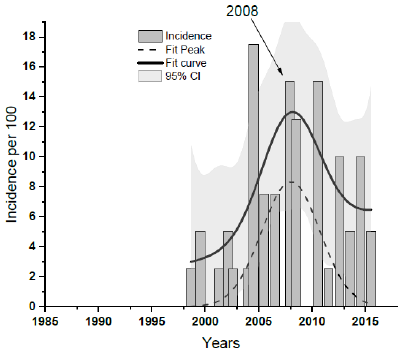
It is clearly seen (Figure 2) that hypertensive heart disease dominates (I11 - 45.1%). The second place in the structure of morbidity belongs to chronic ischemic (I25) and atherosclerotic heart diseases (I25.1). Essential hypertension was registered in the cohort for comparison only once (2% of all cases). The study of the cumulative morbidity during the entire studied time interval showed that the incidence of CVD in the cohort of irradiated women began to be registered immediately after the accident (Fig. 3), while in the cohort of non-irradiated women the beginning of the registration of diseases was shifted to a later period (1999). The morbidity in the cohort of women irradiated during their pregnancy was higher than that in women who were not irradiated during their pregnancy until 2008 (Figure 3), after which an increased incidence of cardiovascular diseases began to be recorded in the cohort of women who did not fall under the “iodine blow” during pregnancy.

Figure 2: The pattern of morbidity in a cohort of women who were not irradiated by radioactive iodine during pregnancy.

Figure 3: Cumulative morbidity of all forms of cardiovascular diseases in cohorts of women irradiated and non-exposed to radiation during their pregnancy.

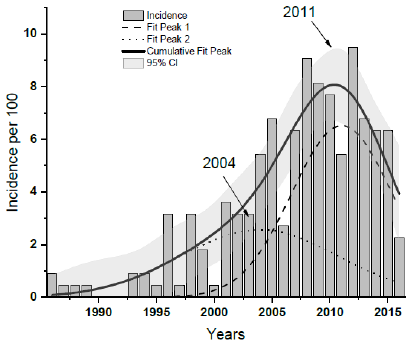
Analysis of the data showed that the incidence of all types of CVD in pregnant women who were exposed to radioactive iodine in April 1986 has a maximum in 2011, although this dome-shaped relationship is asymmetric due to the flattening of the left shoulder of the peak, which may be due to the superposition of a small maximum detected in the 2004 (Figure 4). Registration of the time dependence of morbidity in women who were not exposed to radioactive iodine revealed a slightly different dependence (Figure 5). There is a broad peak on the incidence curve centered in the 2008 region. As in the previous case, an additional peak around the year 2004 is also revealed on the left shoulder of the function of dome-shaped dependence. At the same time, it is clearly noticeable that until 1990, in this group of women, in contrast to those affected by the “iodine stroke”, the incidence of CVD was not recorded. These data are in good agreement with the results shown in Figure 3, which also clearly shows that the onset of morbidity is different in both groups.

Figure 4: Incidence of CVD (from 1986 to 2016) among women who were pregnant during the Chernobyl accident and were irradiated by I-131.

Figure 5: The incidence of CVD (from 1986 to 2016) among women who were not pregnant during the Chernobyl accident but were irradiated by I-131.

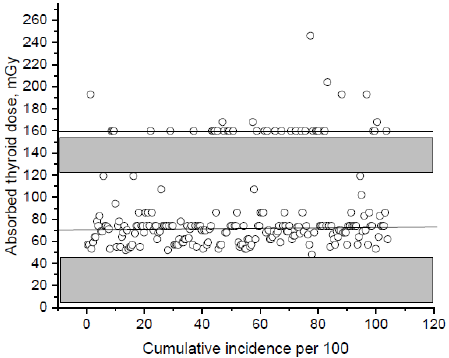
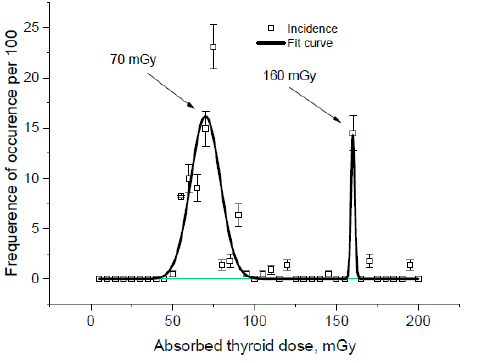
One of the next steps in this work was to identify the dose dependence, i.e. to compare the incidence of CVD with doses absorbed by the thyroid gland of pregnant women due to the incorporation of radioactive iodine. Figure 6 shows the cumulative incidence of CVD in the cohort of women who were exposed during their pregnancy. Attention is drawn to the absence of any relationship between these two indicators. Cardiovascular pathology occurred in the range of absorbed doses by the thyroid gland of women of 50-120 and 160-250 mGy. Up to 50 mGy, as well as in the range of 120 - 155 mGy, no pathology was found in the future. The same data, but presented in different coordinates, showed approximately the same dependence. The dose dependence diagram clearly shows two peaks (Figure 7). The first of them, that is wide, corresponds to the absorbed dose by the thyroid gland in the region of 70 mGy. The second, that is very narrow, is in the region of the absorbed dose equal to 160 mGy. These data are unexpected and therefore require careful evaluation.

Figure 6: Cumulative incidence of CVD in the cohort of irradiated pregnant women (1986-2016).

Figure 7: Dose dependence of the incidence of CVD in the group of pregnant women irradiated during the pregnancy. The figure shows data with an error of the indicator.

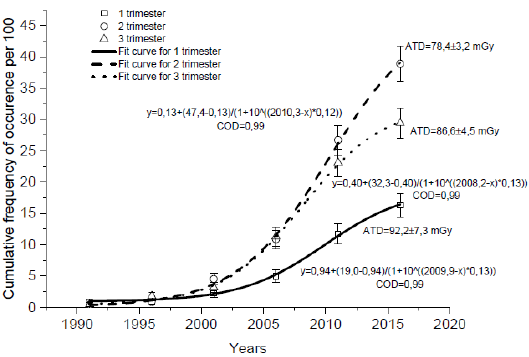
It is well known that during pregnancy, certain periods (trimesters) should be distinguished during which the functional characteristics of the woman’s body, her hormonal background, adaptive and reserve reactions change. Also, significant changes in the fetal organism occur: the laying of organs, their development and differentiation, etc. In this regard, it was of interest to analyze the timing of pregnancy, during which the irradiation happened, for the subsequent morbidity of women. The first trimester corresponds to 1-12 weeks, the second trimester corresponds to 13-26 weeks and the third trimester corresponds to 27-41 weeks of pregnancy. In Figure 8 the data on the incidence of CVD, depending on the period of pregnancy during which the irradiation by I-131 happened, are presented. It was found that irradiation of women in the first trimester of pregnancy was accompanied by the lowest incidence of CVD. The average absorbed dose by the thyroid gland in this group was 92 mGy. The highest values of the frequency of occurrence were typical for irradiation of women in the second trimester (the absorbed dose was 78 mGy). Irradiation in the third semester of pregnancy was characterized by intermediate values of the incidence of CVD (absorbed dose was 87 mGy).

Figure 8: Cumulative incidence of CVD in women exposed to radiation at different trimesters of pregnancy. The figure shows data with an error of the indicator.

Note: ATD - absorbed thyroid dose (mGy).

Discussion

The analysis of the presented data is of the undoubted interest. First, the fact of an increase in the incidence of CVD in the postaccident period in both cohorts of women requires explanation. The increase in the incidence of cardiovascular pathology in the main cohort began to be recorded immediately after the accident (Figure 3). In the cohort of women who were not irradiated exactly during the pregnancy, this pathology began to occur much later, starting from 1999. After some period of time (after 2008), the incidence of CVD in the control cohort began to exceed the same indicator in the main cohort. Living conditions of the mentioned cohorts of women were the same, and so they received approximately the same exposure. It can be assumed that in the main cohort of women, the role of an inducer of the growth of cardiovascular pathology could have been played by the irradiation of the thyroid gland during the “iodine stroke” in April-May 1986 when they were pregnant. There is an evidence that low-dose irradiation is associated with the occurrence of hypothyroidism [7], and changes in the level of thyroid hormones can have a significant effect on cardiovascular hemodynamics [8].

However, in women who were pregnant at a later date after the Chernobyl accident the incidence of CVD is also growing in time. A possible explanation for this fact can be found in our previous studies that included a cohort of women who were not irradiated at all. Studying the psycho-emotional status of the same cohort of irradiated women due to the incorporation of radioactive iodine and non-irradiated pregnant women, we were able to establish that a cohort of women exposed to radiation is characterized by the absence of a clear connection between post-traumatic stress disorder (PTSD) and psychological distress. At the same time, only the “Avoidance” factor according to the five-factor model of guidance in the diagnosis of mental illness (DSM-IV), which was analyzed using the PCL-S questionnaire in a group of women over the age of 19 with stress indicators, was especially clearly manifested [9]. This can be the reason for the smoothness of the emotional state, i.e. avoidance of experiences after 30 years after the Chernobyl accident.

A psychometric analysis of women whose pregnancy occurred a year after the Chernobyl accident, on the contrary, showed a strong correlation between most of the factors of PTSD with psychological distress (factors of “Re-experiencing”, “Numbing”, “Dysphoric Arousal” and “Anxious Arousal” excitements) [10]. These signs were expressed in sleep disturbances, insomnia, anxious alertness, etc. It is known that the period after the Chernobyl accident was characterized by an abundance of often inaccurate information about the effects of radiation. Fear for the health of the unborn child and of the own health could play an important role in the development of latent internal tension in women. There is an evidence that an altered psychological status accompanied by the stress can be the cause of the subsequent appearance of somatic pathology [11]. In this regard, the delayed growth of CVD pathology in the mentioned cohort of women who had been irradiated, but became pregnant later, becomes clear.

The maximal values of the incidence rates in the main (2011) and control (2008) cohorts can be explained by the onset of menopause in women. Since the average age of women in the main cohort in April 1986 was 24 years old, and the average age of women in the control cohort was 26 years old, they were over 48 years old at the time indicated above. This is the age of menopause. During this period, the level of estrogens in women decreases, and estrogens are known to serve as protectors of normal function of CVS [12]. So, at the age of menopause numerous complaints of a different nature, including CVD, occur, and women turn to medical specialists with complaints about CVS for the first time. It is known that the early-onset menopause happens in women at the age of 40 – 45 years. The percent of such cases in population is around 10% [12]. So, the hidden peak at 2004 year from Figure 4 might occur because of women with early-onset menopause that is usually more frequent among rural residents, than in those who live in cities.

New data on the peak dependence of the incidence of CVD depending on the absorbed dose by the thyroid gland of pregnant women are of a great interest. As shown in Figure 7, there are two incidence peaks: in the region of 70 and 160 mGy. Recently, convincing evidence has been obtained that radiation damage, in addition to the effect on the genetic apparatus of the cell, causes a complicated cascade of biochemical processes associated with the involvement of extra- and intracellular signaling systems, anti-inflammatory cascade mechanisms of cytokines, etc. [13]. The delayed effects of increased CVD morbidity observed by us in women, many years after the irradiation, can hardly be explained by metabolic changes in thyrocytes. Most likely, they can be associated with the mechanisms of gene expression in these cells. Earlier, in the study of the action of I-131, 27 up- and downregulated genes were found in thyroid cells [14]. Some of them may be of a particular interest in terms of the explanation of changes we found.

Thus, the expression of the Mb gene encoding the MYG protein is suppressed by low doses of radioactive iodine, and sharply increases with at higher doses. MYG is responsible for facilitating the transfer of oxygen from the cell membrane to the mitochondria. This protein also plays a role in regulating the physiological levels of nitric oxide. For this gene, there are many variants of transcripts encoding different isoforms. The phosphorylating capacity of mitochondria will play an important role in the production of ATP and, therefore, support the contractile function of the muscles. A number of other genes (Pax8, Sic5a5, Tg, Tpo), which play an important role in the functioning of the thyroid gland, the synthesis of thyroid hormones and the effect on the metabolism of peripheral cells, are downregulated by small doses formed from I-131 and change their activity with an increase of radiation exposure. There are other examples. Thus, the mentioned gene Sic5a5 is also downregulated at low and medium doses of radiation caused by I-131, and it is upregulated at high doses of exposure [14].

From this point of view, the above written data on the existence of two peaks in the incidence of CVD among pregnant women who were irradiated with radioactive iodine in April-May 1986 can be explained. In women, various absorbed doses were formed, which could be responsible for the change in the expression of genes and the appearance of two peaks. The thyroid gland, in turn, plays an important role in the functioning of the cardiovascular system through the production of its hormones [15]. At the same time, it is known that ionizing radiation induces genome instability [16]. The consequences of radiation-induced genome instability are: morphological and functional inferiority of tissue elements at the tissue level, the increased risk of developing tumors and non-tumor somatic pathology at the organismal level. Genome instability is a persistent, epigenetically transmitted, functional state of the cell genome, leading to a violation of genetic control and being the most important factor in the induction of pathology. These changes can be fixed in the body of pregnant women, and therefore we observe these effects many years after the Chernobyl accident.

It is known that certain periods of pregnancy are associated with complex changes in the pituitary-thyroid system of women [17]. In different trimesters of pregnancy, many biochemical indicators change, including the levels of T4, T3, thyroidstimulating hormone (TSH), etc. So, at the end of the first trimester of pregnancy (at 10 weeks), the TSH level drops to minimum values, and then, as the gestation period increases (by week 20), its level is coming back to a normal value [18]. Accordingly, the T4 level in the woman’s body will also change. For the formation of T4, the transmembrane transport of iodide (I-) is required, first through the basolateral and then through the apical membranes into the colloid for the subsequent iodination of thyroglobulin. For these processes, the expression of the Sic5a5 / NIS, Tg genes, and possibly other genes is required [14]. It has already been mentioned that their expression demonstrates a dose dependence. The inhibitory effect is pronounced at lower doses of I-131, and at higher doses it decreases.

According to our observations, irradiation in the second trimester of pregnancy was accompanied by the formation of lower absorbed doses by the thyroid gland of women (Figure 7). Against the background of a decrease in the level of TSH, an insufficient level of transmembrane transfer of iodide will negatively affect the state of the thyroid system of a woman and a fetus and, due to the mentioned instability of the genome, may serve as the reason for the subsequent appearance of non-oncological pathology. However, it should be kept in mind that the mechanisms suggested by us should work only in pregnant women, due to the fact that this physiological state is characterized by the tension of many body systems, including endocrine, and can be the cause of genome instability under radiation exposure.

Conclusion

The incidence of CVD in the cohort of women irradiated during the pregnancy began to be registered immediately after the accident, while in the group of women who were irradiated but not pregnant at that time, the beginning of the registration of the onset of CDV was shifted to a later period (1999) and after 2008 began to exceed that in the first cohort. These data can be explained by the peculiarities of the psycho-emotional state of women in the control cohort, who became pregnant soon after the Chernobyl accident: signs of stress due to the abundance of information about radiation, which are capable of inducing general somatic pathology. On the diagram of the dependence of morbidity on the absorbed dose by the thyroid gland, two peaks are clearly evident. The first of them, that is wide, corresponds to the absorbed dose by the thyroid gland in the region of 70 mGy. The second, that is very narrow one, exists in the region of the absorbed dose equal to 160 mGy. The highest CVD incidence rates were typical for women exposed to radiation in the second trimester. The obtained data can be explained by the instability of expression of specific genes of the thyroid gland in the organism of pregnant women after the incorporation of I-131, which are capable of being responsible for the synthesis of thyroid hormones, and other functions, which will cause the appearance of cardiovascular pathology.

For more Articles on : https://biomedres01.blogspot.com/


Wednesday, June 29, 2022

Teaching Reform of Obstetrics and Gynecology Nursing Course in Higher Vocational Colleges Based on OBE Education Concept from the Perspective of Big Data


Teaching Reform of Obstetrics and Gynecology Nursing Course in Higher Vocational Colleges Based on OBE Education Concept from the Perspective of Big Data


Introduction

Obstetrics and gynecology nursing is one of the core courses of nursing specialty in higher vocational colleges. This course is opened in the third semester, with a total of 3 credits. This course is a key course for students to master before entering gynecology and obstetrics clinic. Through the study of this course, students are required to have solid professional knowledge and proficient practical skills. Therefore, this course needs to cultivate students’ clinical thinking ability and operation skills through the combination of theoretical knowledge and practical operation. The course team analyzed the current situation of the course of Obstetrics and gynecology nursing in Higher Vocational Colleges by using big data tools and found that the teaching materials of this course are relatively backward; The teaching mode is single; The assessment method is single; Students’ learning initiative is weak; The training of theoretical knowledge and practical ability. In this regard, our curriculum group adopted OBE teaching concept to reform the curriculum through comparison and exploration. OBE (outcomesbased education) means that the final results of teaching activities are presented by students’ learning outcomes. Students’ learning achievement is the maximum ability that students can achieve after a period of learning. Schools and teachers are required to make clear the students’ learning achievement, combine the diversified learning process and hierarchical learning requirements, and let students complete the challenge of self-realization through the learning process.

Teachers can feedback and improve the original teaching plan and teaching implementation by using the results. Secondly, the ways of enrollment in higher vocational colleges are diversified, students’ learning background is different, and the use of unified teaching materials in different learning situations obviously does not meet the needs of learning situation, which leads to the decline of students’ learning initiative and enthusiasm. Therefore, starting from the learning situation, the loose-leaf teaching material is used to deconstruct the knowledge system and framework, reconstruct the knowledge chain, reconstruct the teaching module, and teach at different levels according to the learning situation background. This course takes the female life cycle as the logic of the course and reconstructs the knowledge module of the course; Taking the students as the center, based on the training objectives of the five major learning areas of OBE, the differentiated teaching is designed, and the course implementation is carried out in the same class and heterogeneous way; With students’ learning achievement as the guidance, multiple assessment methods coexist and multidimensional assessment is carried out simultaneously; Based on the learning situation, starting from the needs, project-based teaching, students are the main body of the course; Integrated teaching of theory and practice [1,2].

In the course of teaching reform, how to reconstruct the teaching system, optimize the teaching content, improve the teaching methods, standardize the teaching process and improve the teaching evaluation as the main content, it is imperative for us to implement the teaching reform and practice of big data application technology course, and cultivate the compound talents with practical ability and technological innovation ability.

Construction of DQP Academic Framework Under OBE Teaching Concept

In 1981, American scholar Spady first put forward the concept of achievement-oriented education, and gradually formed a complete education system. The theoretical connotation is that students are the main body, and the ultimate learning achievement of students is the goal. From the setting of teaching objectives to curriculum design, curriculum implementation, curriculum evaluation are all result oriented, and then every link of curriculum implementation is deduced from the results. The DQP model is based on students’ learning outcomes. The main structure of DQP is composed of five institution specific areas and three academic levels, namely: professional knowledge, extensive and integrated knowledge, intellectual skills, applied and collaborative learning, citizen and global learning. Among the five learning areas, “extensive and integrated knowledge”, “application and collaborative learning”, “citizen and global learning” are the three areas emphasized in general education to achieve the teaching effect“Professional knowledge and intellectual skills are the two fields that put more emphasis on the requirements of students’ professional knowledge and skills. According to the theory of DQP, the five learning areas in the same level of academic structure combine the differences among different students, which can truly and uniformly reflect the ability evaluation standard. The three academic levels include associate degree, bachelor’s degree and master’s degree.

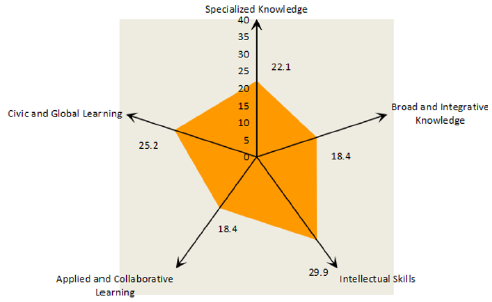
The differences in different academic levels mainly reflect the progressive relationship between the reference points of learning achievement requirements in the five major learning fields: the learning achievement requirements of all bachelor’s levels include the learning achievements of associate degree, and the learning achievements of all master’s levels also include the learning achievements of bachelor and associate degree. The requirements of learning outcomes at each level show the further challenges and skills that students need to deal with when they move from one degree to a higher degree. Through the spider web diagram of the five major learning fields, the unity of the evaluation of each educational level is intuitively reflected; The hierarchy of ability requirements; Comprehensive knowledge support and achievement embodiment [3] Figure 1. Taking the knowledge structure of the five learning fields as the framework template, students can change from “understanding, mastering and memorizing” in the previous curriculum standards to curriculum norms, including the process comprehensive assessment of “being able to say, be able to do, be able to solve, etc. “For example, DQP puts forward that “in a special field or a relatively common field of art and science, when doing a project, writing an article or program, or performing a performance, we can effectively find the information we need, classify the collected information, evaluate the usefulness of the information, and properly quote or apply the useful information to the project Article or scheme, performance “.

Figure 1: five learning areas.

For example, in order to cultivate students’ creative ability, teachers can carry out evidence-based analysis of clinical operation guidelines in the practical training of Obstetrics and gynecology nursing, let students divergent thinking, find evidence through empirical research to support existing views or improve existing views, innovate existing equipment, etc. We should cultivate and incubate valuable research to promote the progress of teachers and students. Students and teachers design together, verify the results together, learn together and grow together [4]. The form of curriculum assessment is not only reflected in knowledge memory and knowledge accumulation, but also focuses on the practicality of knowledge. At the same time, it combines the application and innovation of knowledge, which is well in line with the call of the country for innovation and entrepreneurship. Through the learning process of peer-to-peer curriculum, diversified curriculum achievements are reflected, and students’ learning process and skills are deposited in the display of learning achievements, which can be measured, evaluated, further corrected and improved. Verify the learning effect of students and reflect the teaching effect of teachers, so as to reverse design the course and further implement the classroom reform and optimization [5].

Through peer-to-peer learning process, diversified curriculum achievements are reflected, and students’ learning process and skills are deposited in the display of learning achievements. Through data comparison and analysis, students’ learning achievements can be measured, evaluated, and further corrected and improved. With the development and improvement of information technology, people’s learning methods and behavior habits have been gradually changed. The traditional teaching mode has been unable to meet the current teaching needs. Under the perspective of “Internet plus big data”, students have more learning means and various learning channels. Nowadays, most of the students in Higher Vocational Colleges grow up in the period of rapid development of information technology. They have a natural curiosity about new things and ideas. Their thinking mode and learning state are very different from those of the past. Through big data technology, students can search most of the content on the Internet. To a certain extent, it has changed the students’ learning style, and also provided some new ideas for the curriculum teaching reform in higher vocational colleges. Only by adopting the methods that students can accept, can the curriculum teaching be effectively changed. Through the analysis of statistical data to understand the teaching effect, verify the learning effect of students.

So as to feedback the teaching quality of teachers. Through the analysis and comparison of classroom data, we can reverse design the curriculum and further implement the classroom reform and optimization.

Curriculum Standard of Obstetrics and Gynecology Nursing

Teaching Content: According to the female life cycle, this course is designed into five modules: basic theory 2 class hours, including female reproductive system anatomy and physiology. 16 hours of gestational care, including pregnancy physiology to start the journey of life, prenatal examination to explore the secret of baby growth, prenatal examination to explore the mother’s secret, abnormal pregnancy to reveal the mother’s troubles. Childbirth care for 10 hours, including normal childbirth escort, abnormal childbirth race against the clock. 16 credits for gynecological diseases, including inflammation of reproductive system, tumor of reproductive system and endocrine diseases. 4 class hours for women’s health care.

Analysis of Learning Situation: We get a series of data by using questionnaire survey and other methods, and then use big data analysis method to get the students’ learning situation of this course. The specific performance of his learning situation is as follows. The student group of this course is the new generation after zero, which belongs to the third semester of nursing sophomore. This student group not only has the common characteristics of students of this age group, but also has the specific learning situation characteristics of students of this major. First of all, the new generation after 2000 is full of personality and curiosity about new things. They have strong hands-on ability. They don’t like to be limited and always have unlimited creativity, but they have certain shortcomings. For example, they are not willing to repeat learning and are not willing to train many times. Secondly, the proportion of male and female in nursing major is very different, female students account for 80% - 100% of the class on average, and the classroom activity is relatively low compared with ordinary classroom. In terms of basic knowledge, students have offered systematic anatomy, female physiology and other courses when they enter the course. Because the enthusiasm of students’ repeated learning is not high, so the mastery of theoretical knowledge is relatively weak. According to the learning characteristics of students, this course combs the preview before class through mind map and other ways, strengthens the review after class, and reviews the old to learn the new. In terms of basic skills, students have preliminary contact with nursing and obstetrics and Gynecology related skills, but their proficiency is not high.

In this regard, this course carries out situational guidance, optimizes training courses, refines training standards, and improves students’ enthusiasm through mutual training and evaluation. At the same time, the learning characteristics of this course are different from other courses. Because most of the students in the class are girls, they are very interested in exploring the secrets of pregnant mothers. It is very important for teachers to take the students’ interest as the ignition point, to stimulate the enthusiasm of students’ active exploration of learning, and to let the students become the main body of the classroom, active learning. In terms of learning characteristics, students like hands-on operation, but induction and summary, clinical thinking ability need to be improved. Through the project-based curriculum module, this course integrates knowledge and skills into vivid nursing cases and improves students’ problem-solving ability through case training. In terms of learning habits, students are willing to try to use intelligent mobile terminal devices to carry out learning, prefer personalized learning tasks, make full use of online teaching resources, carry out hybrid teaching, and respect and promote students’ personality development by personalized assessment of learning results. The new generation of post-Zero students have distinctive personality characteristics, strong innovation ability, but poor knowledge transfer ability. Therefore, it is necessary to teach students in accordance with their aptitude, improve classroom participation, and formulate executable training objectives that match the learning situation, which is the embodiment of OBE education concept [6].

Teaching Objectives

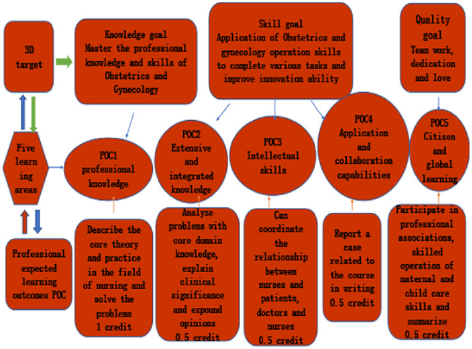
Overall Objective: By using big data analysis tools, we connect the knowledge points and skills of nursing practical jobs with our higher vocational obstetrics and gynecology nursing course, to implement the training program of nursing professionals and the curriculum standard of Obstetrics and gynecology nursing based on the analysis of learning situation. The curriculum design establishes a three-dimensional target system of knowledge, skills and quality, and designs the corresponding program outcome (POC) Figure 2. The objective of this course is to master the obstetrics and Gynecology professional knowledge, cultivate professional skills and promote the ability improvement. The three-dimensional objectives of this course include knowledge objectives, skill objectives and quality objectives. The training objectives of each dimension correspond to and match the relevant learning fields in DQP education framework structure. Knowledge objectives correspond to one credit of PoC1 professional knowledge in five major learning fields. Students can describe the core theories and practices in the field of nursing with relevant terms in the nursing field and solve the nursing problems in the professional field. The skill objectives correspond to the knowledge of poc2, poc3 intelligence, poc4 application and cooperative learning in the five learning fields. Poc2 is 0.5 credits in wide and integrated knowledge. Students can analyze a controversial problem (such as unprotected delivery, clinical treatment without payment ability) with knowledge of core areas learned, explain the clinical significance of the dispute, and explain their own opinions with the knowledge learned. Poc3 has 0.5 credits of intelligence skills and can use the knowledge learned to solve and coordinate the relationship between nurses and patients, medical care and nursing, and propose solutions for specific cases and revise the implementation plan.

Figure 2: learning target decomposition diagram.

Poc4 application and cooperative learning 0.5 credits, report at least one case related to the course in writing (such as head basin incorrect, multiple pregnancy, etc.) to explain how to apply the knowledge learned to clinical practice and to standardize clinical evaluation standards. The quality goal is 0.5 credits in poc5 citizens and global learning fields, that is, through the course learning, students participate in the relevant professional associations (including nursing health association and midwifery knowledge association) to skillfully operate maternal and infant nursing skills, make oral or written summary (report), and improve coordination ability, organizational ability and communication ability through organizational activities [6].

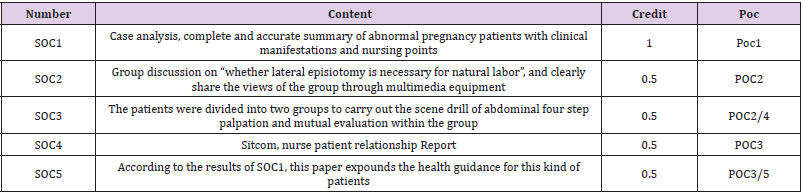
Expected Learning Results of Representative Courses: According to the characteristics of nursing specialty, we carry out three-dimensional education of people, and integrate the cultivation and practice of socialist core values into the teaching process of each class, so as to keep things fine and silent. Through the guidance of classroom thinking and politics, we should carry out labor education, life education, humanistic care, etc. In order to support and realize the achievement of POC, the corresponding “subject outcome” (SOC) [7] (Table 1).

Table 1: Comparison of learning outcomes and expected learning outcomes.

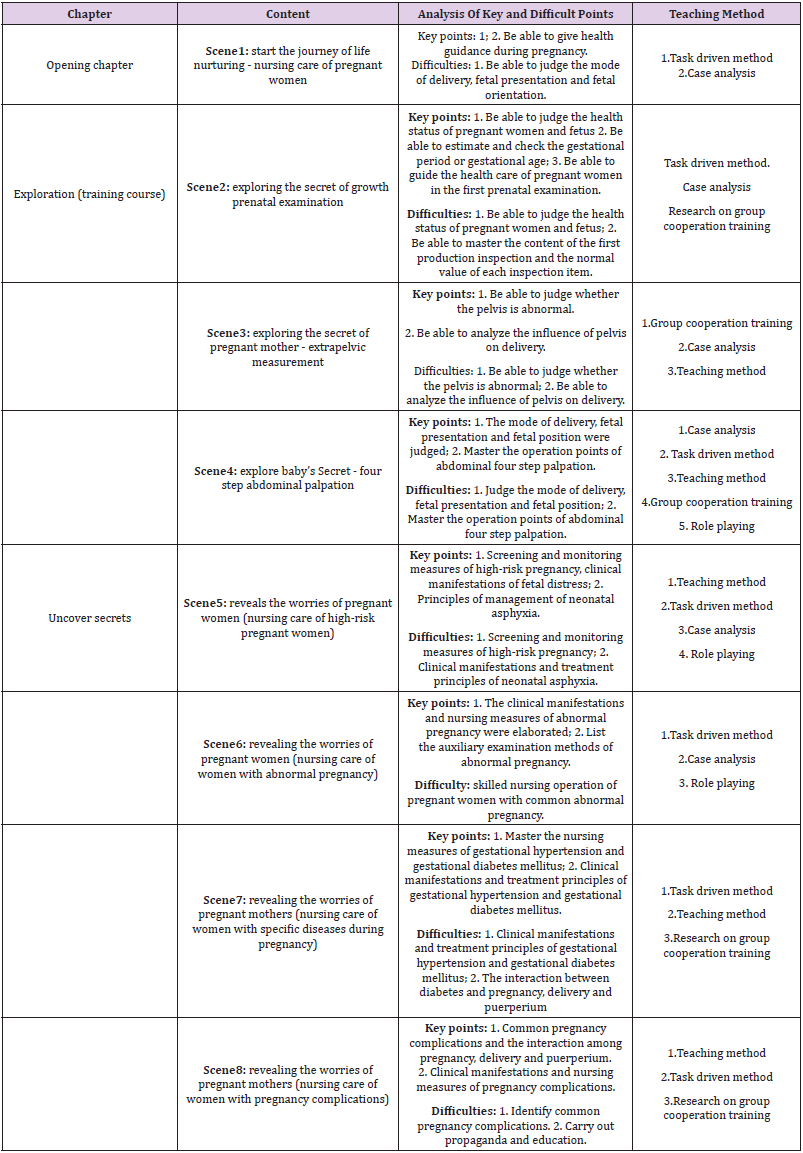
Analysis of Key and Difficult Points and Teaching Strategies: Based on the background of learning situation analysis, under the guidance of teaching objectives and professional norms, the focus of this course is to describe the pathogenesis and symptom characteristics of Obstetrics and Gynecology related diseases without error and complete the nursing operation of Obstetrics and Gynecology related diseases without error. We deconstruct and reorganize the curriculum according to the female life cycle and divide the curriculum into five modules. Now take module two pregnancy care as an example to choose the key and difficult points and corresponding teaching strategies (Table 2) [8].

Table 2: curriculum modules and teaching strategies.

Implementation and Effect of Classroom Teaching

Teaching Design Ideas: The teaching design is based on the analysis of learning situation which is gotten by big data analysis method, cognitive law of higher vocational students and industry orientation. 1: integrated teaching, this course adopts integrated teaching, takes the post demand as the classroom logic, combines theory with practice, so that students can learn by doing, practice in learning, and master knowledge and skills. 2: Double subject teaching, course teaching module, on campus and off campus training, practice together. School learning and job needs are seamlessly linked. That is: three stages of classroom teaching, preview before class, knowledge navigation, practice in class, knowledge consolidation, after class expansion, knowledge extension, learning for application, improve ability. This model highlights the progressive cultivation with students as the center, industry post skills as the basis, students’ learning achievements as the guidance and ideological and political education as the soul. This teaching mode realizes “three highs” of teaching effect, that is, high participation of students, high timeliness of learning process, and high personalization of learning results [9].

Teaching Implementation Process

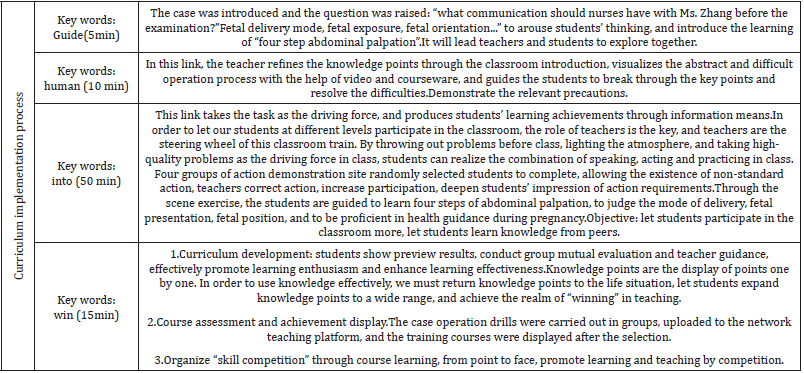
Overall Curriculum Implementation: The teaching process can be divided into three stages: guidance before class, practice in class and development after class. Based on the teaching plan, the teaching activities strengthen the communication between students and teachers by means of information-based teaching. The information dissemination is timely and the distance between teachers and students is shortened. Through the comprehensive and continuous feedback, the evaluation and implementation of the whole teaching classroom and course teaching can complete a complete evaluation and diagnosis closed loop in the three stages of the teaching process““Learning to practice in class” is carried out with students as the main body and teachers as the guide. Each independent classroom is divided into four links of “leading people, entering and winning” (Table 3). Although this course focuses on adapting to clinical needs, it is impossible to include a large amount of knowledge in one class. Therefore, we focus on each class. Now to explore the baby’s Secret “abdominal four step palpations” as an example to show the four links. The first key word of classroom promotion is “lead”, that is, knowledge navigation. In this link, the teacher leads out the knowledge points of the course by cases, videos, high-quality questions, etc. The second key word of classroom promotion is “people”. In this link, the main body of the classroom is students. The teacher manages the classroom as a scaffold.

Table 3: “fascinating” four links.

Through the teacher’s demonstration, it shows a complete operation process or an independent case analysis, so that students can chain up the knowledge chain from point to area. The third key word of classroom promotion is “entering”. In this link from “people” to “entering”, the classroom initiative turns from teachers to students. Teachers help students to sort out the knowledge chain through the independent inquiry learning mode, sort out the knowledge fragments in the classroom, apply the knowledge points to various clinical situations, think independently and help each other to improve. Students sort out the knowledge chain, sort out the operation points and matters, from the simple memory of the second link to the reappearance and application of the third link knowledge, students repeat learning, active thinking. The fourth key word of classroom promotion is “win”. This link is the embodiment of learning achievements. Through the climbing of learning process, students and teachers grow together in the classroom, and teaching and learning are mutually beneficial [10].

Course Fragment Design: Taking the Course of Four Step Palpation of Abdomen as An Example

The teaching difficulty of this course lies in the operation method of abdominal four step palpation, and the judgment of fetal delivery mode, fetal presentation and fetal position. This class is divided into three stages (diagnosis closed loop) of pre class guidance, learning practice and after class development, with a total of 2 class hours. Guidance before class. Before class, teachers publish the preview materials to the information-based teaching platform and push them to the wechat end of students’ mobile phones. The teacher analyzed the preview results, understood that the students’ judgment on the mode of delivery, fetal presentation and fetal position was weak, and they had a good grasp of the purpose of abdominal four step palpation, and finally determined the teaching plan [11].

After Class Development: After class exercises were pushed through the teaching platform which si established by big data system, and the after-class exercises were mainly based on the real questions of nurses’ qualification examination to prepare for the students’ nurses’ qualification examination. Answer questions in WeChat group, shorten the distance between teachers and students, and break the time and space restrictions of the classroom. Relevant knowledge is released through the platform of student associations, and professional associations organize knowledge and skills competitions.

Teaching Evaluation

The three-dimensional evaluation promotes the effectiveness, through students’ self-evaluation, students’ mutual evaluation and teachers’ comments, The big data system is used to collect the above three-dimensional evaluation information, the three-dimensional degree can understand the knowledge mastering situation, at the same time, through role perception and mind map, summarize the learned knowledge, cultivate students’ ability to build a systematic and rigorous knowledge structure, and promote students’ learning effectiveness. The assessment of students’ performance should change the traditional single assessment method of theoretical knowledge, pay attention to the comprehensive assessment of students’ learning attitude, thinking ability, practical ability and problem-solving ability, and objectively evaluate the students’ learning situation. Curriculum assessment is closely related to medical practice, and knowledge and skills are consistent with the national nurse qualification certificate assessment, higher vocational education personnel training mode and 1 + X certificate system. The assessment subjects are diversified. The evaluation data adopts wide-angle evaluation, including students’ selfevaluation, group mutual evaluation, course teacher’s comments, and clinical teaching teacher’s comments, striving for multi angle evaluation and multi angle improvement from knowledge to skills, skills to ability [12].

Implementation Effect

This teaching mode realizes the “three highs” of teaching effect, that is, high participation of students, high timeliness of learning process and high personalization of learning results. Students’ participation is high. The whole classroom teaching is completed in the environment of integration of theory and practice, which promotes students’ participation and self-confidence, and improves their ability of knowledge transfer and application. Compared with the traditional teaching, the effect of teaching reform is obvious. The efficiency of learning process is high. The teaching process is streamlined, and the diagnosis closed loop is formed. The efficient teaching implementation has been achieved, and the basic teaching objectives have been basically achieved. Learning outcomes are highly personalized. In and out of class, students are encouraged to discover and develop their own interests and expertise. Students actively participate in personalized learning results display and exchange activities and enhance their learning initiative and initiative.

Teaching Characteristics and Reflection

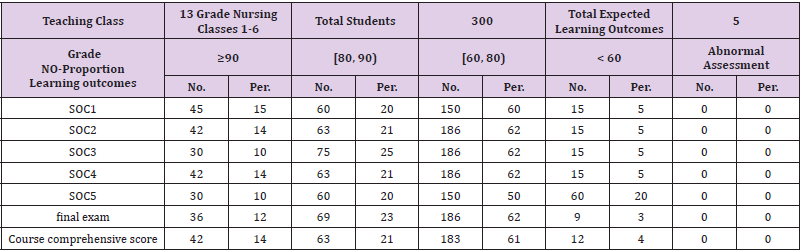
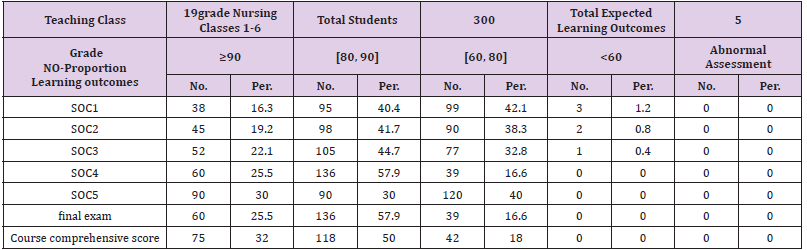
Since January 2014, we have been carrying out the practical research on the curriculum reform of Obstetrics and gynecology nursing in Higher Vocational Colleges Based on the OBE education concept from the perspective of big data. We have been deepening the reform, the teaching effect has been continuously improved, and the students’ ability has been continuously improved [13]. Before the teaching reform, the average score of Obstetrics and gynecology nursing course was only (73. 94 1 ± After the reform, the average final score of each semester was (88.72 10.60) ± Through big data analysis, students’ satisfaction with the course was 90.41 points, which were higher than that before the implementation of the reform. The students’ passing rate of the examination was significantly improved, and their learning initiative and enthusiasm were also greatly improved. According to the comparison between (Table 4) (assessment of Obstetrics and gynecology nursing in June 2014 - before the education reform) and (Table 5) (assessment of Obstetrics and gynecology nursing in the second semester of 2020-2021 academic year - after the education reform), We get the following conclusions: from the perspective of big data, based on the OBE education concept, the practical research on the curriculum reform of Obstetrics and gynecology nursing in higher vocational colleges has greatly improved students’ mastery of the knowledge points and operation skills of Obstetrics and gynecology nursing, greatly improved their autonomous learning ability, and cultivated students’ lifelong learning ability.

Table 4: Assessment of Obstetrics and gynecology nursing in June 2014 (before education reform).

(Notes: No.=Number, Per.=Percentage)

Table 5: Assessment of Obstetrics and gynecology nursing in the second semester of 2020-2021 academic year (the latest year after the education reform).

(Notes: No.=Number, Per.=Percentage)

Especially, From May 2021 to now, during the New Coronavirus epidemic in Guangzhou, we used the big data system to carry out online teaching, uploading a large number of teaching video screens, chapters of the target test questions and comprehensive exercises to the database, and set the teaching video screen as playback status in the database, so that students can use fragmented spare time to learn repeatedly. Master the key and difficult points thoroughly. The teaching effect is greatly improved. Teachers use the big data system to arrange a large number of extracurricular research topics and course papers and require students to use the Internet and big data to search for information in the system. Students can make full use of big data system and computer network system for conscious learning, in-depth learning, and complete course papers and research topics, which greatly improves students’ scientific research and innovation ability and cultivates students’ pioneering spirit. It creates a new mode of Higher Vocational Education from “teachers want students to learn” to “students are willing to learn”, which lays a solid foundation for higher vocational education to cultivate more and better high skilled talents to meet the needs of society, and makes due contributions to the development of nursing and Health Management College of Guangdong Lingnan vocational and technical college, At the same time, it has also explored some experience reference for the higher vocational colleges of nursing medicine, which benefit more students, teachers and colleges. Therefore, from the perspective of big data, the practical research on curriculum reform of Obstetrics and gynecology nursing in Higher Vocational Colleges Based on OBE education concept has created great social benefits.

The starting point of education is not knowledge, but people, and it is the object of our education.0be teaching concept is student-centered, based on the learning background to set up courses, from curriculum design, curriculum implementation, curriculum evaluation, and through the results of reverse design courses, modify the classroom implementation, form an effective classroom teaching closed loop, so as to implement the curriculum objectives, realize the requirements of five major learning areas of professional talent training. The curriculum reform of Obstetrics and gynecology nursing based on OBE education concept is based on the “123 teaching mode” of work study combination based on the analysis of learning situation, cognitive law of higher vocational students and industry orientation. This model highlights the progressive cultivation with students as the center, industry post skills as the basis, students’ learning achievements as the guidance and ideological and political education as the soul. This teaching mode realizes the “three highs” of teaching effect, that is, high participation of students, high timeliness of learning process and high personalization of learning results. The teaching process can be divided into three stages: guidance before class, practice in class and development after class. Each teaching link has assessment and diagnosis, which provides reference data for the next link.

Through the comprehensive continuous evaluation and feedback, the evaluation implements the whole teaching classroom and course teaching, so that the three stages of the teaching process complete a complete evaluation and diagnosis closed loop. Through knowledge learning, school skills practice, clinical skills observation and internship, clinical hospital internship progressive extended learning space, multi angle and multi-level cultivation of students’ clinical comprehensive quality and nursing professional quality. From simulated training to feeling the relatively real work scene, observing the clinical operation process to using skills to solve practical clinical problems, the separation between classroom learning and post, progressive extension of learning space and zero gap connection between major and post have been solved [13]. Education is a subject that is constantly being revised, just like the endless curriculum reform. The introduction of OBE teaching concept, through the feedback of learning results to modify the classroom. In the course reform, we find that the new generation of students have unlimited potential, unlimited creativity, and each has its own characteristics. The significance of education is to respect each individual’s progress and personality. Therefore, we are still thinking about how to refine the measurement standard of learning outcomes, further humanize and personalize the quantitative results, and respect each individual learning process and output.

Summary

Finally, it should return to our teaching goal: from professional knowledge to methods and abilities, and finally reflect the students’ social adaptability and ability to produce gradient climbing. Any teaching method is not an isolated way, it needs absorb anything and everything. Any kind of teaching method is not only suitable for a course, but also can be copied and improved, and suitable for more subjects; Any kind of teaching method is not only aimed at a certain group of people, but it should also be adjusted through “teaching students in accordance with their aptitude”, so that more students can use it and produce greater learning influence. In the theme of education, students should pay attention to their interests; Starting from the major, students should pay attention to it; Starting from emotion, arouse students’ resonance [14]. From the perspective of big data, based on the OBE education concept, a series of reforms of Obstetrics and gynecology nursing courses in higher vocational colleges have been carried out for many years. The practice shows that the knowledge and skills of Obstetrics and Gynecology Nursing of higher vocational college students have been improved rapidly, their ability to analyze and solve problems has been greatly strengthened, their graduates are more popular in the society, and the popularity and reputation of higher vocational colleges have been improved, The number of students registered for Guangdong Lingnan Institute of Technology is also increasing year by year, forming a virtuous circle, which promotes the further development of College of nursing and health of Guangdong Lingnan Institute of Technology.

Therefore, it is very urgent to continue to promote a series of reform of Obstetrics and gynecology nursing curriculum in Higher Vocational Colleges Based on OBE education concept from the perspective of big data, and keep pace with the times, constantly promote the achievements and experience of teaching reform, and promote the teaching reform to a deeper and broader direction. In particular, how to make good use of the Internet for Teaching Reform [14], how to make better use of big data to carry out indepth teaching reform research of Obstetrics and gynecology nursing course in Higher Vocational Colleges Based on OBE education concept from the perspective of big data are our future efforts.

For more Articles on : https://biomedres01.blogspot.com/


Thursday, June 16, 2022

A Needle for Clinical Pathologists to Obtain Bone Marrow Core Samples During an Autopsy


A Needle for Clinical Pathologists to Obtain Bone Marrow Core Samples During an Autopsy


Introduction

In recent years several new single-use bone marrow core biopsy needles have been introduced for obtaining bone marrow biopsy samples for histologic evaluation from patients with hematological and non-hematological disorders [1-5]. However, obtaining samples of bone marrow during autopsy still retains traditional methodology and involves an old-fashioned way of chiseling or slicing vertebral bodies with a saw. The process is cumbersome and most importantly it often does not provide samples deeply placed for examination where bone marrow abnormalities may sometimes be found. Also, when a saw is used to obtain bone marrow samples at postmortem, the sawing process can damage the tissue adjacent to the cut and result in a sampling attributable artifact. To overcome the inadequacy of the conventional methods of obtaining bone marrow samples for histological evaluation at post-mortem and to improve diagnostic efficacy, we have used a newly introduced core retention bone marrow biopsy needle [5]. Unlike conventional bone marrow biopsy needles this new needle has a unique internal core retention device and, as a result, no additional components or parts, such as the sleeve [1] or marrow acquisition cradle [2] required by other needles to capture the biopsy specimen is necessary and the needle can be withdrawn with a straight pull. No rocking, sculling, or gyratory movements, or change in the direction of the tip of the needle to capture the biopsy specimen is necessary. As a result, the needles are not bent or damaged and can be used over and over again after adequate cleaning and disinfection. As the needles are supplied non-sterile, they are less expensive and can be used as a single-use (disposable) needle to avoid contamination with HIV or hepatitis.

Materials and Methods

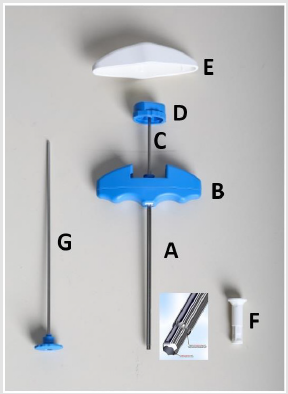
The Instrument* (Figure 1) Consists of Five Parts

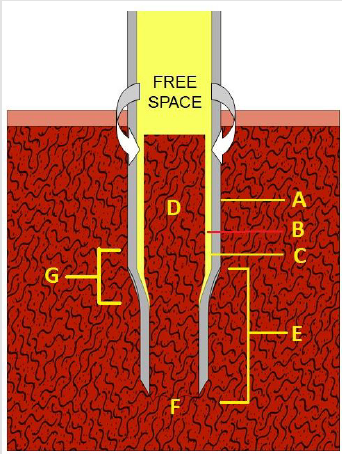
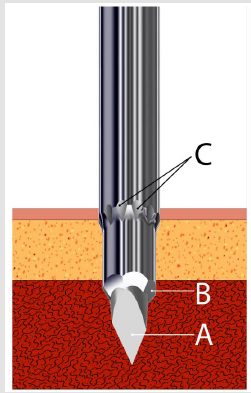
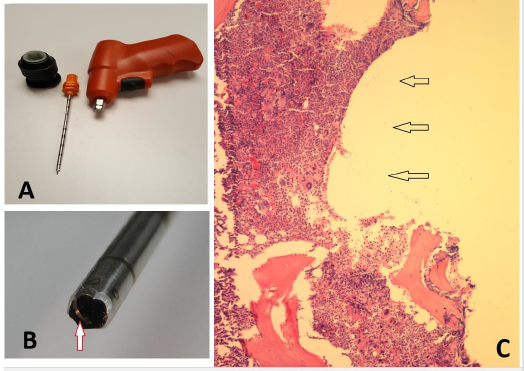
a) The needle (Figure 1A) which has an overall length of 100 mm, an uniform external diameter of 3.25 mm, and a constant internal diameter of 2.5 mm except for the 3.5 mm distal portion where it is narrowed and has multiple surface serrations/ flutes (Figure 1 inset). The terminus of the needle has six sharp cutting facets (Figure 1 inset). The internal diameter of the needle’s distal portion is less than the overall internal diameter of the needle and begins with a short, slanted step of 0.2 mm. This specially designed distal portion (Figure 1 inset) cuts the trabecular connections of bone which might keep the biopsy specimen anchored to its base and also holds on to the biopsy sample so that it does not slip out of the needle during the process of its withdrawal. The larger internal diameter of the needle at its proximal segment provides free space (Figure 2B) within the interior of the instrument thus avoiding crushing and compression of the tissue as well as plugging the lumen of the needle. It also facilitates easy delivery of the core sample through the proximal end of the needle. The introduction of the needle through the dense cortical bone can be mechanically challenging. To assist in easy, smooth entry multiple surface serrations/flutes (Figure 3C) are provided at the junction of the distal narrower portion with the adjoining wider proximal portion of the needle. These surface serrations/flutes provide a means of drilling as the needle is being advanced through the dense cortical bone while rotating the needle by clockwise and counter clockwise rotary motions. The proximal end of the needle is fitted with a large plastic T- bar handle (Figure 1B) for a firm grip.

Figure 1:The needle (A), plastic T-bar handle (B), stilette (C) with its plastic head (D), white plastic cap (E), insertion aid (F), and the pusher rod (G).

b) The stilette (Figure 1C) is a solid steel shaft of 2.0 mm in diameter. It ends with a 3.0 mm long three-faceted, sharply pointed tip (Figure 3A) which projects beyond the cutting edge of the needle. It also provides a means of easy penetration of the cortical bone. The proximal end of the stilette is fitted with a round knurled plastic knob (head) (Figure 1D) which fits into the proximal (top) end of the needle.

c) The large white plastic cap (Figure 1E) fits over and covers the top of the plastic T-bar handle (Figure 1B). It also fits snugly in the palm of the operator’s hand and fosters comfortable manipulation during the biopsy procedure.

d) The insertion aid (Figure 1F) is a tubular segment of plastic 30 mm long and 5 mm wide except at the end that fits the mouth of the needle where it is flat and 10 mm in diameter. It is centrally hollowed out to receive and permit the passage of the pusher during the removal of the biopsy specimen through the proximal end of the needle.

e) The pusher (Figure 1G) is a solid steel rod of 2.0 mm in diameter attached to a knurled, flat plastic disk. The pusher rod is used to expel the biopsy specimen from within the lumen of the biopsy needle with the help of the insertion aid which guides the pusher rod into the mouth needle.

*The non-sterile (as well as the sterile) needles are available from Cardinal Health. Cardinalhealth.com/Core Retention Bone Marrow Biopsy Needle.

Figure 2:Schematic representation of the biopsy technique. (A) the needle, (B) free space between the marrow core (D) and the internal wall of the needle (C). (E) Specially tooled distal cutting end of the needle which cuts the trabecular connections of the core at its base (F) and holds the core sample during the process of its extraction so that it does not slip out of the needle. (G) shows the area of the distal cutting end of the needle where it joins the main body of the needle which is wider.

Figure 3:Schematic representation of the distal penetrating and cutting end of the needle showing the elongated, trocar pointed stilette (A), sharp cutting facets (B) and the external surface serrations/flutes (C).

Operative Procedure (Figure 4)

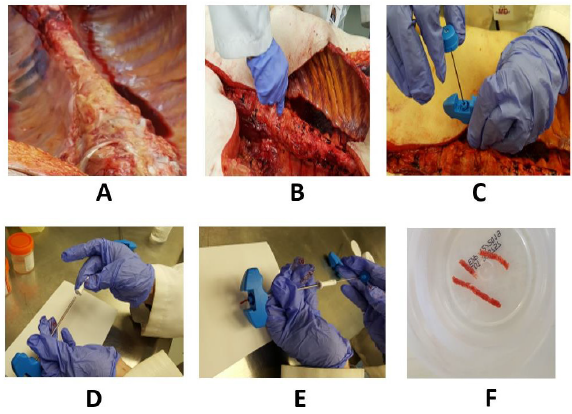
During post-mortem, once the viscera are removed the bodies of the vertebral column are exposed (Figure 4A). The biopsy needle with the stilette and large white plastic cap in place is advanced slowly pointing towards the spinous process of a lumbar vertebra (Figure 4B). The cortical bone is then penetrated by gentle rotary motions of the needle. Once the cortex is penetrated the stilette is removed by twisting the knob of the stilette anti-clockwise with one hand while holding the needle in place with the other (Figure 4C). The biopsy needle is then advanced with slow, steady, and controlled clockwise-counter-clockwise rotary motions until an adequate depth is reached (about 20-25 mm). The biopsy needle is then rotated completely several times about its long axis to sever all the trabecular connections at its base and sever the core sample from the surrounding spongy bone. It is then slowly withdrawn with a straight pull with gentle alternating rotary motions. No rocking, sculling, or gyratory movements or changes in the direction of the tip of the needle are necessary. Once the needle is completely withdrawn from the vertebral body the insertion aid is attached to the distal cutting end (mouth) of the needle (Figure 4D). The biopsy specimen is then pushed out of the needle with the pusher rod which is introduced through the opposite end of the insertion aid (Figure 4E).

Figure 4:(A) demonstrates the vertebral bodies following removal of the viscera. (B) The needle with the stilette in place is inserted into the bone. Once the cortex is penetrated the stilette is withdrawn (C). (D) The photograph shows the attachment of the insertion aid to the distal cutting end (mouth) of the needle. (E) The photograph shows the introduction of the pusher through the insertion aid to push the core sample out of the needle. (F) Shows several bone marrow core samples in a fixative. Note the long and uniform core of marrow tissue obtained with this needle.

Results

The needle has been extensively tested on multiple cadavers obtaining at least 6-8 samples from each cadaver. The sites used for obtaining the core samples were slightly to the right or slightly to the left of the anterior midline of thoracic #12 and lumber # 1-5 vertebrae. An excellent sample was obtained with each attempt (Figure 4F). Bony trabeculae were clean-cut and crush artifact was almost negligible even at the edges of the biopsy specimen. Detailed histologic analysis of bone marrow specimens obtained using this new needle and other conventional bone marrow biopsy needles, including the Jamshidi [2] and the on control needle [4] since this is the downstream intent of any bone marrow core biopsy needle has already been reported [6].

Discussion

Since the introduction of the bone marrow biopsy procedure by Ghedini in 1900 [7], bone marrow core biopsy has become a routine procedure for diagnostic and prognostic evaluation of patients with hematological and non-hematological disorders [8-12]. Although the method and instrumentation of procuring such samples from the human body have become easier due to the sophistication and development of new and improved needles, tissue sampling of bone and bone marrow at post-mortem has not changed and remains crude and cumbersome. Using the conventional method of chiseling or sawing a bone segment from the vertebral bodies is still considered the norm. Although the above approach generally yields a rather large but relatively superficial area of bone and marrow this method is likely to miss a potentially desired tissue mass that is residing in the deeper, distal regions of marrow mass.

In the United States, however, the technique of obtaining core samples at post-mortem is not new, as there are several types of needles commercially available, such as Core-lok [1] or Jamshidi [2] needles. These needles are normally collected from the hematology department following bone marrow procedure, washed, cleaned, and subsequently used by the pathologists to obtain marrow and core samples at post mortem. In practice, the samples are taken from iliac crests, though vertebral bodies are not uncommon. Unfortunately, none of the existing bone marrow biopsy needles except the one described here has internal core retention devices. As a result, to capture a core sample, the newer needles (i.e., Core-lock, Jamshidi) require additional components such as the sleeve (a tweezer-like component) or a drain-spade-shovel like component called marrow acquisition cradle. They also require multiple steps and several maneuvers to complete the procedure. This often results in fragmentation of the core sample. Unlike the needle described in this article, none of the commercially available needles are sold in a reusable (non-sterile) form. There are also powered devices such as the On Control needle [4], which makes bone cutting easy. But the high-speed drilling and the associated sickle-shaped hook present near the distal cutting end of the needle (Figure 5B) which is used to capture the biopsy specimen causes considerable damage to the biopsy, particularly near the edge (5C) of the biopsy specimen as the hook passes over the core and excises the bone and marrow. On Control needles are also very expensive and are not sold in disposable forms.

Figure 5:

Core loss has been a real problem using the conventional bone marrow biopsy needles, such as the older Jamshidi or similar type of needles, which do not have a trapping device to capture a core sample, thus requiring a second or third attempt to secure a core sample. To overcome this problem and to secure a biopsy specimen, these needles do require rocking, sculling or gyratory movements or change in the direction of the tip of the needle to capture a core sample. As a result, the needles are often bent or damaged (Figure 6) and cannot be used over and over again.

Unlike the conventional bone marrow biopsy needles the needle described here (5) does not require any rocking, sculling or gyratory movements or change in the direction of the tip of the needle to capture the biopsy specimen. As a result, the needles are not bent or damaged and can be used over and over again. This needle has an internal core retention design and as a result, no additional components or parts such as a sleeve (1) or marrow acquisition cradle (2) to capture the biopsy specimen is necessary and the needle can be withdrawn with a straight pull. When additional components or parts are used to capture the biopsy specimen, they may not only cause fragmentation of the biopsy specimen but also can cause considerable damage to the biopsy and significant crush artifact particularly near the edge of the biopsy specimen. This proposed needle does not require any additional components and avoids these limitations.

In a series of histopathological bone marrow investigations in forensic medicine 35% of the cases (n=78), abnormal histopathologic changes were identified [13]. Forty of them were neoplastic, predominantly hematological diseases which were unknown during the patient’s lifetime. Referring to these findings the authors suggested that extraction of post-mortem bone marrow specimens for histopathological investigation should become an essential procedure for both the forensic and clinical pathologists’ investigations [13].

The use of the needle described herein would make the pathologist’s efforts simpler and more productive. It can be used to obtain multiple samples from different bony regions. Because the needle is supplied in a non-sterile state it is modest in cost. It can be used multiple times provided the cutting facets are not damaged. We believe the availability of this needle will give pathologists further impetus to sample bone marrow at post-mortem and perhaps resolve questions that would otherwise not be recognized or addressed.

 For more Articles on : https://biomedres01.blogspot.com/ 


Faba Bean Varieties Response to Phosphorus Application on Yield and Yield Components at Kulumsa Area of Tiyo District, Arsi Zone, South-Eastern Ethiopia

  Faba Bean Varieties Response to Phosphorus Application on Yield and Yield Components at Kulumsa Area of Tiyo District, Arsi Zone, South-Ea...