Diagnosis of Psoriasis in Hard-To-Treat Body Locations
Psoriasis is a chronic, multisystemic disease with many
comorbidities, which is often difficult to treat, and some cases may
be refractory to treatment. Total eradication of plaques is difficult
to achieve, and the remission time is short. Recurrence is inevitable
and is often preceded by poor adherence to topical therapy. Forms
of gouttate psoriasis may resolve spontaneously or may progress to
chronic plaque psoriasis. Erythrodermic psoriasis and generalized
pustular psoriasis can be life-threatening if left untreated and
recurrences are common [2]. The clinical form of psoriasis
in plaques refers to the form of well-defined erythematoussquamous
plaques, “salmon-pink” to bright red, covered with
thick, multilayered, non-adherent silvery white or gray-white
scales. Brocq’s methodical maneuver highlights the whitening and
fragmentation of the scale, and the detachment of the last layer of
scales can objectify a punctiform bleeding (Auspitz sign) due to the
phenomenon of papillomatosis. The annular or arched appearance
may appear through the central resolution of the plaques and the
confluence of the small plaques may determine the appearance of
a geographical map.
The common locations are represented by the extension areas
of the limbs (knees, elbows), the lumbosacral area, the scalp or
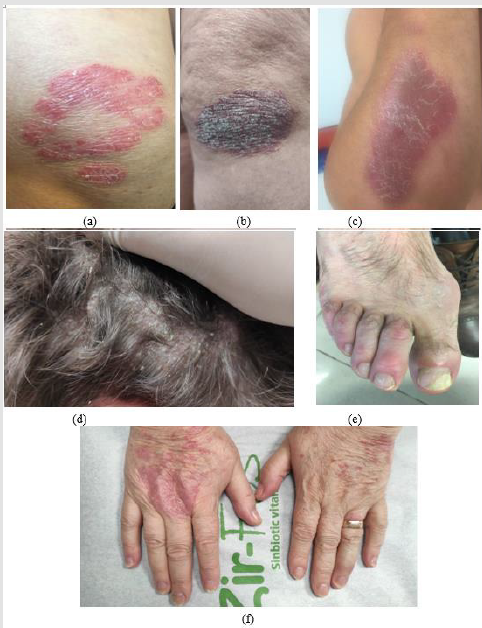
the umbilical region. Clinically form of gouttate psoriasis presents
multiple, round, small lesions (0.5-1 cm in diameter) (Figures
1a-1f), particularly on the trunk and upper limbs, with rapid
extension, being a common form in children and young adults.
Inverted (flexural) psoriasis has erythematous plaque lesions, with
fine scales, in the major genito-crural, axillary and submammary
folds [3]. Healthcare professionals and patients using the term
psoriasis usually refer to plaque psoriasis and unless otherwise
stated. The term “difficult-to-treat areas” usually refers to the face
region, flexion areas, genitals (affected in 45% of cases), scalp,
palmoplantar region and are so named because psoriasis in these
places can have a significant impact and can lead to functional
impairment and require carefully selected topical therapy, which
may be resistant to treatment [4].
The scalp is one of the most common sites for psoriasis, usually
with well-defined individual erythematous-squamous plaques,
which often which usually extend about 1 cm beyond the hairline
and advance to the cervical, retroauricular and facial regions,
accompanied by pruritus and discomfort. Scalp psoriasis does not
usually induce alopecia and the most common differential diagnosis
of scalp psoriasis includes seborrheic dermatitis, tinea capitis and
lichen planopilaris [5]. In addition, dermatomyositis involving
the scalp may have lesions similar to psoriasis [2]. Flexural or
inverse psoriasis is characterized by erythematous, shiny, smooth,
well-defined plaques, the scales are not clearly visible due to the
characteristic moisture in the folds and common topographic areas
include the axillary area, sub mammary folds, groin and intergluteal
fold. Inverse psoriasis is less common than plaque psoriasis and is
estimated to affect 3-36% of patients [6]. In infants, it can often
occur in the diaper area, with a typical damage to the groin folds,
also known as napkin psoriasis. Common differential diagnoses
include bacterial or Candidiasis intertrigo, tinea cruris, contact
dermatitis, fold eczema and Hailey-Hailey disease [1].
Genital psoriasis affects up to 60% of patients throughout life
[7] and can have a significant impact on patients’ psycho-social
function due to physical symptoms such as itching and local
pain, with a negative impact on sexual health [1]. As with inverse
psoriasis, the scales are discrete or absent, and painful fissures in
the intergluteal fissure and intense erythema can be a diagnostic
argument. Vulvar psoriasis requires differential diagnosis with
atopic dermatitis, contact dermatitis, sclero-atrophic lichen, lichen
planus and premalignant lesions [8]. In men, irritative balanitis,
Zoon balanitis, Queyrat erythroplasia or extramammary Paget’s
disease can mimic genital psoriasis [8]. When nail changes or typical
erythematous-squamous lesions of psoriasis are missing elsewhere
in the body, skin biopsy may be helpful in establishing a certain
diagnosis. The motivation of the study is given the importance of
the need to outline the epidemiological profile of psoriasis which
affects the quality of life through psycho-emotional impact and
hard to treat body locations.
We performed a retrospective epidemiological study of 527
hospitalized patients diagnosed with psoriasis vulgaris in the
Dermatological Clinic of the Emergency County Clinical Hospital
“Saint Spiridon”, Iasi in order to establish the frequency of major
forms of psoriasis and describe the characteristics demographics
such as gender distribution, age group and hard to treat body
locations in psoriasis. The collection of information from the
observation sheets complied with both the type of information
collected for each patient and the time intervals at which they
were obtained. Criteria for inclusion in the group of patients with
inflammatory pathology included patients with main clinical and/
or histological diagnosis with psoriasis vulgaris hospitalized in
the Dermatology Clinic within the County Emergency Hospital
“Saint” Spiridon in Iasi, during 1.01.2016-31.12.2019 for 4 years,
patients whose observation sheets or electronic files contained
sufficient information to make them relevant to the study. Exclusion
criteria were represented by patients whose observation sheets or
electronic files did not contain sufficient information to make their
inclusion in the study possible.
After applying the selection criteria, a series of 527 patients was
created that met all the specified conditions. The information was
collected from computer databases and patient observation sheets
and included a number of variables relevant to the research. Variables
analyzed in the group with psoriasis vulgaris were represented by
gender (female or male), age, clinical form of psoriasis (plaque
psoriasis, gouttate psoriasis, palmoplantar pustular psoriasis,
generalized pustular psoriasis, erythrodermic psoriasis, inverse
psoriasis, plaque and gouttate psoriasis, pustular psoriasis, inverse
and gouttate psoriasis, psoriasis vulgaris in plaques, gouttate and
inverse psoriasis, pustular and inverse psoriasis vulgaris, gouttate
psoriasis and pustular psoriasis). Similarly, hard to treat locations
distribution such as scalp, palmoplantar area, nails, genital region,
large folds, face were analyzed. Quality of life was assessed using
standardized Daily Life Quality Index (DLQI) severity score through
questionnaire which revealed following values: 0-1 = no effect on
the patient’s quality of life; 2-5 = low effect on the patient’s quality
of life; 6-10 = moderate effect on the patient’s quality of life; 11-
20 = important effect on the patient’s quality of life; 21-30 = very
important effect on the patient’s quality of life.
In order to carry out retrospective studies subsequently, we
coded this information in order to be able to enter it in a database
with parametric and non-parametric data that we analyzed
statistically. The statistical analysis of the data was performed
with the software STATISTICA ver. 7.0. Depending on the needs
of the statistical analysis, the data were used either in the original
version or were grouped according to some classification criteria
imposed by methodologies, or established according to the type
and particularities of the variables included in the analyzes. We
analyzed the differences between the mean values according to
the grouping variables, using the t test for independent samples
according to the grouping variables sex and environment of origin,
appreciating as significant the differences located at a significance
threshold p <0.05. The significance of the differences between the
frequencies was evaluated with the help of the χ2 test, appreciating
as significant the differences when the calculated value of the χ2
test will be higher than the critical value corresponding to the
significance threshold p = 0.05. If percentages were compared,
the significance of the differences was assessed using the Z test,
assessing as significant the differences located at a significance
threshold p <0.05.
The present study was carried out in accordance with the
1964 Helsinki Declaration and subsequent amendments and
was approved by the Ethics Commission of the University of
Medicine and Pharmacy “Grigore T. Popa” Iasi and by the Ethics
Commission of the Emergency County Clinical Hospital “Saint
Spiridon”, Iași, through the ethics opinion in accordance with the
Research Law no. 206 of 27 May 2004 on good conduct in scientific
research, technological development and innovation, as well as
with the European legislation in force (European Regulation 679)
on the processing of personal data. The rights to integrity and
confidentiality of the subjects included in the study were respected.
Frequency of Cases with Special Impairment, Depending
on Age Groups
To compare the frequency of cases by age groups by sex, the
Z test was used to compare the percentages of two different
populations (in our case men and women), at the minimum
significance threshold p <0.05. The study included a number of 527
patients diagnosed with psoriasis vulgaris, with a distribution by
age groups showing 229 women and 298 men, with 49.15% of the
total number of the group , respectively 288 patients with urban
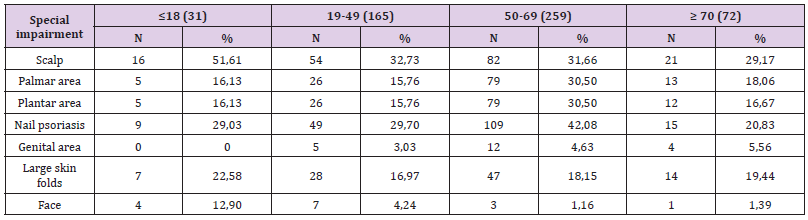
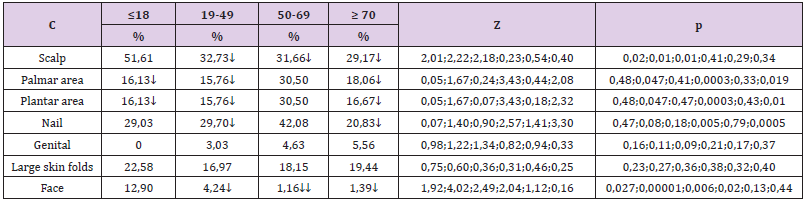
background. After comparing the frequency with which special
impairments occurred by age groups, the following (Tables 1 & 2)
significant differences were obtained:
a) The frequency of scalp psoriasis was significantly higher in
patients aged ≤18 years (51.61% compared to 32.73% aged
19-49 years, Z = 2.01, p = 0.02; compared to 31 , 66% aged
between 50-69 years, Z = 2.22, p = 0.01; compared to 29.17%
aged ≥ 70 years, Z = 2.18, p = 0.01);
b) The frequency of palmar involvement was significantly higher
in patients aged 50-69 years (30.5% compared to 16.13% aged
≤18 years, Z = 1.67, p = 0.047; compared to 15.76 % aged 19-
49 years, Z = 3.43, p = 0.0003; compared to 18.06% aged ≥ 70
years, Z = 2.08, p = 0.019);
c) The frequency of plantar involvement was significantly higher
in patients aged 50-69 years (30.5% compared to 16.13% aged
≤18 years, Z = 1.67, p = 0.047; compared to 15.76 % aged 19-
49 years, Z = 3.43, p = 0.0003, compared to 16.67% aged ≥ 70
years, Z = 2.32, p = 0.01);
d) The frequency of nail psoriasis was significantly higher in
patients aged 50-69 years (42.08% compared to 29.7% aged
19-49 years, Z = 2.57, p = 0.005 and compared to 20 , 83% aged
≥ 70 years, Z = 3.30, p = 0.0005);
e) The frequency of facial extension was significantly higher in
patients aged ≤18 years (12.9% compared to 4.24% aged 19-
49 years, Z = 1.92, p = 0.027, compared to 1.16 % aged between
19-49 years, Z = 4.02, p <0.00001 and compared to 1.39% aged
≥ 70 years, Z = 2.49, p = 0.006); it was found that the frequency
in patients aged 19-49 years was significantly higher than that
of patients aged 50-69 years (4.24% compared to 1.16%, Z =
2.04, p = 0.02). 3.2. The relationship between the clinical form
of psoriasis and the special condition:
To see if a particular clinical form of psoriasis is significantly
associated with a particular special condition, it was necessary
to compare the frequencies of each special condition with all the
others in each clinical form of psoriasis. In order to be able to
make those comparisons, it was necessary to convert the gross
frequencies of each special affectation into percentage frequencies
by relating them to the total cases of each corresponding special
impairment, the result of which was then multiplied by 100. The
differences between the percentages were tested with Z test, being
considered significant those differences that were located at a
significance threshold p <0.05.
Comparison of the incidence of special conditions in patients
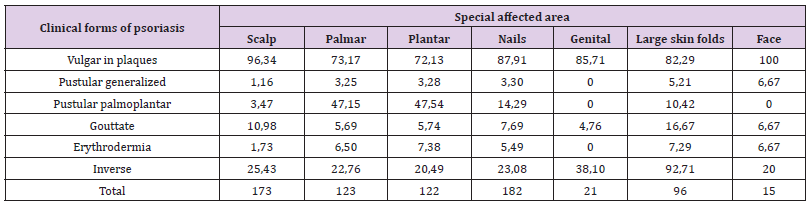
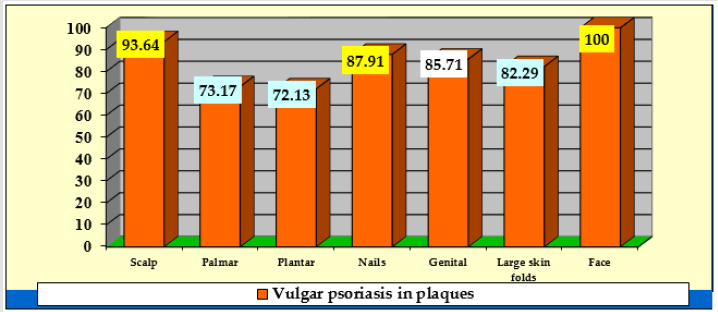
with plaque psoriasis (Table 3, Figure 2) showed that:
a) Facial psoriasis (100% of cases) was significantly more
common compared to: 73.17% in the palmar area, Z = 2.3, p =
0.01; 72.13% in plantar area, Z = 2.36, p = 0.009 and 82.29% in
large folds, Z = 1.77, p = 0.038;
b) Scalp involvement (93.64% of cases) was significantly more
common compared to: 73.17% in the palms, Z = 4.88, p
<0.00001; 72.13% in plants, Z = 5.06, p <0.00001; 87.91% for
nails, Z = 1.86, p = 0.03 and 82.29% for large folds, Z = 2.92, p
= 0.0017;
c) Nail psoriasis (87.91% of cases), was significantly higher than:
73.17% in palms, Z = 3.28, p = 0.0005 and 72.13% in plants, Z
= 3, 48, p = 0.00025;
d) The involvement in the area of large folds (82.29% of cases)
was significantly higher than 72.13% in plants, Z = 1.76, p =
0.04.
In patients with inverse psoriasis it was also observed that the
frequency of cases with psoriasis of genital area was significantly
higher, 38.1%, compared to 20.49% with plantar area, Z = 1.77,
p = 0.038. 3.3. Comparison of the frequency of cases with DLQI
scores <10, between 10-20 and higher than 20 (Tables 4 & 5): In
the four age groups, the results highlighted the following significant
differences:
a) The frequency of cases with DLQI scores <10, was significantly
higher in patients aged 50-69 years (38.22% compared
to 22.58% of those aged ≤18 years, Z = 1.71, p = 0.04 and
compared to 29.09% of those aged 19-59 years, Z = 2.10,
p = 0.017) and those aged ≥ 70 years (44.44% compared
to 22.58% of those aged ≤18 years, Z = 1.93, p = 0.027 and
compared to 29.09% of those aged 19-49 years, Z = 2.3, p =
0.01); the frequency of cases with DLQI scores between 10-20,
did not differ significantly depending on the age groups;
b) The frequency of cases with DLQI scores> 20, was significantly
lower in patients aged ≤18 years (6.45% compared to 30.03%
of those aged 19-49 years, Z = 2.76, p = 0.0028, compared
to 25.48% of those aged 50-69 years, Z = 2.36, p = 0.009,
compared to 36.11% of those aged ≥ 70 years, Z = 3.10, p =
0.001); the frequency of cases with DLQI scores> 20 was
significantly higher in patients aged ≥ 70 years compared to
those aged 50-69 years (36.11% compared to 25.48%, Z =
1.78, p = 0.037 ).
Psoriasis is a major global health problem with an increased
prevalence with values ranging from 0.09% [9] to 11.4% [10] with
a significant impact on patients’ quality of life. Clinical examination
and evaluation through several tools that quantify the quality of
life, such as the Dermatology Life Quality Index (DLQI). Cutaneous
involvement of the scalp, face, palms, soles, nails and mucosal
involvement such as genitals can be particularly debilitating [11].
Few available research on patients with psoriasis in hard-to-treat
locations were based on large study populations with psoriasis. The
main objective of this study was to describe patients’ clinical and
demographic characteristics, disease severity, and quality of life
impacts in patients with hard-to-treat body locations of psoriasis.
We investigated the prevalence of hard-to-treat body locations
of psoriasis, and similarly we described patients’ clinical and
demographic characteristics. In the current retrospective study, the
analysis of the total number of hospitalizations (527) in relation to
the distribution by sex showed that each year the percentage was
higher in men, the percentage frequency differences between the
sexes being due to the higher number of men (298) compared with
that of women (229).
Gender differences in the characteristics of skin conditions can
be influenced by complex interactive mechanisms involving the
effect of anatomy, physiology, immunity, genetics, epigenetics, sex
hormones, ethnic background, as well as geographical, sociocultural
and environmental factors. Epidemiological data reported in the
literature show that psoriasis is considered equally prevalent
in both sexes [12]. However, of all the studies that reported
prevalence by sex, some indicated that psoriasis is more common
in men [13], but the values quoted are not statistically significant,
and others indicate that psoriasis appears to be less common or
more widespread among women than among men [14], so further
studies and investigations are needed to differentiate genetic and
behavioral factors. The age distribution of the clinical forms of
psoriasis vulgaris in the group of patients analyzed showed that the
frequency of gouty psoriasis associated or not with erythematoussquamous
plaque lesions appeared significantly higher in patients
aged 18 years or less, aspects confirmed in the literature as well
[15].
Psoriasis was subclassified according to the age of onset and
thus psoriasis with early onset (also called type I) can occur before
the age of 40, with maximum onset at the age of 16-22. Late-onset
psoriasis, also called type II psoriasis, has onset at or after the age
of 40, with a maximum age of onset between 57 and 60 years [16].
Other epidemiological studies indicating that the average age in
patients with pustular psoriasis is reported between 48 and 50
years [17]. Another significant difference was found in patients
aged ≥ 70 years in whom the frequency of reversed psoriasis
appeared significantly higher with vulgaris and pustular psoriasis
(98.61% compared to 92.28% in those aged 50-69 years). There
is a relationship between plaque and pustular psoriasis, as some
people may have episodes of plaque psoriasis that precede or follow
pustular lesions, the most common trigger factors being viral or
bacterial infections or improper use of corticosteroid therapy. This
higher frequency may also be due to the fact that as the population
of people over the age of 65 in the world continues to grow, the
incidence of older people suffering from psoriasis will also increase
proportionately.
Patients with the clinical form of plaque psoriasis had as the
most common special location to the scalp (93.64% of cases)
compared to the palmo-plantar, nail or flexural region. Psoriasis
located in areas difficult to treat has a negative impact on quality of
life. Thus, studies show that up to 80% of psoriasis patients develop
scalp psoriasis and up to 97% of affected individuals reported that
the disease affects their daily lives [18]. The frequency of facial and
scalp damage was significantly higher in patients younger than 18
years and aged 19-49 years than in patients aged 50-69 years. Scalp
is one of the most common sites for psoriasis and facial damage
occurs at one time in about half of those affected by psoriasis. Thus,
in young, active patients, the damage to these special areas by the
unsightly presence of erythematous-squamous lesions on very
visible areas often causes psychosocial problems. Common chronic
conditions such as psoriasis may be associated with increased
psychological distress [19]. Psoriasis is associated with low selfesteem,
anxiety (30%) and depressive disorders (60%) [20].
The treatment of psoriasis can promote the relief of depression
both due to decreased psychodynamic problems and the production
of tumor necrosis factor alpha (TNF-alpha), aspects that need to
be considered during therapeutic decision-making [21]. In the
presence of these multiple possible comorbidities, the optimal
management of the patient with psoriasis vulgaris consists in the
holistic approach and the interdisciplinary approach [22]. After
comparing the frequency with which special impairments occurred
by age groups, it was obtained that the frequency of palmoplantar
involvement was significantly higher in patients aged 50-69 years.
Although palmoplantar psoriasis is a disabling variant of psoriasis
and therapeutically challenging condition its epidemiology is
poorly defined [23,24]. Palmoplantar psoriasis can occur at any
age. Statistically analyzed data are according to available data from
a systematic review and meta-analysis [25] which included a total
of 2083 patients with palmoplantar psoriasis (1072 men and 841
women) and the ages of the patients ranged from 8 to 87 years,
while the mean age ranged from 37.4 years to 58.5 years. With
the exception of two studies, all studies reported a clinical type
of palmoplantar psoriasis with hyperkeratosis, pustular or mixed
plaques, and the most common was the type of hyperkeratosis
plaque [25].
Also in this age group between 50-69 years the frequency of
nail damage was significantly higher than those aged 19-49 years
(42.08% compared to 29.7%). Literature review shows that men
and women are equally affected by nail psoriasis, and its prevalence
increases with the age of the study population [26]. Results from
a Danish skin cohort with a total of 4016 adults with psoriasis
showed that the most frequently affected hard-to-treat area was the
scalp (43.0%), followed by the face (29.9%), nails (24.5%), soles
(15.6%), genitals (14.1%), and palms (13.7%) [27]. Similarly to our
study results, higher prevalence was generally seen with increasing
psoriasis severity and patients with involvement of certain hard-totreat
areas such as hands, feet, and genitals had clinically relevant
DLQI impairments. Psoriasis is no longer considered just a skin
disease, but rather a chronic systemic inflammatory disease that
presents a substantial risk in increasing the rate of comorbidities
[28]. Nail damage is an important problem in dermatological
practice, and nail psoriasis may be present alone or may be
associated with other skin lesions.
The nail involvement (87.91% of cases) was significantly higher
than the palmoplantar area, and the damage in the area of large
folds (82.29% of cases) was significantly higher than 72.13 % of the
plantar area. Nail psoriasis has been reported in 10-80% of patients
with psoriasis, with nails psoriasis on the upper limbs being more
often affected than those on the lower limbs. Moreover psoriasis is
a common cause of disturbance of the nail morphology and may be
associated with all clinical forms of disease [29]. The importance
of nail psoriasis was studied, and in a survey in the Netherlands,
79% of patients reported nail involvement, 52% suffering from
associated pain and 14% having major restrictions in daily life due
to changes in the nail apparatus [2]. Currently, the association of
an inflammation of the nail bed has a prevalence between 10-80%
recorded in patients with psoriasis [2]. The anatomical connection
between the last phalanx and the nail unit determines the
correlation between arthropathic psoriasis and nail changes [30].
Some manifestations of psoriasis are associated with an
increased risk of developing other manifestations, for example,
psoriatic arthropathy in patients with psoriasis with manifestations
on the scalp and nails [31]. Psoriatic arthritis is a chronic systemic
inflammatory disorder characterized by joint inflammation with
a prevalence of 0.05% - 0.25% of the population and 6% to 41%
of patients with psoriasis [32]. Although nail psoriasis is usually
investigated by clinical examination, the diagnosis of incipient form
of disease is needed. Patients with nail damage appear to have
an increased incidence of psoriatic arthritis [33]. In the present
study, out of the 527 patients with psoriasis, 98 patients presented
different clinical forms of onychopathy (18.6%), a result that
falls within the range reported in the literature. In our study the
frequency of cases with psoriasis of genital area was significantly
higher, 38.1% in patients with flexural psoriasis compared to
20.49% with plantar area, Z = 1.77, p = 0.038. Similarly, Kelly, et
al. [34] reported that psoriasis involving the genital area occurs in
up to two-thirds of psoriasis patients but is often overlooked by
physicians.
Furthermore, often the impact this small area of psoriasis can
have on a patient is neglected. It can have a significant impact on
patients’ psychosocial function due to intrusive physical symptoms
such as genital itch and pain, and a detrimental impact on sexual
health and impaired relationships. Analysis of the distribution of
DLQI values according to age groups showed a higher quality of life
impairment in patients older than 70 years.
For more
Articles on : https://biomedres01.blogspot.com/