Monday, April 4, 2022

Electrical Neurostimulation Therapy: An Alternative Treatment Option for Obstructive Sleep Apnea


Electrical Neurostimulation Therapy: An Alternative Treatment Option for Obstructive Sleep Apnea

Introduction

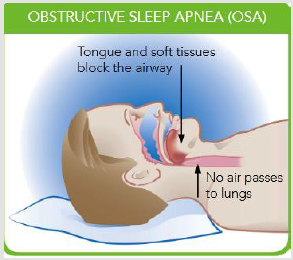
Obstructive sleep apnea, or OSA, is a condition that disrupts breathing during sleep. OSA occurs when the tongue and other soft tissues relax during sleep and obstruct the airway [1] (Figure 1). During sleep, upper airway muscles tend to relax, in healthy subjects, muscle tone is high enough to prevent the upper airway from collapse during sleep but in OSA patients upper airway is not capable to maintain the patency and leads to a partial or complete collapse of the upper airway. The oxygen level in the blood decreases and the brain senses a problem due to sudden reduction (hypopnea) or complete cessation (apnea) of airflow that persists at least for 10 sec. The severity of OSA is measured by apnea/hypopnea index (AHI), which is calculated by apneas and hypopneas per hour of sleep. Sleep studies (Polysomnography) are recommended for the diagnosis of OSA. The AHI score depicts the severity of OSA: Mild (5 ≤ AHI < 15/h), moderate (15 ≤ AHI < 30/h), and severe (AHI ≥ 30/h) sleep [2]. The OSA is more common in males (14%) as compared to females (5%) [3]. Common symptoms of OSA include snoring, daytime sleepiness, irritability, or difficulty with focus or concentration. If left untreated, OSA can lead to secondary health issues such as:

a. Heart attack

b. High blood pressure

c. Stroke

d. Heart failure

e. Irregular heartbeats

f. Weight gain

To reduce the morbidity of OSA, successful treatment of OSA is important. Multiple treatment options are available. Electrical neurostimulation therapy is an emerging treatment option for OSA. In this therapy hypoglossal nerve is stimulated by an electric current that protrudes the tongue and opens the upper airway.

biomedres-openaccess-journal-bjstr

Figure 1:Obstructive Sleep Apnea.

The purpose of this article is to describe the mechanism of electrical neurostimulation therapy for OSA patients.

Current Treatment Options

Current treatment options for OSA range from lifestyle changes to external device-based treatments, such as continuous positive airway pressure (CPAP), to surgery [2] Lifestyle changes such as losing weight, exercising regularly, or consuming less alcohol before sleep may help improve sleep. If lifestyle changes alone do not resolve OSA, CPAP is typically prescribed. CPAP is the most common treatment for OSA. CPAP is an effective treatment that uses a mask to deliver air pressure and keep the airway open. While CPAP is often successful, some people are unable to tolerate this therapy. Oral appliances may be prescribed as an alternative to CPAP. Oral appliances keep the airway open by holding the jaw forward during sleep. Surgical options may be considered by some people who are unable to use or adhere to CPAP or oral appliances. Traditional sleep apnea surgery is intended to make the airway larger by removing or altering facial or airway anatomy. These anatomy altering surgeries can be painful and involve lengthy recovery time.

Electrical Neurostimulation Therapy

Three different systems are available for this nerve stimulation therapy; the working mechanism of each system is different [4]-

1. Hypoglossal Nerve Stimulation (HGNS) system (Apnex Medical, Inc., St. Paul, Minnesota)

2. Aura6000 Targeted Hypoglossal Neurostimulation (THN) system (ImThera Medical, Inc., San Diego, California))

3. Inspire Upper Airway Stimulation (UAS) device (Inspire Medical Systems, Inc., Maple Grove, Minnesota).

Inspire UAS system device is the only system that has approval from Food and Drug Administration (FDA).

Principle of Stimulation Therapy

Neurostimulation therapy reduced the activity of dilators muscles of the upper airway during sleep and also stimulates the hypoglossal nerve. Stimulation of the hypoglossal nerve activates the genioglossus muscle which leads to protrusion of the tongue during sleep and prevents the tongue fall back into the pharynx [5].

Patient Selection

Eligibility for the implantation

a. Have been diagnosed with moderate to severe obstructive sleep apnea

b. Have either failed or not tolerated CPAP treatment

c. Have a body-mass index, or BMI, of 32 or less

d. Do not have any other active implantable devices, such as

a pacemaker

e. Do not have certain diseases or conditions that may disqualify them as candidates

Inspire Stimulation Device

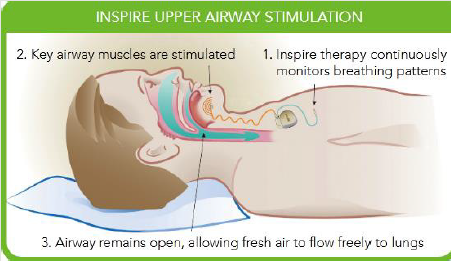
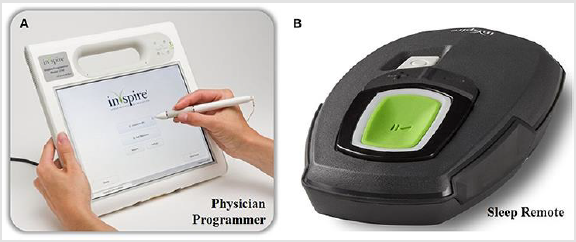
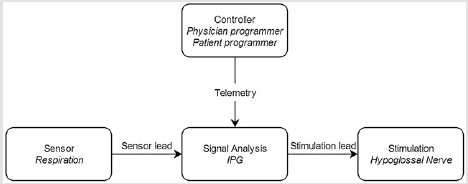
This is a small device that consists of three implantable and two external components, interconnected via either leads or telemetry (Figure 2). Pulse generator, Stimulation, and Sensing leads need to be implanted in the patient’s body (Figure 3). The stimulation electrode was placed on the hypoglossal nerve to recruit tongueprotrusion function and the sensing lead was placed between the internal and external intercostal muscles to detect ventilatory effort [6]. Sensing signals are transferred to a Pulse generator, which filtered and amplified the signals. Physician’s programmers and patient’s programmers are the external components of the Inspire system (Figure 4). These programmers are used to control the pulse generator. A physician’s programmer is a tablet used by a surgeon to control the stimulation and adjustments in the amplitude of signals. The patient’s programmer is used by a patient to switch on and off the device. This system generates the electrical signals, these signals excite the hypoglossal nerve. The depolarization of the nerve produces the action potential in the genioglossus muscle, resulting in protrusion of the tongue [7].

biomedres-openaccess-journal-bjstr

Figure 2:Components of Inspire Stimulation Therapy.

biomedres-openaccess-journal-bjstr

Figure 3:Inspire Stimulation Therapy.

biomedres-openaccess-journal-bjstr

Figure 4:External component of Inspire Stimulation Device.

Conclusion

Electrical neurostimulation therapy is an innovative and novel therapy for moderate to severe obstructive sleep apnea. Patient selection can optimize both the efficacy and the workflow of this therapy for selected patients.


For more Articles on : https://biomedres01.blogspot.com/


Brain-Inspired Computing Research: DARPA HIVE Project for Developing Next-Generation AI Platforms


Brain-Inspired Computing Research: DARPA HIVE Project for Developing Next-Generation AI Platforms

Introduction

As described by DARPA, main HIVE goal is creation of a “graph analytics processor” which incorporates the power of graphical representations of relationships in a network more efficiently than traditional data formats and processing techniques according to DARPA. In combination with emerging machine learning and other artificial intelligence techniques that can categorize raw data elements. By updating the elements in the graph as new data becomes available, a powerful graph analytics processor could discern otherwise hidden causal relationships among the data elements in the graph representations [1]. DARPA suggests such a graph analytics processor might achieve a “thousand-fold improvement” in processing efficiency over today’s best processors, enabling the real-time identification of strategically important relationships as they unfold in the field rather than relying on after-the-fact analyses in data centers. Current software includes algorithms exposed via API, internal graph representation of data and hardware “backends” (GPU, CPU, ASIC). Chinese specialist Wang explained that under the current AI platforms major tradeoffs must be made, whether it is optimizing for a certain type of hardware or optimizing for certain algorithms. He said: “If you specialize in graph representation, then you will be disconnected from the data science ecosystem because you are “cut off” from some important libraries” [2]. As part of the second phase of HIVE, they are developing a modular architecture framework. Existing software is being reintegrated into their components so that they can be inserted into the framework according to the best features of the software.

The structure includes Workflow Scheduler and Dispatch Engine. They use the DASK task scheduler to perform scheduler and dispatch operations. In fact, they are fully targeted at a wide range of hardware so that data scientists can immediately span CPUs, GPUs and ASICs to take full advantage of the same software infrastructure. So, we can use PUMA graph processor to accelerate the load processes. Framework must include a set of converters that can convert data in different formats [2,3].

Basic Targets

In Russia we also promote proactive development of domestic massively parallel processors. Objectives of the project also include information and analytical work and the development of technical solutions for creating high-speed element and design base. The basic component of the processor is a tile formed by a 64-thread core, connected by specialized accelerators (SFU). The massively parallel processor must include connected by an on-chip network hundred tiles, several links of an on-chip interaction, PCI-e interface with the host processor. The ideology of massively parallel architecture is similar to processor “Colossus” (company Graphcore) [4], focused on machine learning tasks. But the domestic massively parallel systems are hybrid and reconfigurable platforms. Now we will look at the basic principles for the development of innovative AI systems. DARPA project includes five key technologies:
a) Intelligent scheduling to manage the set of domain resources in the context of specific applications. This should be a technical focus of this project, and it is also the basis for the realization of the project’s goals. Only by realizing runtime intelligent scheduling can software and hardware be decoupled. The performance of smart scheduling is directly related to the efficiency of the final system. For the implementation of this part, there are some further discussions in the technical description, such as adding a processor dedicated to scheduling in the system, allowing each PE to analyze and report its own running status.
b) Software tools to enable a development ecosystem that exercises the full capability of the highly programmable system. Software tools include development tools, such as compilers and debuggers, algorithm libraries, applications and examples. Software tools should be the most important part of whether specific calculations can truly be implemented. A basic requirement is that they can also support new designs in the field. DARPA strongly encourages the use of existing software tools and also supports Open-source work.
c) Forming domain representations as ontologies. This is a job worthy of attention, how to describe a “Domain”. For Domain-Specific software and hardware design work, the premise of the design is a good description of the characteristics of this field. However, these definitions are still too simple to reflect the relationship between different groups.
d) Medium access control (MAC) to interconnect the PEs and to allow the data throughput, taking into consideration latency, power, and other domain constraints. In HIVE project the MAC layer is the medium for exchanging data structures between PEs, including physical structure, topology and a standard programming interface.
e) Hardware integration of the right set of PEs on the MAC layer with the operating scheduler and software into a fabricated socket. The final result of this project also includes a heterogeneous SoC hardware, but this does not seem to be the focus of this project. According to the description of this project, PE is a concept with a relatively large granularity, such as CPU, GPU, TPU, Neuromorphic Unit, DSP and hardware accelerators.

Testing Results

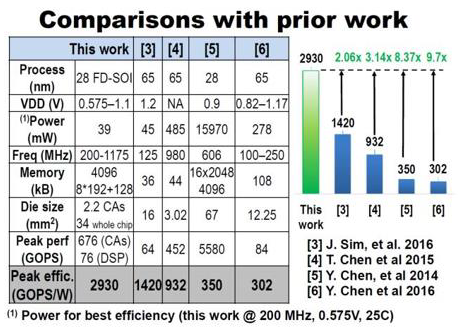
In the field of dedicated processor and accelerator design the performance competition is fierce. It has even become an international-level scoring contest. Usually, international high-level publications (such as ISSCC) publish the latest “scoring results”, such as the performance comparison result of a CNN acceleration chip shown in Figure 1 [5]. The scoring result does not represent an absolute advantage, but it also becomes a measure of whether the design can be recognized as a good design. But the benchmarks obtained from the references are not completely comparable, because each design has its own special features. In the article [6] author hopes that readers can jump out of the thinking mode of “mutual scoring” and get the best design possible in theory (from the point of view of extreme design).
Analysis is traditionally divided into four parts:
a) Performance indicators of digital logic chips.
b) Checks and balances between indicators and trade-off methods.
c) Limit quantitative design method.
d) Investigation and analysis of the reasons for not reaching the optimal performance.
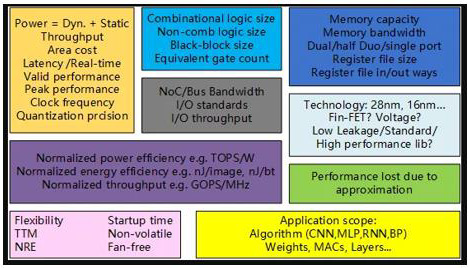
When we analyze chip architecture, we mainly need to consider the following indicators, as shown in Figure 2 [4]:

biomedres-openaccess-journal-bjstr

Figure 1: A “ scoring “ report announced at the ISSCC2017 meeting.

biomedres-openaccess-journal-bjstr

Figure 2: Collection of digital circuit performance indicators.

Single Standard (Orange Part)

a) Power consumption: static power consumption, dynamic power consumption.
b) Energy consumption: the energy for processing a task.
c) Throughput: such as communication speed (bps), images per second.
d) Delay: the time difference between input and output. For real-time systems, latency is very critical.
e) Effective computing capacity: when performing a certain calculation, the total number of operations per second is calculated.
f) Peak computing capacity: the sum of computing operations per second in the chip structure.
g) Clock frequency: adjustable clock frequency/voltage, peak clock frequency.
h) Quantization accuracy: the data quantization width of input/output/intermediate levels.

Normalization Standard (Purple Part)

Due to the checks and balances between indicators, an increase in an expected indicator may lead to an increase in other undesired indicators, so it needs to be measured by a normalized scale. This is often related to the application of the chip, such as: computing power normalized to power consumption; throughput normalized to energy; computing power normalized to the clock frequency and etc.

Comprehensive Results (Light Blue Part)

In the preliminary evaluation or sub-assessment, some comprehensive key indicators given by the comprehensive tool. These indicators are based on netlists and therefore do not include connections and can only be used for initial chip cost evaluation. Including: combinatorial logic resource cost, non-combination logic resource cost; device cost (such as RAM), combinatorial logic cost can also be measured by the number of equivalent gates. The difference is that the combinatorial logic overhead is related to the process library, while the number of equivalent gates is independent of the process library.

Memory Related (Dark Blue Part)

Memory is often represented as a black box. The number of memory chips, the capacity, depth and width of each memory chip. Whether it is dual-port or single-port (the size of dual-port is about twice as large as single-port). For small-scale memory less than 1KB or memory with many read and write ports, it is often implemented by register file size. When a smaller memory is needed or a storage device with a complex read-write interface is required, the register array is generally used to build it directly. The difference between the realization of the register array and the register file is that the register file often needs to be realized by a dedicated compiler, while the register array is directly realized by the hardware description language. The area of the register file will be much smaller than the equivalent function of the register array.

Interface and Bus Related (Grey Part)

Including the process library used, the number of wiring layers, operating voltage, low power consumption or high-performance process and etc.

Design Cost and Special Features (Pink Part)

a) For engineering research and development, it is also necessary to consider the software/application development cost and the ability to map new algorithms and parameters: Time to market (TTM), non-refundable engineering expenses (NRE) and etc.
b) Some chips tend to have advantages in other areas, such as: boot time optimization, non-volatile, no fan requirements (less than 4W), dynamic voltage frequency adjustment, gated clock and other functions.

Conclusion

Similarly, integrating a new user API only needs to add an interface to one of the hardware and use at least one algorithm. Ultimately, the overall goal of HIVE is to unify and simplify the process of “optimizing the communication between graph software and hardware”. Reconfigurable hardware often needs to support multiple operating modes or operating parameters. Configurability and programmability are ultimately the need to add some redundancy to the original dedicated circuit to improve flexibility. But the efficiency of “ordinary” processors is not consistent. With proper ASIC design we can demonstrate good indicators for a limited class of “hard” logic algorithms. For a successful “breakthrough in the field of microelectronics” it is necessary to start developing a mass-parallel processor based on of multithread cores with specialized accelerators.


For more Articles on : https://biomedres01.blogspot.com/


The Role of Information Management in the Process of Digital Health Confrontation with Covid-19

The Role of Information Management in the Process of Digital Health Confrontation with Covid-19

Introduction

A successful decision, under normal circumstances where the capacity of human thinking is normal, depends on the ability to analyze, quality information, accuracy, and focus. However, in critical situations, the capacity of human thinking decreases, and lack of time aggravates the severity of the crisis. In such a situation, providing quality information is a hard task that would never accomplish undoubtedly without the help of information and communication technology. Information management, on the other hand, is the process of collecting and processing data in order to provide quality information. The role of this process becomes more prominent with the help of information technology and it operates successfully in critical situations [1,2]. The purpose of this study is to review how to prevent infodemic using information management and digital health.

Background

With the outbreak of the SARS viral pandemic in 2003, human society faced a phenomenon called Infodemic and has been living with this phenomenon along with the persistence of viral pandemic diseases such as MERS and COVID-19, COVID-19. The infodemic, introduced by the United Nations and the World Health Organization on March 31, 2020, following the SARS Cov-2 crisis, has cast a frightening shadow over human society [3,4]. Infodemic is literally a portmanteau. In fact, it consists of the words information and epidemic and means the universal spread of true and false information about any phenomenon, including disease. In this case, rumor and fear are intertwined so inextricably that complicate learning a subject. This concept itself includes two concepts, namely misinformation, and disinformation. Misinformation is false information about a subject, regardless of its being intentional or unintentional. Moreover, disinformation refers to misleading or false information that is deliberately provided to deceive the audience. Historically, the term has been coined and used by some countries’ security agencies to deliberately diffuse misleading information about the military, which is sometimes propounded to boost military power [5,6].

The bitter and costly experience of coexistence with viral diseases has clarified it for human society that in order to ensure its national security it needs to equip and rehabilitate health care professionals more than equip and reorganize its military [7]. In addition, the utilization of information and communication technology provides considerable preparation for the management of future pandemic-viral diseases due to the nature of pandemicviral diseases that can be managed by observing the principle of physical distance. On the other hand, the nature of information and communication technology is such that makes it possible to track patients and provide remote health care services to people at risk [8]. Noteworthy to mention is that digital health can not only facilitate the management strategy and response to pandemic diseases, but also can curb and manage the annoying phenomenon of infodemic, which severely increases the conditions caused by the outbreak of Covid-19 based on educational and informational application [9,10]. The application of digital health (which is actually e-health with a greater focus on health) can facilitate the management strategy and response to pandemic diseases. This perspective provides a framework for the use of digital technologies in the management and response to pandemics. It also presents the methods that successful countries in using digital technologies have adopted and implemented for the planning and management of pandemic diseases, including surveillance, screening, triage, diagnosis, monitoring, contact tracing, and health care [11].

Results

The Necessity for Information Management in a Pandemic Crisis

In October 2020, The British Academy and the Royal Society both made an announcement about the infodemic phenomenon that the spread of Covid 19 vaccine would confront a flood of misinformation that would fill the knowledge void. They believe that the existing infidelity has five features including distrust of science, distrust of pharmaceutical companies and the government, spreading outspoken words, using emotions, and expanding echo chambers. For this reason, the Singaporean government has praised the action of the Penal Code (POFMA) on natural or legal persons who spread lies [12]. It is noteworthy that some countries, such as China, India, Singapore, and South Africa, have enacted punitive laws against individuals, organizations, sites, and social media outlets that have intentionally or unintentionally published false information about the Covid pandemic. Other countries such as Taiwan, South Korea, and Switzerland, demonstrated their commitment to democracy and the free flow of information through interaction with and with the help of the people and managed the destructive phenomenon of infodemic. In the meantime, some countries, like the United Kingdom, acted in a double standard [13-19].

The various thematic areas plagued by the pandemic of false news include the cause of the disease, misleading statistics about its prevalence and casualties, the economic effects of the Corona crisis, journalism and their discrediting; medicine (symptoms, diagnosis, and treatment), society, and social beliefs (Panic), politicization (discrediting the politicians), Internet scams, and personal life of celebrities [20]. Since 2003, some countries have gained experience in controlling infestations, preventing the circulation of false information, and strictly monitoring all social media in the country, by undergoing the outbreak of SARS and the vigilance of the pandemic. They have managed the flow of data and information from both the people and the government (a health system), and in fact, by consolidating the digital health and information management, they have been able to prevent the problem of infodemic and the spread of fake news and rumors into the society. International organizations have taken effective actions to counter the destructive effects of spreading lies, public ignorance, and the lucrative activities of some social media. Among them, the World Health Organization has introduced a framework that includes a five-step process for managing infodemic, which includes: identifying evidence, translating knowledge and science, amplifying actions, quantifying impact, and coordination and governance [21].

UNESCO, in particular, has tackled the spread of false information through the provision of Open Education Resources, Networks of fact- checkers, and the provision of media and information literacy resources. It has also used digital technologies such as artificial intelligence to combat the existing pandemic in response to the crisis [22]. What follows is a more detailed description of the framework provided by the World Health Organization for the management of the infodemic phenomenon. At the stage of identifying evidence, all scientific findings that can have a positive effect on the health of individuals and the society should be collected, examined, and evaluated. False and misleading information also needs to be identified in collaboration with international organizations such as the World Health Organization. Governments and public health institutions are responsible for the circulation of accurate and quality information in society since they are trusted by the people. The government is obliged to check the contents of social media through the relevant and designated institutions and identify all fake news and false information.

In the translation phase of science and knowledge, health authorities should translate their scientific messages into simple and general language and into practical messages that change behavior in a way that can be easily used by everyone so that all classes of the people and even its politicians understand easily. This makes the community trust the health authorities. Cultural bias should be considered and applied to the content of the message. Local and ethnic translation is also required. The step of strengthening the action is done at the national level aiming at building trust and disseminating the right information to the right people at the right time. The government must optimize the use of social platforms through reputable and approved agencies and use all necessary media, including text, video, and infographics. Frequent and accurate messaging in culturally friendly formats is essential. Also, the timely correction of incorrect information and, if necessary, the use of the method of denial should be considered. Governments and other relevant actors need to reach out to key communities to understand their concerns and information needs, and it is best to provide advice and messages that can help these communities identify their audiences. Through this process, communities of any kind, whether religious, professional or etc., can reinforce appropriate public health messages in a way that is user-friendly leading to correct changes in behavior.

Active contacts and dialogues should be established with private sector employers, telecommunications companies, the food and agriculture sector, religious or humanitarian charities, medical and health professional associations, and the media. Community health workers, the first line of health care in many low-resource environments, must be equipped with the right information, graphics, and narrative to mobilize in communities. Strategic partnerships with the social media platforms of technology platforms and stakeholders, as well as universities and civil societies, all of which reinforce and monitor information, are also needed. Through strategic partnerships with health authorities, these platforms can prioritize and prioritize relevant information and advice, ensuring that it is seen by citizens. In the quantifying impact phase, it is necessary to collect, organize and analyze data with the participation of all key institutions to help measure and describe the information epidemic. In addition, the process of managing fake news and social media as well as the circulation of accurate and quality information and the impact of messages and interventions should be pursued.

The coordination and governance phase emphasizes the principle of public participation and the need to continue monitoring all activities. To achieve this important coordination between stakeholders including the World Health Organization and its member countries, scientific and public health institutions, telecommunications companies and private communication institutions, government communication institutions, search engines, civil society, universities, and academies, health care workers on the front lines, and all institutions to the lowest level of local mutual support groups are required [22].

Conclusion

Some countries, being Prudent and informed about global issues, understood the outbreak of newfound pandemic-viral diseases and the possibility of their continuation and have tried to improve their digital technologies and focused on digital health which is based on using smart phones since 2003. The use of digital technologies as well as digital health in critical outbreaks of pandemic diseases that require physical and social distance is a smart and successful plan to manage the disease. On the other hand, in addition to paying attention to the recommendations of international organizations such as the World Health Organization and UNESCO, these countries have opposed the publication of false news by creating a mechanism for the exchange of accurate data and information that is in the cycle of society and government, as well as implementing methods based on ICT.

Some countries have controlled the phenomenon of infodemic by enacting punitive laws on spreading lies about the pandemic disease, and others by interacting with the people and preventing the situation from escalating. Gathering reliable information and identifying fake news, monitoring the activity and content of social media, educating people on how to use social media and avoiding spreading rumors false information, and news, creating a system of collecting data from people, and distributing reliable information from the government (which is considered as a system of data exchange and reliable information) are among the important measures taken by the governments of successful countries in managing the crisis of Covid-19.
 

For more Articles on : https://biomedres01.blogspot.com/


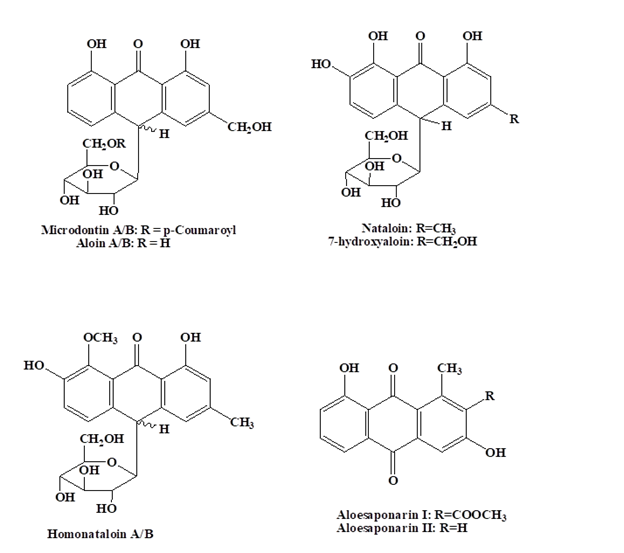
Antimalarial Aloe Compounds

  Antimalarial Aloe Compounds Introduction Among the most prevalent diseases caused by protozoan parasites, malaria is caused by parasites o...