A Study of the Level of Special Knowledge of Rural
Women Small Productive Projects and the Most
Important Activities Provided by the Social Fund in
Yemen
Development is an essential, imperative, and national
requirement for all countries of the third world, and it is
characterized by a general and continuous nature, that is, once it
ends at a certain level until it begins again from where it ended
and with tools and means dominated by the characteristic of
modernization and renewal to suit the dynamic reality of the
permanent community, and aims to advance the economic level
The social, health, educational and cultural through the optimal
utilization of all human and material resources and multi-pronged
development. Improving income levels and increasing productivity
require changes in the economic and social structure and a
change in the value frameworks of the population and must be
comprehensive in order for them to be sustainable [1].
Given the importance of the agricultural sector in rural areas
as one of the most important sectors able to provide new job
opportunities for the rural community by exploiting the available
natural resources, by setting up small agricultural projects in
the field of inputs and requirements for agricultural, animal and
craft operations and the circulation, marketing and manufacture
of their outputs, the Yemeni state and the fund have adopted
Social Development Group has a set of development programs
to solve these problems, especially in the Yemeni countryside,
which contains many small productive projects and development
activities that work on comprehensive development, with what
they achieve of great benefits represented in: increasing the income
of the majority of the population, improving their standard of living,
and increasing job opportunities, Participation of rural residents in
various projects, and the implementation of these projects through
cooperatives as well as commercial and specialized banks such
as the Al-Amal Microfinance Bank and the National Microfinance
Foundation and other banks for microfinance. The projects under
implementation in most of the governorates of the Republic of
Yemen were covered [2].
Cognitive changes play an important role in the success of
development projects in achieving their economic and social goals,
as modifying the individual’s cognitive framework has an important
role in his participation in various development activities [3]with
the consequent increase in their incomes and thus raising the level
of their family living. To achieve the goals of rural development,
many bodies and organizations have been established in many
Arab countries that contribute to achieving these goals and then
the development of the rural community [4]. Agricultural extension
is considered one of the most important organizations that work
to advance the countryside through many roles that it performs,
either individually or collectively, and is to: take advantage of all
the opportunities, resources and natural and human capabilities,
education and awareness of rural people, develop their capabilities,
improve their skills, and change their attitudes so that they can
benefit Full of technology developed, which contributes to raising
the living standards of these individuals.
Qualified and trained human resources are the critical element
in the development issue, as development experiences have
proven that building modern societies depends primarily on the
level and quality of their human resources, and that the success
of development efforts depends on the active participation of all
human energies, both men and women, in these efforts. And rural
women have a prominent role in agricultural production, through
the practice of actual work or their contribution to opinion in
agricultural investment methods and means, and the participation
of men in agricultural decisions in the family, which would increase
the family’s income and raise the standard of living. The World
Food Conference makes clear that 50% of women in developing
countries contribute to food production, but that food work is
usually not taken into account for being unpaid work [5]. This is
what motivated those responsible for thinking about establishing
the Social Fund for Development, and one of the first tasks of the job
was training and rehabilitation for rural women through work and
organizing extension and development programs for productive
families and focusing on women and girls from poor families in
need through training courses in different areas and helping them
to help themselves And providing them with job opportunities.
The Social Fund for Development is one of the pillars that
depend on it in achieving rural development through its methods,
means and mechanisms in all aspects of rural life, among which is
the concern for rural women through what it provides to them with
loans and training that may be reflected in changing knowledge,
practices and attitudes they have through presenting projects Small
income-generating that leads to the integration of rural women in
society, which makes them feel entity and themselves in that they
achieve additional income that helps the family and thus enables
them to participate and effectively in family decisions and social
upbringing of family members and the formation of a healthy
generation capable of bearing the burdens. By analyzing the vision
and strategy, the financing tasks and activities undertaken by
the Social Fund for Development in this field, especially in rural
activities related to food and small-scale crafts industries and loans
to rural women in this regard, it was noted in general that there
is no clear vision or specific strategy for this matter, especially
towards rural women.
From this standpoint, the need to conduct this research has
emerged on rural women, and therefore the research problem has
evolved in the following questions: What is the prevailing knowledge
level of rural women in relation to small productive projects and
what are the most important activities provided by the Social Fund
in Yemen)? What is the effect of some personal, economic and
social variables on the knowledge of rural women related to small
productive projects and the most important activities provided by
the Social Fund in Yemen)? What are the most important problems
facing female respondents benefiting from social fund loans in
Yemen and their proposals for solving them? And answering the
previous questions may lead to the clarification of the truth about
the knowledge of rural women related to small productive projects
and the most important activities provided by the Social Fund in
Yemen and some of the related variables, in addition to that there is
a clear lack in the volume of studies that dealt with the knowledge
levels of rural women and related to the activities studied in Yemen
In order to be able to meet its educational and training needs in this
vital field.
Research Objective
Based on the research problem mentioned above, its objectives
can be determined as follows: -
a. Knowing the prevailing knowledge of rural women related
to small productive projects and the most important activities
provided by the Social Fund in Yemen.
b. Determine the relationship between the degree of
knowledge prevalent among rural women and related to
small productive projects and the most important activities
provided by the Social Fund in Yemen and each of the following
studied independent variables: age, degree of education,
degree of formal social participation, degree of informal social
participation, degree of openness to The outside world, the
degree of exposure to information sources and the mass media,
the degree of exposure to the activities of the social fund, the
degree of direction towards small productive projects, the
degree of opinion of the researchers regarding the educational
and social effects that can occur as a result of the application of
small productive projects, the degree of educational and social
returns achieved for small production projects From the point
of view of rural women.
c. Determine the contribution rates of each of the
independent variables with a significant correlation with
knowledge related to small productive projects for rural women
in explaining the total variance.
d. Knowing the most important problems facing female
respondents who benefit from social fund loans from the point
of view of rural women.
e. To get acquainted with the most important proposals
needed to solve the problems facing female respondents who
benefit from Social Fund loans from the point of view of rural
women.
Procedural Definitions Used in the Research
Rural Women: In this study, it means participants who
participated in courses and training in all agricultural and craft
extension and development activities as well as agricultural and
non-craft development projects.
The Degree of Knowledge: This study refers to the extent
of knowledge of rural women in all items of knowledge and
information related to small productive projects and the most
important activities provided by the Social Fund in Yemen to
increase the knowledge of rural women in the small project.
Rural Women who are Beneficiaries of the loans of the
Social Fund for Development projects: they are the individuals
who interact with the associations of the districts. Loans have been
disbursed to them from the Social Fund project, and they carry out:
a production activity or several production activities.
Formal Social Participation: this study means the degree of
participation of rural women in agricultural and developmental
community membership in a local council, cultural center or
political party, and knowledge of their participation with a type of
membership.
Informal Social Participation: this study means the degree to
which rural women are able to exchange visits and interact with
women from their village.
Opening Up to the Outside World: means visits made by the
respondent to visit the city that follows her village, visiting the
capital of the governorate that belongs to the respondent, visiting
other provinces, making trips outside Yemen, to know the degree of
openness to the outside world among rural women.
Exposure to Information Sources and the Mass Media: It
refers to the various channels and means of communication that
rural women are exposed to in order to obtain the information they
need about activities and programs related to small agricultural
and craft development projects.
Participation in the Activities Provided by the Social Fund
for Development: it refers to the activities carried out by the Social
Fund for Development in which rural women participate in order to
obtain the information they need about the activities and programs
of agricultural development projects and small craftsmanship.
The Trend towards Small Productive Projects: This refers to
the extent of the inclination of rural women who are supportive,
opposed or neutral towards some expressions that reflect the facts,
knowledge, behaviors and trends associated with small agricultural
and craft development projects.
The Degree of the Respondents’ Opinion regarding
educational and social effects that can occur as a result of
applying small productive projects: In this study, the opinion of
the respondents is understood to be approvals, rhetoric, or nonapprovals
of sixteen terms that represent the set of educational as
well as social returns that can occur As a result of applying small
production projects.
The Extent to Which Educational and Social returns have
been achieved for small productive projects from the point
of view of rural women: this study refers to the responses of the
respondents, which ranged between complete verification, partial
verification, or lack of verification about sixteen terms that revolve
around both social and educational returns for small productive
projects, according to Self-assessment of the respondents.
Research Hypotheses
Theoretical Assumptions:
A. There is a significant relationship between the degree
of the female respondents’ knowledge of the information items
for small productive projects and the most important activities
provided by the Social Fund for Development and the following
independent variables: age, degree of education, degree of formal
social participation, degree of informal social participation,
degree of openness to the outside world, degree of Exposure to
information sources and mass media, degree of exposure to social
fund activities, degree of trend towards small productive projects,
degree of opinion of respondents regarding educational and social
effects that can occur as a result of implementing small productive
projects, degree of educational and social returns achieved for
small production projects from a women’s viewpoint Rural.
B. Each of the independent variables with significant
correlations with the degree of rural women’s knowledge of
information items related to small productive projects and the
most important activities provided by the Social Fund in Yemen
contribute to explaining the total variance.
Statistical Assumptions
A. There is no significant relationship between the degree
of the female respondents’ knowledge of the information items
for small productive projects and the most important activities
provided by the Social Fund for Development and the following
independent variables: age, degree of education, degree of formal
social participation, degree of informal social participation, degree
of openness to the outside world, The degree of exposure to
information sources and the mass media, the degree of exposure
to the activities of the Social Fund, the degree of direction towards
small productive projects, the degree of the opinion of the
researchers regarding educational and social effects that can occur
as a result of the application of small productive projects, the degree
of educational and social returns achieved for small productive
projects from the point of view Rural women.
B. Each of the independent variables with significant
correlations with the degree of rural woman’s knowledge of
information items related to small productive projects and the most
important activities provided by the Social Fund in Yemen do not
contribute to the interpretation of the total variance.
Research Methodology
Sana’a governorate was chosen to conduct this research,
and given the breadth of the governorate, four directorates were
chosen from them: directorates: Bani Matar, Bani Hashish, Juhana,
external circumvention according to the material capabilities of the
researcher and their inability to collect data from all the mentioned
directorates. To determine the sample of rural women in order to
obtain the data necessary to achieve the goals of the study, a random
sample (5%) of the total number of clients with associations in
the Social Fund for Development project was selected, through
benefiting from social fund associations loans or other alternative
sources, and the sample size reached about (156) respondents, out
of their total number of about (3128) respondents, at a rate of 5% of
the total number of respondents in the four directorates, and they
were chosen in a systematic, random way from the reality of the
statements of the Social Fund for Development in the directorates
under study, and they are distributed according to the previous
percentage as follows: 53 in the Directorate Bani Matar, 57 Bani
Hashish, 36 Juhana, 10 outside neighborhood. The number of (2)
forms was excluded due to incomplete data, and the final sample
size became (154) respondents distributed as follows: 53 in Bani
Matar District, 56 Bani Hashish, 35 Juhana, 10 external virginity.
The study data was collected from mid-March 2018 to May
2018 through a personal interview by means of a questionnaire
after it was initially tested, and was used to statistically analyze
the data: the arithmetic mean, the tabular presentation of the
frequencies and the percentages, the simple correlation coefficient
of Pearson and the polymorphic regression and multiple upward
regression model.
The Knowledge of Rural Women about Information
Items related to small productive projects and the most
important activities provided by the Social Fund in Yemen To
determine the knowledge of the rural woman who was researched
about the information items related to small productive projects
and the most important activities provided by the Social Fund in
Yemen, she was asked about a number of information items related
to these projects as shown in the research method, and by using
the sum of the values of the phrases obtained from the responses
of the respondents to the inquiries related to With the information
items, the theoretical grades of the scale were confined between,
the theoretical grades of the scale were confined between a
minimum of zero and a maximum of 66 degrees, while the actual
and obtained grades of the respondents’ response were limited
to a maximum of 46 degrees and a minimum value of 29 degrees
With an average mean of 36.21 degrees, and a standard deviation of
5.15. Accordingly, the studies were classified into three categories
according to their total score, expressing their knowledge of the items
of information related to small productive projects and the
most important activities provided by the Social Fund as shown in
Table 1 Are
a. Low knowledge (less than 35 degrees)
b. Moderate Knowledge (35 - less than 41 degrees)
c. High knowledge (41 degrees or more)
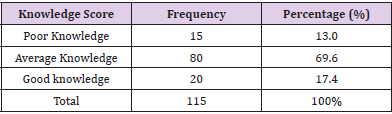
The results shown in the same table show that 37% of the
respondents fall in the group with low knowledge, 37.7% of them
fall in the category with medium knowledge and that 25.3% of them
fall into the category with high knowledge. These results indicate
that 74.7% of the respondents were of low and medium knowledge
of the information items for small productive projects and the
most important activities provided by the Social Fund, which may
indicate the need to guide them with programs aimed at increasing
their knowledge of these items in order to be able to apply this
knowledge Thus obtaining a high income and high income that will
achieve a stable life for them, also the existence of an educational
knowledge need for them means that there is a wide scope for
indicative activity through the Social Fund for Development to work
to address the deficiencies in the knowledge of the researchers and
their awareness, and amend their knowledge structure in relation
to the activities of small production projects that have shown The
study indicates that the knowledge of the respondents was low and
medium, and this requires planners, implementers of extension
programs and employees of the Social Fund for Development to
take this into account when planning guidance programs aimed
at familiarizing the respondents with knowledge and information
about small productive projects in the study area in Yemen.
To get acquainted with the degree of knowledge of the
respondents for each item of information for items related to small
productive projects and the most important activities provided
by the Social Fund, the average scores for this knowledge were
calculated for each item of the studied information, where the
averages of the degrees of their knowledge of this information were
limited to 0.4 degrees as a minimum by 1.95 %, And a maximum
score of 100% by 100%, and this confirms what the results indicate
from the actual average height above the theoretical average of
the degree of knowledge where the theoretical average is limited
to one degree between a minimum of two and a maximum of two
degrees while the overall average of the levels of the respondents’
knowledge of the project information items was Small productivity
is 1.10 degrees, at 54.86%. The information items for small
productive projects and the most important activities provided
by the Social Fund in terms of averages of degrees of female
researchers’ knowledge have been divided into three categories as
shown in Table 2, namely:
A. Low knowledge (less than 0.69 degrees)
B. Moderate knowledge (0.69 - less than 1.34 degrees)
C. Knowledge is high (1.34 degrees or more)
It was found that 24.2% of the information items on small
productive projects and activities provided by the Social Fund were
of low knowledge, while it was found that 39.4% of information
items on small production projects and activities provided by the
Social Fund were of medium knowledge, while 36.4% of Items of
information for small productive projects and the most important
activities provided by the Social Fund. It was found that 24.2% of
the information items on small productive projects and activities
provided by the Social Fund were of low knowledge, while it
was found that 39.4% of information items on small production
projects and activities provided by the Social Fund were of
medium knowledge, while 36.4% of Items of information for small
productive projects and the most important activities provided
by the Social Fund. It was clear from Table 3 that the items of
information for small production projects and the most important
activities provided by the Social Fund for Development for which
the average levels of knowledge of the respondents were low are:
a project to provide the requirements of agricultural production,
and the average degree of knowledge of the researchers for this
item was 0.51 degrees by 25 32%, and the item on a project to
produce seedlings and the establishment of nurseries for fruit and
ornamental trees and coffee 0.31 degrees by 15.26%, as well as
knowledge about the item on government banks, and the average
degree of knowledge of the researchers for this item was 0.42
degrees by 20.78%, while none of the respondents were known The item on commercial banks, the average level of knowledge of
respondents for the training of beneficiaries item was 0.42 degrees
by 20.78%, the item for providing technical assistance to the small
project 0.42 degrees by 20.78%, the item for wholesalers is 0.04
degrees by 1.95%, and the item for wholesale markets 0.04 1.95%
score.
It has also been found that the most important items of
information for small productive projects and the most important
activities provided by the Social Fund for Development, for which
the average levels of knowledge of the subjects were average: the
item for the project with a loan amount of between 300 thousand to
one million Yemeni riyals (a small project), and it was The average
knowledge of the respondents for this item is 1.17 degrees with a
rate of 58.44%, and the item for the project that has a loan amount of
between 100 thousand to 200 thousand Yemeni riyals is considered
a very small project, and the average degree of knowledge of the
researchers has 0.82 by 40.91%, as well as the item for the fattening
project Cattle to provide red meat 1.27 degrees, 63.64%, and for
a honey production project, the average level of knowledge of
the respondents for this item was 1.18 degrees, by 59.09%, and
the average degree of knowledge of the respondents for an item
representing an increase in livestock products of all kinds was 0.86
degrees, with percentage of83%, and the item For the provision of
new job opportunities, 0.86 degrees, with a percentage of 143%, and
the item for encouraging investment in various fields (agricultural,
craftsmanship) 0.92 degrees, by 46.10%, and the item for achieving
food and social security, 0.82 degrees, bin The percentage of 40.91%,
the item on contributing to the employment of unemployed hands
is 1.17 degrees at 58.44%, the item on providing soft loans is 0.77
degrees at 38.31%, the item on exhibitions held by the marketing
financing agencies is 0.92 degrees or 46.10%, and the item on
local markets was average The degree of the female respondents
was 0.73, or 36.36%, and also the item for the village markets. The
average degree of female respondents was 1.17, or 58.44%.
It turned out that the information items for small productive
projects and the most important activities provided by the Social
Fund for Development, for which the average levels of knowledge of
the respondents were high are: The item for the project to provide
milk for the provision of milk, and the average degree of knowledge
of the subjects for this item was 1.65 degrees by 82.47%, as well
as the item For the project for poultry raising, and the average
degree of knowledge of the researchers for this item was 2 degrees
by 100%, and also the item for the food industries project, and
the average degree of knowledge of the subjects for this item was
2 degrees by 100%, and the item for a handicraft project such as
(stitching, sewing, embroidery , Cover and engraving) The average
degree of the respondents was 2 degrees by 100%, and also the
item for increasing the products of all kinds (sewing, embroidery,
sewing, etc.), and the average degree of the respondents’ knowledge
was 1.58 degrees by 79.22%, and for an item that contributes to
improving family assets, the average degree was The respondents
‘knowledge of this item is 1.65 degrees, at a rate of 82.47%, and the
average degree of female respondents’ knowledge of an item that
has been able to acquire new knowledge and expertise for project
management is 2 points at 100%, and the item for achieving life a
Preferred from 1.69 degrees by 84.42%, the item for the Social Fund
for Development 1.47 degrees by 73.70%, the item for microfinance
programs and institutions 1.69 degrees by 84.42%, and the special
item to deepen awareness among women of the importance of
establishing, owning and managing small projects as a choice for
the future 1.69 degrees by 84.42 %, The item on knowledge of
marketing products 2 degree 100%.
The previous results indicate that there is a knowledge
gap and a strong need among rural women in the field of small
productive projects, which requires planners and implementers of
extension programs and the Social Fund for Development to take
into account what the results of the study showed when planning
and implementing extension programs so that rural women can
succeed in the field of projects The small productivity it implements
and raises its standard of living.
The Relationship Between the Degree of the Female
Respondents’
The relationship between the degree of the female respondents’
knowledge of information items related to small productive projects
and the most important activities provided by the Social Fund for
Development with the studied independent variables. This part
is concerned with presenting the most important findings of the
research, which relate to testing the correlation between the degree
of the researchers’ knowledge of information on small productive
projects and the independent variables under study, namely: age,
degree of education, degree of official social participation, degree
of informal social participation, degree of openness to The outside
world, the degree of exposure to information sources and the mass
media, the degree of participation in the activities provided by
the Social Fund, the degree of direction towards small productive
projects, the degree of opinion of the researchers regarding the
educational and social effects that can occur as a result of the
application of small productive projects, the degree to which
educational and social returns are achieved for projects Small
productivity from the perspective of rural women.
To study this relationship, the first statistical hypothesis was
formulated that “there is no significant relationship between
the degree of the female respondents’ knowledge of information
items related to small productive projects and the most important
activities provided by the Social Fund for Development and the
previously mentioned independent variables. “To test the validity
of this hypothesis, Pearson’s simple correlation coefficient was
used. Table 4 data show a significant relationship at level 0.01 of
the level of informal social participation, the degree of exposure to
information sources and mass media, the degree of participation in
social fund activities, the degree of direction towards small projects,
and the degree of He saw the subjects regarding educational and
social effects that could occur as a result of implementing small
productive projects.
Whereas, they were not related to the other studied independent
variables, which are: age, degree of education, degree of formal
social participation, degree of openness to the outside world,
and degree of educational and social returns to small productive
projects from the point of view of rural women.
Based on this result, the statistical assumption can be partially
rejected and the alternative hypothesis accepted, and there is a
moral relationship between both the degree of informal social
participation, the degree of exposure to information sources and
the mass media, the degree of participation in social fund activities,
the degree of direction towards small projects, and the degree
of opinion of the respondents with It relates to the educational
and social effects that can occur as a result of the application of
small productive projects and between the degree of the female
respondents’ knowledge of the information items of the small
productive projects and the most important activities provided
by the Social Fund for Development, and this may be due to the
greater the degree of participation of the informal social research
and the degree of its exposure to sources of information and media
The masses, the degree of their participation in the activities of the
social fund, the degree of their direction towards small projects,
and the degree of their opinion regarding educational and social
effects that can occur as a result of implementing small productive
projects. The more they become aware of the importance of
small production projects and the greater their desire to obtain
knowledge and innovations in this field, especially the research
Young women are young And those who are expected to deal in
the field of small projects for a longer period than the elderly, and
therefore they become more eager to increase their knowledge in
this field.
Determining the Percentages of the Contribution of the
Variables
Determining the percentages of the contribution of the
variables that have a moral correlation with the degree of the female
respondents’ knowledge of the information items related to small
productive projects and the most important activities provided by
the Social Fund and to make sure of the previous results indicating
that there is a significant relationship between the degree of the
female researchers’ knowledge of the information items for small
productive projects and the most important activities provided by
the Social Fund for Development and between the independent
variables with a moral relationship with them and make them more
accurate in light of the dynamics of other variables, and by taking
the impact of these variables into consideration, The following
statistical hypothesis has been put in place that “each of the
independent variables with significant correlations with the degree
of knowledge of rural women does not contribute to information
items related to small productive projects and the most important
activities provided by the Social Fund in the overall explanation of
the variance and these variables are: the degree of informal social
participation, and the degree of exposure For sources of information
and mass media, the degree of participation in the activities of the
Social Fund, the degree of direction towards small projects, and the
degree of opinion of the respondents regarding educational and
social effects that may occur as a result of the application of small
productive projects.
To test the validity of this hypothesis and to estimate the
contribution rates of each of the independent variables with a
moral relationship with the degree of the researchers’ knowledge of the
information items for small productive projects and the most
important activities provided by the Social Fund for Development in
the overall explanation of variance, use the model of correlative and
regression of the progressive multiple regression, which proved that
there are nine Independent variables with a moral relationship in
the interpretation of all the moral variables to which the conditions
apply are: the degree of participation in social fund activities, the
degree of direction towards small projects, the degree of informal
social participation, the degree of exposure to information sources
and the mass media, and from the results of the analysis shown in
Table 5 It was clear that the percentage of the contribution of these
variables to the explanation of the total variance of the degree of
the respondents’ knowledge of information items related to small
projects was 99.4%, of which 70.1% was attributed to the degree
of participation in the activities of the social fund, and 17.9% to the
degree of trend towards small projects, and 10. 2% to informal social
participation, and 1.2% to the degree of exposure to information
sources and the mass media.
The positive relationship between the degree of respondents’
knowledge of information items related to small productive
projects and the most important activities provided by the Social
Fund for Development, can be explained by the greater the degree
of the respondent’s participation in the activities of the social fund,
the degree of its direction towards small projects, the degree of
its informal social participation, and the degree of its exposure
to information sources and the media The greater the public’s
awareness of the importance of small productive projects and the
greater their desire to obtain knowledge and innovations in this
field, especially young female researchers who are expected to deal
in the field of small projects for a period longer than the elderly and
therefore they become more eager to increase their knowledge in
this field. Among the previous results of the relationship of some of
the independent variables under study related to the level of female
researchers’ knowledge of information items related to small
productive projects and the most important activities provided by
the Social Fund for Development, it is clear that the variables of the
degree of participation in the activities of the social fund, the degree
of trend towards small projects, the degree of informal social
participation, and the degree of exposure Information sources and
the mass media are among the best variables studied as facilities
to know the respondents with information items related to small
productive projects and the most important activities provided
by the Social Fund for Development, which requires planners and
implementers of extension programs related to increasing the
knowledge of the female researchers in the field of small projects
to pay attention to these variables in particular and that contribute
to increasing Knowledge of research related to small productive
projects and the most important activities provided by the Social
Fund for Development, and the need for future studies to be aware
of the other variables not covered in the study.
The Most Important Problems Facing
The most important problems facing female respondents who
benefit from loans from the Social Fund for Development and their
proposals to solve them: The results of the study also showed the
existence of problems facing female researchers in the field of
small productive projects. The most important of these problems
was the scarcity of training programs appropriate to the nature
of the project (86.4%), the weak ability to pay the loan amount in
the specified dates (79.2%), the inability to market or export the
product (77.9%), lack of marketing experience for the beneficiaries
(72.7%), as shown in Table 6. The respondents also pointed to
some proposals to overcome such problems, the most important
of which is providing a database on investment projects, reducing
procedures for disbursing the loan, providing transportation
through cooperative marketing societies, and holding training
courses for borrowers during their projects as shown in Table 7.
Based on the results of the research, the application benefits
can be summarized as follows: In light of the results shown by a
decrease in the knowledge of the respondents, as these results
indicate that 74.7% of the respondents were of low and medium
knowledge of the information items on small productive projects
and the most important activities provided by the Social Fund,
the research draws the attention of planners and implementers of
extension programs and fund programs The social development
focus on increasing activities and indicative efforts to educate the
respondents about the knowledge of small projects so that this
knowledge can be applied and thus obtain a high income and return
that provides the rural women with a stable life. The need for
planners and implementers of future extension programs aimed at
increasing rural women’s knowledge of small productive projects
and the most important activities provided by the Social Fund to
be concerned with the following variables: degree of participation
in social fund activities, degree of trend towards small projects,
degree of informal social participation, and degree of exposure to
information sources The mass media, as having a high impact on
the knowledge of rural women, are predicting the extent of this
change in the future. The necessity that future research related
to the behavior of rural women in the field of small productive
projects be concerned with studying the personal and situational
variables that were not included in the research, and that they may
have a significant contribution to the overall explanatory variation
of the change in rural knowledge in the study area and other similar
areas.
For more Articles on : https://biomedres01.blogspot.com/