Thursday, November 27, 2025

Nano-Bio Applications in Photo-Bio Processes and Photochemical Devices


Nano-Bio Applications in Photo-Bio Processes and Photochemical Devices

Introduction

It is expected that photovoltaic processes or devices will have a strong impact on both wastewater treatment and air purification processes, as well as energy storage devices. Where mechanical or chemical methods can be used in the application of effective filtration methods. One class of filtration methods is based on the use of membranes with appropriate pore sizes, allowing the liquid to be compressed across the membrane. Nanoporous membranes are suitable for mechanical filtration with micropores of less than 10 nm (“nanofiltration”) which may consist of membrane nanotubes. Nanofiltration is mainly used in the process of removing ions or separating different liquids. On a larger scale, membrane filtration methods are called nanofiltration, and they work between sizes of 10 to 100 nanometers [1-3]. Perhaps one of the important areas of nanofiltration applications is medical purposes, including the dialysis process. Magnetic nanoparticles provide a reliable and efficient way to remove heavy metal pollutants from wastewater by utilizing magnetic separation methods. Nanoparticles increase the efficiency of the ability to absorb pollutants, in addition, compared to traditional filtration and filtration methods, they are inexpensive. Some of the devices used to treat water using nanotechnology are now presented on the market, but more of them are in the process of being developed and developed. A recent study has demonstrated that low-cost nanomembrane separation methods are effective in producing potable water [4-6].

Electro-Optical Devices

The fabrication of devices that take advantage of the properties of low-dimensional elements such as nanoparticles is a promising field due to the possibility of applying a number of electrophysical, optical and magnetic properties to change the sizes of nanoparticles, which can be controlled during the manufacturing process. For example, in the case of nanopolymers, we can use the properties of turbulent, unstable systems. Here, some of the recent developments in the field of nanopolymers and some of their applications were reviewed. Although there are not enough opportunities for use in this field, there are many limitations as well. For example, the release of drugs using nanofibers cannot be controlled independently and often the mode is an explosive release, when a linear release is required. Hence, let us consider the future features in that field and study them. There is also the possibility of constructing ordered arrays of nanoparticles in a polymer matrix. A range of possibilities are also available for fabricating nanocircuit boards [7-9]. There is even a very attractive way to use nano polymers in neutral network applications. Also promising areas for development are optoelectronics and optical computing. The nature of single-band highly permeable metalcontaining nanoparticles with superior paramagnetic behavior can be used to fabricate an optical-magnetic storage medium.

The crystal defects also affect the electrical properties of the nanotube in the electronic device. A common finding is a reduced ability to conduction across the defective area of the tube. A deformation of the Arechia-shaped nanotube (which has the ability to conduct electricity) may cause the surrounding region to become semiconducting rather than electrically conducting, and the single-atom gaps have magnetic properties [10-13]. The crystal deformations clearly and strongly affect the thermal properties of the tube. Such distortions may lead to phonon scattering, which in turn increases the relaxation rate of these phonons, thereby reducing the mean free path and reducing the thermal conductivity of carbon nanotube structures. Simulations of phonon transmission indicate that alternative defects such as nitrogen or boron primarily scatter high-frequency optical phonons. However, large distortions such as Stone Wells distortions cause the phonon to scatter over a wide range of frequencies, resulting in an even greater reduction in thermal conductivity [14-17].

Nano-Parts in Electrical Instruments

The non-linear response of smart polymers is what makes them unique and efficient in the field of manufacturing sensitive and electronically efficient nanoparticles in optical devices. A large change in structure and properties can be brought about by a very small stimulus. Once this change occurs, there is no further change, which means that a predictable all-or-nothing response occurs, with perfect uniformity throughout the polymer. Smart polymers may alter the deformation, adhesion, or water-retaining properties, due to small changes in pH, ionic strength, temperature, or other stimuli. Another factor in the effectiveness of smart polymers lies in the inherent nature of polymers in general. The strength of each molecule’s response to changes in stimuli is the composite of changes in individual monomer units, which alone would be weak. However, these weak responses, multiplied hundreds or thousands of times, create significant power to drive biological processes [18-20]. Electronic single-walled nanotubes represent an important variety of carbon nanotubes because they exhibit electrical properties that are not present in the multi-walled nanotube variants. In particular, their bandgap ranges from zero to about 2 eV, and their electrical conductivity shows their metallic or semiconducting properties, while multi-walled carbon nanotubes are zero-gap metals. This makes single-band carbon nanotubes a good candidate for miniaturizing electrons beyond the precise electromechanical scale currently used for electrons. Perhaps the most basic building block of these systems is the electric wire, which makes single-walled carbon nanotubes (SCNTs) an excellent conductor. One of the useful applications of single-walled nanotubes was the development of the first transistors affected by the intermolecular field [21-23].

The Practical Application of Nanotechnology in Optical- Electronic Devices

Many of the electronic applications of carbon nanotubes depend precisely on methods for the production of both semiconductor or optionally metallic carbon nanotubes, preferably having a certain hydrophobicity. Noting that many methods for separating SCTs are known, but most of them are still not suitable for largescale technical processes. The most efficient method is based on a density gradient ultracentrifugation process, which separates surface-coiled nanotubes by a small difference in their density. This difference in density often translates into a difference in the diameters of the nanotubes and their (semi)conducting properties. Another method of separation is the use of a sequence of freezing, thawing, and compression of single-walled carbon nanotubes (SCNTs), which are an integral part of the agarose gel [24-27]. This process yields a solution containing 70% SCNTs and leaves a gel containing 95% SCNTs semiconductor. The dilute solution separated by this method shows many colours. Furthermore, carbon nanotubes can be separated using column chromatography. We note that the output we get is in the form of 95% of the semiconductor single-walled carbon nanotubes and 90% of the metal-type single-walled carbon nanotubes. In addition to the separation of metallic and semiconductor single-walled carbon nanotubes, it is also possible to classify single-walled carbon nanotubes based on length, diameter, and cyclist.

biomedres-openaccess-journal-bjstr

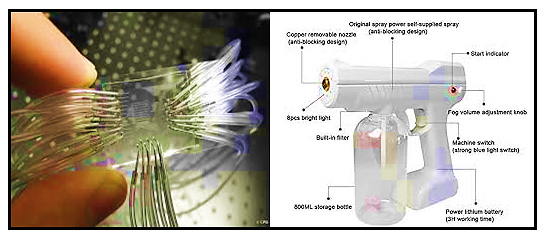
Figure 1: Nano-Wireless for wave sensor.

The highest grading of the highest solution length [28-30], with a length variation of less than 10%, was achieved by size exclusion chromatography of scattered carbon nanotubes in the DNA. The SWCNT diameter separation was accomplished by density-gradient ultracentrifugation through the use of SWCNTs scattered in surfaceactivity factors, and by ion-exchange chromatography of SWCNTs Single-walled nucleic acid was also purified by ion exchange chromatography between single-walled carbon nanotubes and DNA. ion-exchange chromatography (IEC) for DNA-SWNT: Special short DNA oligomers can be used to isolate single-walled carbon nanotube ligands. Hence, 12 s.c. nanotubes have been isolated so far with purities ranging from 70% between (8.3) and (9.5) SWCNTs to 90% for SWCNTs (6.5), (7.5) and (10.5). Successful efforts have been made to integrate these purified nanotubes into devices such as the field transistor, for example. The development and development of selective growth of semiconductor or metallic carbon nanotubes is one alternative to the separation process. A new chemical vapor deposition (CVD) recipe was recently announced that includes a mixture of ethanol and methanol vapors as well as quartz substrates [31-45], all producing horizontally aligned bundles of 95-98% semiconductor carbon nanotubes (Figure 1).

Conclusion

The degree of efficiency of the internal combustion engine has reached between 30-40% at present. However, nanotechnology may improve the combustion rate by designing special catalysts with greater surface area. In 2005, scientists at the University of Toronto developed a sprayable nanoparticle material that, when sprayed onto a surface, instantly transforms it into a solar collector. Nanotubes often grow on nanoparticles of magnetized metals (iron and cobalt), which facilitate the production of electronic devices (based on spin). As the current tuning in such single tube nanotubes is achieved through the field transistor by magnetic field.


For more Articles on: https://biomedres01.blogspot.com/

Tuesday, November 25, 2025

Orofacial and Digit Force Dynamics in Neurotypical Children


Orofacial and Digit Force Dynamics in Neurotypical Children

Introduction

Biomechanical analyses of active force dynamics can be used for clinical assessment of muscle force control of single motor subsystems, including force control in the tongue, lips, jaw, and digits Barlow, et al. [1-3]. Custom designed force transducers with real time visuomotor tracking software can be used to measure muscle forces in individuals with neuromotor disorders such as Parkinson’s disease and cerebral palsy. The resulting data can be used to predict motor speech impairments and develop corresponding rehabilitative measures Barlow, et al. [1,4]. Furthermore, there is evidence that the sensitivity of strain gage force transducers can be used to precisely measure patterns of muscle force impairment that were not evident from a neurological evaluation, as well as to track changes in orofacial and limb muscle function across the lifespan during periods of recovery and assess the efficacy of motor rehabilitation Barlow, et al. [5-8].

This aim of the present study was to establish normative data regarding fine muscle force dynamics in the lower lip (lower lip compression) and thumb-index finger (pinch grip) of neurotypical children at 0.25, 0.50, 1.00, and 2.00 N (Newtons), which represent less than 20% of a maximum contractile force for these muscle systems typically used in skilled movements. Independent variables examined included target force level, muscle group, sex, and age. Dependent measures included maximum force, reaction time, maximum rate of force change, standard deviation, hold phase criterion percentage, mean force, and peak force. Hypotheses were formulated regarding the dependent variables. A sex effect was anticipated for maximum force measurements. It was expected that an age effect would be present for maximum forces based on increasing muscle mass with age, as well as in hold phase criterion percentage based on fine motor control development. Similarly, it was predicted that the standard deviation of active force would decrease with age due to increasing fine motor control with maturation. Based on results present in adults, a sex effect is not expected for reaction time and a positive relationship was expected between target force and maximum rate of force change Barlow, et al. [9].

Materials and Methods

Participants

Twenty-nine (29) neurotypical children (16F/13M, 9.82 [SD = 1.34] years old) were recruited for the study. These children were stratified into two age groups, including a younger age group (N=16, 7.6-9.9 years, 8.81 [SD = 0.72]) and an older age group (N=13, 10- 12.3 years, 11.07 [SD = 0.77]). Child assent and written informed parent/guardian consent were recorded following University of Nebraska Institutional Review Board approval. Inclusion criteria: no report of injury or illness affecting the nervous system. Exclusion criteria: traumatic injury to the hands or face resulting in sensorimotor impairment, and traumatic brain injury or neurologic disease resulting in sensorimotor impairment to the orofacial or hand movements.

Instrumentation

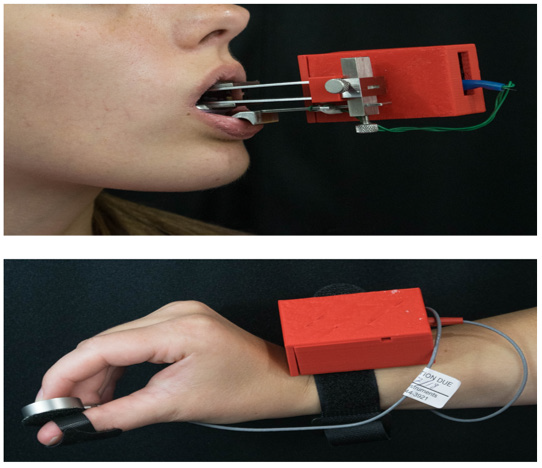
Research participants were assessed using the ForceWIN10 system, a biomechanics visuomotor tracking application that runs on a DELL XPS laptop PC (MS WIN10 x64) with a 15” HD touchscreen display to measure muscle force output for both diagnostic and therapeutic purposes Greenwood, et al. [8]. ForceWIN10 measures voluntary fine force muscle dynamics in both the lower face (tongue, lips, and jaw) and the hand (thumb-index finger pinch). The ForceWIN10 connects to our custom designed Bluetooth low-energy (BLE) strain gage sensors to measure active forces generated by the participant. There are separate transducers used to sample active force dynamics for orofacial and thumb-index finger muscle systems (Figure 1). The transducer for the thumbindex finger pinch is composed of a Cooper Instruments load cell (Model LKCP 410-25 lb; Warrenton, VA, USA) and a Li-ion battery. For the finger transducer, the load cell sensitivity is 1.17mV/V at 100% load (111N). The orofacial transducer is composed of a stainless steel jaw cantilever, lip cantilever, and titanium maxillary and mandibular dental trays. For the orofacial transducer, the lip cantilever sensitivity is 2.03 mV/V at 100% load (40N) Greenwood, et al. [8]. In this study, a pediatric-sized jaw tray set was attached to the transducer apparatus to measure muscle force output of the lower lip. A dental impression mold was created for both the maxillary and mandibular dental trays, so that users could bite down on the trays comfortably to keep the transducer stable in the mouth while testing the muscle groups of interest. The dental molds were made using a polyvinylsiloxane impression material (Kerr Extrude XP, Kerr Corporation, Romulus, MI, USA) Barlow, et al. [3].

biomedres-openaccess-journal-bjstr

Figure 1: Wireless Bluetooth orofacial and finger pinch force transducers.

Protocol

Participants completed a series of visuomotor isometric ‘rampand- hold’ muscle contractions to target forces of 0.25, 0.5, 1, and 2 N in a randomized block design while seated in front of a laptop display. Participants were prompted to contract their muscles ‘rapidly and accurately’ and hold the contraction for approximately 5 seconds before relaxing. Ten ramp-and-hold contractions were completed at each force level for a given structure. For each structure, following the ramp-and-hold trials, participants were asked to contract their muscles maximally for 2 seconds and subsequently relax (3 repetitions) to collect MVCF data. The protocol consisted of 43 trials per structure (lower lip, right thumbfinger pinch, and left thumb-finger pinch). Test order for structure was also randomized for all participants.

Force Signal Processing

A low-pass filter was applied for each ‘ramp-and-hold’ contraction (finite impulse response (FIR) filter at 40 Hz, with high stopband and flat passband attenuation). The terminal holdphase was divided into T1 (2.0-3.4s) and T2 (3.4-4.8s). Hold-phase criterion percentage was calculated using the data points in T1 or T2 that were in the range of ±5 % of the target force measure. Hold phase mean force was calculated for T1 and T2. Baseline force was calculated by finding the mean during the first 100ms of a force trial. The first derivative maxima (dF/dtmax) were used to compute the maximum rate of force change (N/s). During the recruitment phase, peak force was computed by finding the maximum force in the first 2 seconds of a trial. Lastly, reaction time was calculated by linearly interpolating a value when the force was γ standard deviations (SD) above the baseline.

Statistical Analysis

Linear mixed modeling was conducted for each dependent variable [peak force (N), dF/dt (N/s), reaction time (seconds), mean force for T1 and T2 (N), standard deviation for T1 and T2 (N), holdphase criterion for T1 and T2 (proportion within +/- 5% target), and maximum force (N)] to estimate overall difference between muscle groups (right thumb-index finger, left thumb-index finger, lower lip; i.e., muscle effect), change in the dependent variable as a linear or polynomial function of target force (0.25, 0.5, 1, and 2 N; i.e., force effect), and muscle group difference in this change (i.e., muscle-by-force interaction effect). The models accounted for participants’ sex and nesting of repeated measurements within participants, thereby providing unbiased estimates of the model effects. When the muscle and/or muscle-by-force interaction effect was significant, adjusted means were pairwise compared at a Bonferroni corrected alpha level while controlling for Type I error at the nominal level. A proper error covariance structure was determined for each dependent variable based on model fit (i.e., adjusted Akaike Information Criterion, Bayesian Information Criterion). All analyses were conducted using SAS 9.4 SAS Institute [10] and statistical significance was determined at .05 alSignificant improvements in the performance of active force dynamics were apparent for boys and girls between the younger and older age

Results

biomedres-openaccess-journal-bjstr

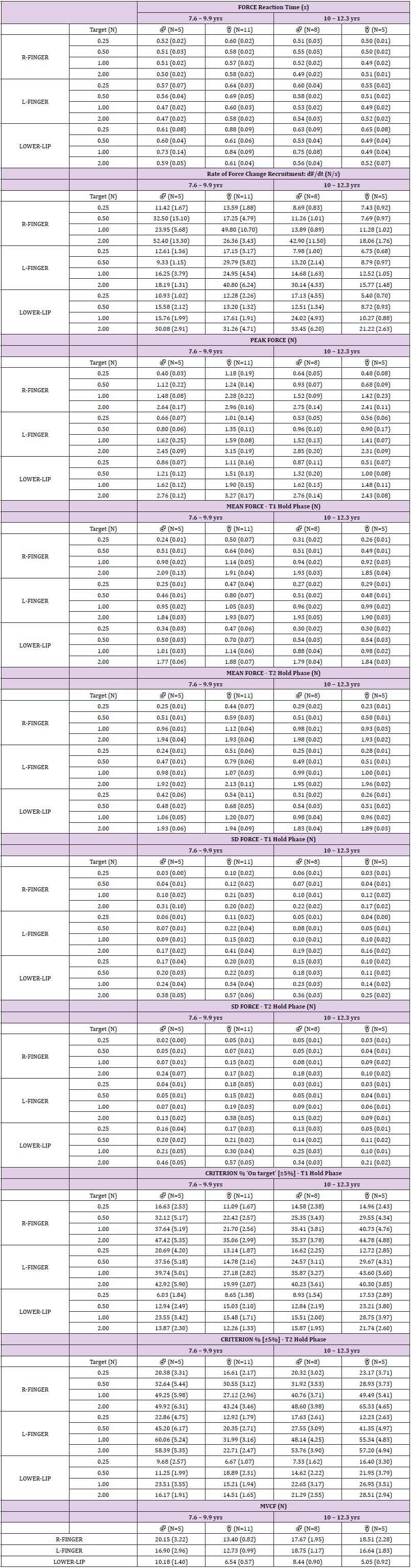
Table 1: Descriptive summary statistics for ‘ramp-and-hold’ isometric force dynamics in children stratified by age group among selected dependent measures [ ± SEM].

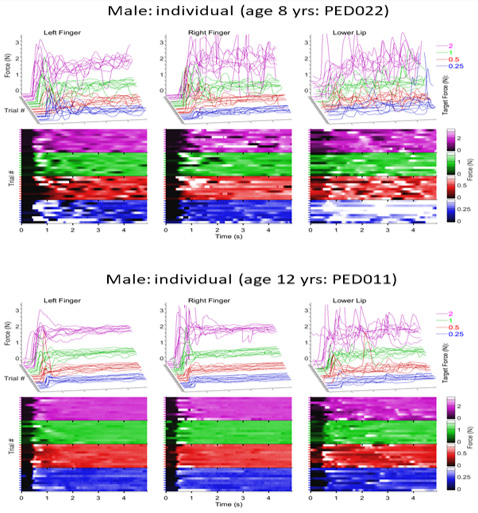
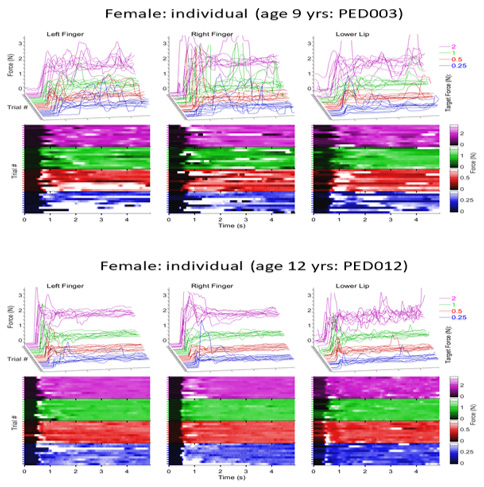
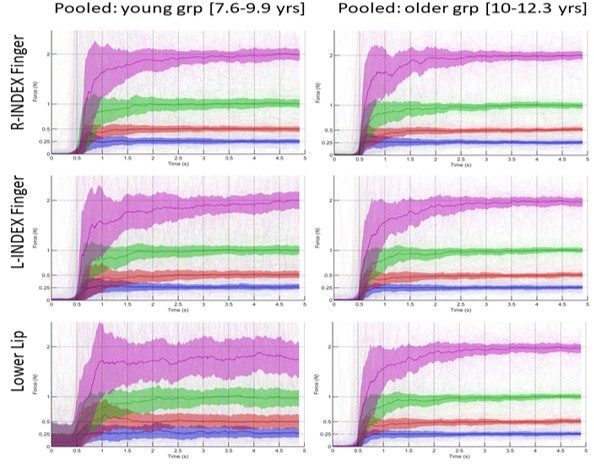
Significant improvements in the performance of active force dynamics were apparent for boys and girls between the younger and older age cohorts, and between the face and digits. An example of individual ramp-and-hold isometric force trials during the ForceWIN10 visuomotor tracking paradigm for the left finger, right finger, and lower lip are shown for two males, at age 8 and 12 years in Figure 2. Waterfall displays are shown at each of the four target force levels for each muscle system. A performance advantage is evident for the left and right thumb-index finger pinch force productions compared to the lower lip during compression. A notable improvement can also be seen between the 8 year-old and 12 year-old males performing similar tasks. Corresponding force heat maps are shown below each of the waterfall displays to highlight striking differences in force variability, baseline force control, and reaction time consistency. Similar trends are evident for girls as well as shown in Figure 3 which contrasts the isometric ramp-andhold force trials as produced by a 9 year-old and a 12 year-old child. The force heat maps also reveal greater variability in achieving the four discrete level target force productions for the three muscle systems. An analysis of the pooled results (N=29 children) is shown in Figure 4 to contrast target force accuracy (thick line at each force is the median) and variability (shaded regions correspond to the median of the standard deviation) of composite trials for each of the three muscle systems among younger and older child groups (left and right plot columns).Overall, the older children (10.0-12.3 years of age) manifest improved accuracy in force control with reduced variability compared to their younger cohort. Descriptive summary statistics are shown in Table 1 by dependent variable.

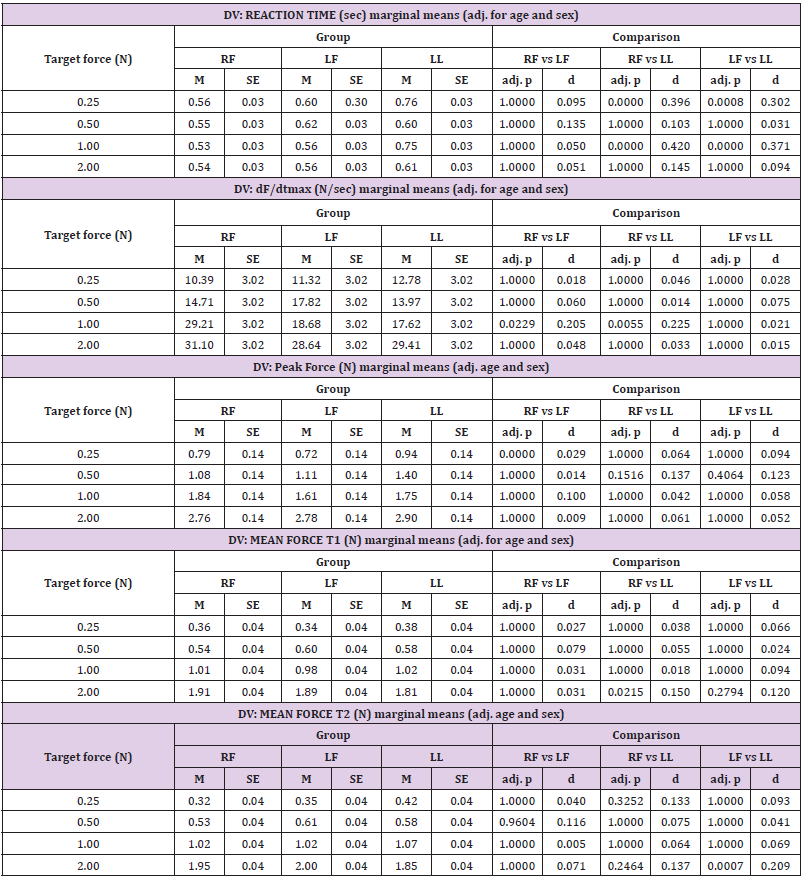
Estimated marginal means for force reaction time ranged from 535 to 760 milliseconds across all conditions and factors (Table 2a). The force reaction time (RT) variable showed significant main effects for age group (p < 0.01), force target (p < 0.01), and muscle group (p < 0.0001). Estimated marginal means for combined digits was 564.6 ms compared to 679.3 ms for the lower lip across the four target levels. The lower lip manifested significantly longer RTs (by 50 to 70 ms) compared to the right and left hand digits during pinch force recruitment. Sex was not significant (p = 0.712). The dF/ dtmax force variable, a measure of active force recruitment, showed significant main effects as a function of target force (p < 0.0001) and age group (p < 0.05) (Table 2a). The estimated marginal means of the force derivative ranged from 10.39 to 31.10 N/sec. The estimated marginal means for dF/dtmax increased as a function of target force (0.25N target = -16.63N/s, 0.5N target = -15.44N/s, 1.0N target = -11.79N/s, and 2.0N target = 0.0N/s (reference)), respectively. The factors muscle group (p = 0.1174) and sex (p = 0.4923) were not significant. Among the neurotypical children in the present cohort, the tendency was to overshoot the visuomotor target during the ‘rapid-and-accurate’ force recruitment task. The magnitude of force overshoot (percent increase re: target force), was greatest at the 0.25N target where estimated marginal means for the right index-thumb, left index-thumb, and lower lip were 0.53N, 0.46N, and 0.68N greater than the target force, respectively.

biomedres-openaccess-journal-bjstr

Figure 2: Upper panel (row 1) shows individual ramp-and–hold force trials sampled from an 8-year-old male at 0.25 [blue], 0.5 [red], 1.0 [green], and 2.0 N [magenta] target force levels in waterfall display format for the left finger, right finger, and lower lip. Upper panel (row 2) shows the distribution of individual force trials including onsets as a function of structure and target as a heat map (absolute force amplitude is coded by a color heat scale). Bottom panel shows similar individual isometric waveforms and heat map sampled from a 12-year-old male.

biomedres-openaccess-journal-bjstr

Figure 3: Upper panel (row 1) shows individual ramp-and–hold force trials sampled from an 9- year-old female at 0.25 [blue], 0.5 [red], 1.0 [green], and 2.0 N [magenta] target force levels in waterfall display format for the left finger, right finger, and lower lip. Upper panel (row 2) shows the distribution of individual force trials including onsets as a function of structure and target as a heat map (absolute force amplitude is coded by a color heat scale). Bottom panel shows similar individual isometric waveforms and heat map sampled from a 12-year-old female.

biomedres-openaccess-journal-bjstr

Figure 4: Pooled right thumb-index finger (row 1), left thumb-index finger (row 2), and lower lip compression (row 3) trials at 0.25 [blue], 0.5 [red], 1.0 [green], and 2.0 N [magenta] target force levels among boys and girls [age 7.6-9.9 years [N=16], and age 10.0-12.3 years [N=13]. The thick colored line at each target force level represents the median, and shaded regions correspond to median standard deviation for composite force trials.

A clear finger advantage was found at the 0.25N target level with peak forces ranging from 186.9% to 214.5% of the intended target, whereas the lower lip peak force was 274.6% of target. The degree of overshoot (expressed as a percentage of the target) decreased with increasing target force levels such that the marginal means resulted in peak forces for the right and left digits that were 37.8% and 38.9% greater than the intended 2N target, whereas peak force for the lower lip exceeded the 2N target by 45%. In absolute terms, the fingers showed the clear advantage with 0.46N to 0.53N of overshoot at 0.25N target, whereas the lower lip yielded the greatest error at 0.69N of overshoot at this target. Peak isometric force overshoot increased at each higher target force, culminating in the largest absolute force errors approaching 0.78N for the digits, and 0.90N for the lower lip at the 2N target force. For the LMM, the peak force dependent variable showed significant main effect as a function of muscle group (p = 0.001) and target force (p < 0.0001) (Table 2a). Age group was marginally significant (p = 0.0539). Sex was not significant (p = 0.617). Mean force during the T1 and T2 hold-phase periods showed a high degree of end-point accuracy in isometric force output, favoring the digits over the lower lip (Table 2a). The LMM revealed a significant interaction for force target by muscle group (T1 phase, p = 0.0013; T2 phase, p < 0.0001). Sex and age were not significant.

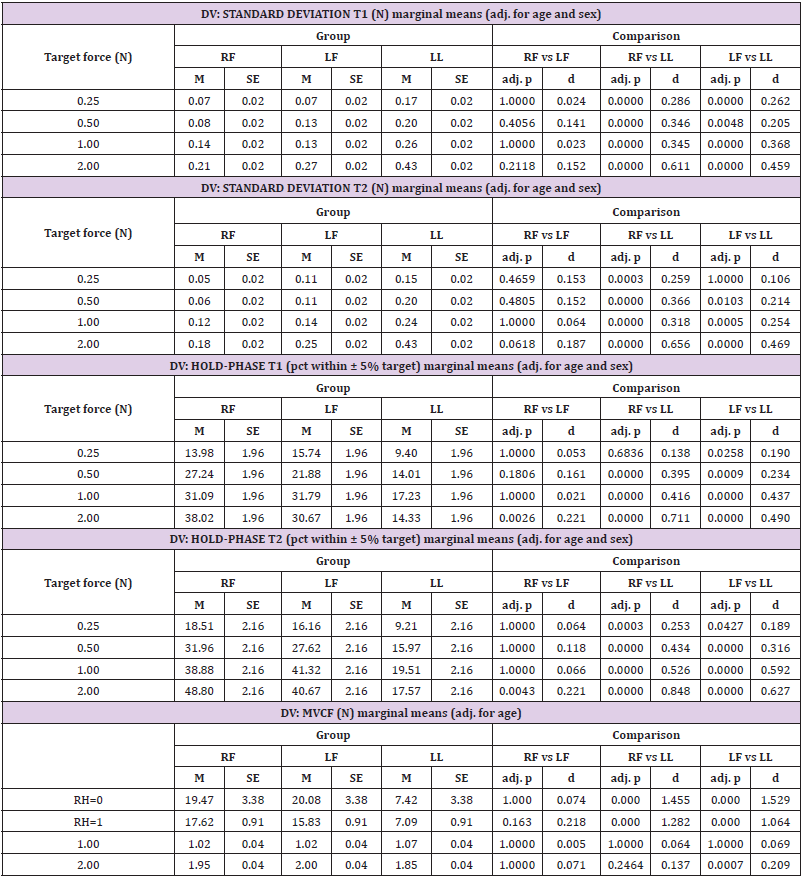
Isometric contraction stability, calculated as the standard deviation (SD) during the same T1 and T2 hold-phase periods showed a significant main effect as a linear function of the child’s age (SD T1, p < 0.01; SD T2, p <0.001). Sex was not significant (SD T1, p = 0.751; SD T2, p = 0.428). LMM for the SD of isometric force revealed a significant interaction between force target and muscle group during the T1 and T2 hold phases after controlling for child’s age and sex (T1 phase, F(6,3440) = 5.21, p < 0.0001; T2 phase, F(6,3440) = 5.92, p < 0.0001). Estimated marginal means for SD showed a significant advantage for the digits at each target force level compared to the lower lip (Table 2b). For example, the composite SD in isometric force output during the T1 period was 0.1233N for the right thumb-index finger, 0.1497N for the left thumb-index finger, and nearly double indicative of greater instability for the lower lip at 0.2659N. A similar pattern for SD in isometric force was found during the T2 period (SD=0.0995N for the right thumbindex finger; 0.1526N for the left thumb-index finger, and 0.2523N for the lower lip). Post-hoc pairwise comparisons confirmed this trend with lower lip isometric compression force SD significantly greater than the same measure for either the right- or left thumbindex finger pinch contractions at each of the four target forces (p < 0.0001, effects size (d) ranging from 0.205 to 0.611). The additional 1.4 seconds of afforded by the T2 period resulted in more stable isometric force output, especially for the dominant right handdigits and lower lip, with marginal means for SD reduced by 16.99 to 26.99% RF, and 1.25 to 12.72% for LL across the force targets 2N, 1N, 0.5N, and 0.25N, respectively.

biomedres-openaccess-journal-bjstr

Table 2a. Linear mixed modeling (LMM) by dependent variables.

biomedres-openaccess-journal-bjstr

Table 2b. Linear mixed modeling (LMM) by dependent variables.

The hold-phase criterion percentage achieved during both the T1 and T2 hold phase periods showed a linear significant main effect age (p = 0.004, and p = 0.0011, respectively). Sex was not a significant factor during T1 and T2 (p = 0.93, and p=0.97, respectively). Overall, the thumb-index fingers of either hand are significantly better at maintaining a target force criterion (within ±5% of target) compared to the lower lip. LMM for the criterion percentage of isometric force at target revealed a significant interaction between force target and muscle group during the T1 and T2 hold phases after controlling for child’s age and sex (T1 phase, F(6,3440) = 11.00, p < 0.0001; T2 phase, F(6,3440) = 13.29, p < 0.0001). Overall, the digits of the hand performed at approximately twice the efficiency of the lower lip in generating isometric force within the ±5% criterion at each of the four target levels. For example, the marginal means for criterion performance (within ±5% of target window) during the T1 phase were 13.98 and 15.74% for the right and left thumb-index finger digits at 0.25N target, whereas only 9.4% of the digitized lower lip isometric force record fell within the prescribed criterion target (Table 2b).

A similar pattern was found at the other target forces for the right- and left-hand, and lower lip (FT=0.5N: 27.24, 21.88, 14.10%; FT=1N: 31.09, 31.79, 17.23%; and FT=2N: 38.02, 30.67, and 14.33%, respectively). As isometric contractions advanced into the T2 phase, criterion performance improved even more favoring the digits of the right- and left hand compared to the lower lip (FT=0.25N: 18.51, 16.16, 9.21%; FT=0.5N: 31.96, 27.62, 15.97%; FT=1N: 38.88, 41.32, 19.51%; and FT=2N: 48.80, 40.67, 17.57%, respectively). Overall, criterion ‘on-target’ performance increased by 22.86% from the T1 to T2 hold phase. Post-hoc pairwise comparisons confirmed this trend with superior criterion level ‘ontarget’ performance exhibited by the thumb-index fingers of the hand compared to the lower lip at each force target (p < 0.0001, effects size (d) ranging from 0.316 to 0.848 among force targets 2N, 1N, and 0.5N; and p < 0.05, d = 0.189 to 0.253 at the 0.25N target force). The maximum voluntary compression force (MVCF) variable showed a significant main effect as a function of muscle group (p < 0.0001). Age (p = 0.18), sex (p = 0.09), and handedness (p = 0.50) were not significant factors. As shown in Table 2b, MVCF marginal means were approximately 2.26 to 2.66 times greater for the thumb-index pinch (15.83 to 20.08 N) compared to lower lip compression (7.09 to 7.42N) (p<0.0001, d = 1.064 to 1.529).

Discussion

Thumb-Index Finger Pinch Versus Lower Lip Compression

One of the themes that emerged from the project was the performance advantage of the fingers over the lower lip in terms of hold-phase variability and force recruitment. Overall, the lower lip showed greater hold-phase variability and a shallower slope for force recruitment to the initial peak. The lower lip showed slower reaction times and a lower MVCF when compared with the fingers. Gentil, et al. [11] studied fine force generation in the fingers and lips of adults, and found that the fingers demonstrated a higher degree of precision, hold-phase stability, and force control accuracy when compared with the lips Gentil, et al. [11].

Age Differences

Another of the emergent trends throughout the research was the different performance capabilities of the two age groups. Overall, the younger children manifest much more variance in their force trials, inconsistency in peaks during force recruitment, hold-phase isometric contraction stability, and a lesser degree of end-point accuracy at each target force level when compared with the older cohort. The older children also showed higher force recruitment rates to the initial peak and shorter reaction times than the younger children. This trend was consistent across muscle groups measured. Ager, et al. [12] found age to be a significant factor in pinch strength of children between ages 5 and 12 years, with strength (MVCF) increasing with age. Similarly, Mathiowetz, et al. [13] found that maximum pinch force increases with age in children between 6 and 19 years of age [14]. For the lower lip, Chigira, et al. [12] found that in typically developing young children, lip pressure increases between 5 months and 5 years of age. They also found that the coefficient of variation for lip pressure decreased with increasing age, supporting this study’s findings of less variance and greater force stability in older children. Limitations of this study include a relatively small sample size (N=29) divided across two age groups, a greater number of female participants (16F/13M), and a greater number of younger children (16 young/13 older). The scope of the study can be expanded to include younger children and teenagers to complement existing data Barlow, et al. [3] sampled using the same ForceWIN10 system to create a developmental profile of active force dynamics over the human lifespan. Further research applications will extend into participants with neuromotor disease and/or brain injury resulting in movement disorders of the hand and/or face Barlow, et al. [4]. The real-time visuomotor tracking features of ForceWIN, also offer many possibilities for motor rehabilitation applications in patients recovering from cerebrovascular stroke and other insults to the brain that affect fine motor control.

Conclusion

This study investigated the orofacial and hand force dynamics of neurotypical children using wireless force transducers and realtime data analytics for the thumb-index finger pinch and the lower lip compression forces. This study found multiple significant effects related to muscle group and age. Overall, the lower lip showed a higher degree of hold-phase variability, slower reaction time, greater standard deviation, and lower MVCF when compared with the fingers. For age, the younger children had greater inconsistency in peak force and hold-phase contractile stability, as well as poorer end-point accuracy when compared to the older children. The ForceWIN10 system, featuring wireless sensing technology and advanced data analytics, has been used to test neurotypical adults Barlow, et al. [3], and survivors of cerebrovascular ischemic MCA strokes Barlow, et al. [4]. The present study is the first to demonstrate the feasibility of ForceWIN10 in a pediatric population to advance our understanding of active force dynamics and development in the lower face and thumb-index finger of each hand.

For more Articles on: https://biomedres01.blogspot.com/

Thursday, November 20, 2025

Serum Cholesterol in East and West Finland in Summer 1956 and Winter 1957 and Its Regulation – Discussion on Dietary Fats, Silicon, Selenium, Magnesium, Weathering and Climatic Factors


Serum Cholesterol in East and West Finland in Summer 1956 and Winter 1957 and Its Regulation – Discussion on Dietary Fats, Silicon, Selenium, Magnesium, Weathering and Climatic Factors

Introduction

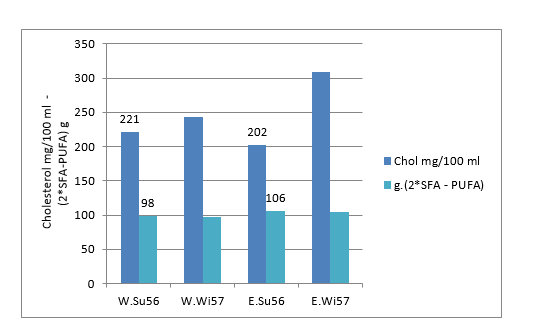
The old textbooks of biochemistry wrote that polyunsaturated fats (PUFA) decrease blood cholesterol content. Some experiments support the theory, that PUFA’s can even protect against atherosclerosis (free abbr. ASO). Keys et al have developed dietary “cholesterogenic formula” for prognosticating serum cholesterol and development of ASO. The aim of this article is to find explanation to the eastern summer cholesterol 5.2 mmol/l, which is 9 % lower to the respective western value, although same time the cholesterogenic index in east was 8 % higher to its respective western value (Table 1). Serum (total) cholesterol (mmol/l) was in summer 9 % lower (E/W ratio 0.91) and in winter 27 % higher than in west. Winter values in west were 10 % and in east 53 % higher than in summer [1]. Values of cholesterogenic formula (g) [2*saturated fatty acids (SFA) – polyunsaturated fatty acids (PUFA)] were 8-9 % higher in east than in east. Their winter values were 1-2 were lower to their summer values. Summer-winter means of cholesterol and cholesterogenic formula were 8-10 % higher in east. (Cholesterol values mg/100 ml are divided by its molar weight 386,7 g/mol and multiplied by 10). Especially summer cholesterol of the east, 5.2 (mmol/l), is in disagreement with the high value of the cholesterogenic formula (105.8), cf. cholesterol of the west (5.7) with value of the cholesterogenic formula 98.1. Seasonal variation in cholesterol was 10 % in the west, but 42 % in the east [2]. Because cholesterol can be seen as an inflammation marker and inflammation can be seen as a causative factor of coronary heart disease, here mortality from CHD has been benefited as an indicator on possible cholesterol associations (Figure 1). Cholesterol levels are dependent on inflammation, TNF-alfa and IL-6 [3].

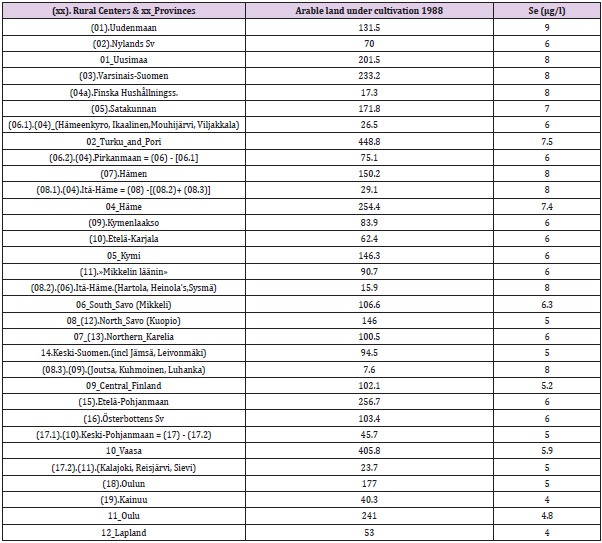
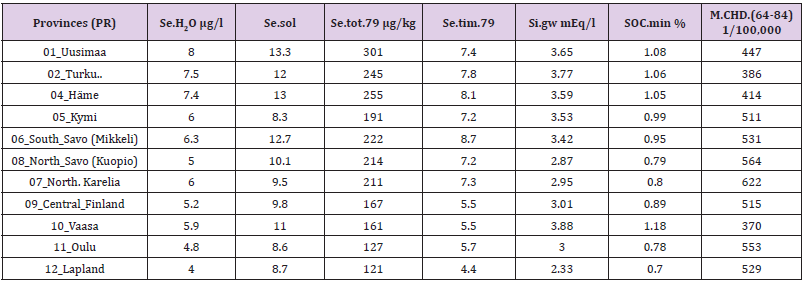
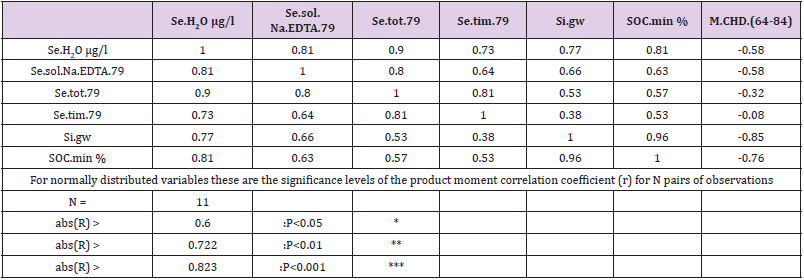
Low serum and milk silicon (Si) content has been associated with inflammation [4]. Low daily intake of magnesium (Mg) is reported to be associated with elevated CRP in humans [5]. Mg (Mg deficiency) can increase serum cholesterol level by controlling HMG CoA reductase [6]. Additional Si [7] or selenium (Se) [8] can decrease serum cholesterol level. Weathering of Mg and Si from soil silicate matrix, which occurs e.g., via fungal and bacterial assistance [9,10], is temperature dependent and starts somewhat later than K liberation [11]. This explains why generally Mg availability via grass is the lowest in the spring [12]. Additionally, temperature of May 1955 was 1-3 degrees lower to the average. Precipitation in June was unusually high in the Southwest Finland (Åland and Lapland) and less to average in other provinces [13]. Rainy weather can increase K contents and decrease Mg contents of plants [12]. High precipitation could dilute the weathered Mg and Si. So, in Jun 1955 the weather conditions could promote more Si and Mg access in East than in West. Less rain in East could be associated with higher amount of sunshine, synthesis of vitamin D and possible antidepressive effects, with possible metabolic effects. Total selenium (Se.tot) (μg/kg), “soluble” Se [Se.sol] (μg/l) and timothy Se content [Se.tim] μg/kg are from [Sippola,[12]]. [Se.tot] was extracted by several acids (HF, HNO3, HClO4 and HCl), in special order and heating. [Se.sol] was extracted with acid ammonium acetate-0.02 M Na2EDTA solution. [Se.tim] extraction is explained in [Sippola [12]]. [Se.H2O] from 1978-80 are provided by Viljavuuspalvelu Oy. Extraction was as follows: Dry and milled soil sample was extracted with boiled water at ratio 1:3. Leachate was analyzed using CV-AAS equipment (Kalevi Koivunen, Eurofins Viljavuuspalvelu Oy (Tables 2-4) [13-25].

biomedres-openaccess-journal-bjstr

Figure 1: Shows the great variation in eastern cholesterol values and association of its low summer value with the highest value of cholesterogenic formula (2*SFA-PUFA).

biomedres-openaccess-journal-bjstr

Table 1.

biomedres-openaccess-journal-bjstr

Table 2.

biomedres-openaccess-journal-bjstr

Table 3.

biomedres-openaccess-journal-bjstr

Table 4.


For more Articles on: https://biomedres01.blogspot.com/

Monday, November 17, 2025

Histaminosis – An Increasing Phenomenon


Histaminosis – An Increasing Phenomenon

Introduction

In the last 2-3 years, cases with histaminosis have clearly increased. We now call it a people’s disease. Histamine (ancient Greek ἱστός histos ‘tissue’) - in nomenclature: 2-(4-imidazolyl)- ethylamine - is a natural substance that acts as a tissue hormone and neurotransmitter. In humans and other mammals, histamine plays a central role in allergic reactions and is involved in the immune system. Thus, it serves as one of the messenger substances in the inflammatory reaction to cause swelling of the tissue. Histamine also acts as an important regulator in the gastrointestinal tract, in the regulation of gastric acid production and motility, and in the central nervous system. Biochemically, like tyramine, serotonin, dopamine, epinephrine, norepinephrine, or octopamine, it is a biogenic amine. It is formed by splitting off carbon dioxide (decarboxylation) from the amino acid histidine and is stored in particular in mast cells, basophilic granulocytes and nerve cells. Important effects of histamine are its function in the defense against foreign – may be dangerous - substances and its pathological involvement in the symptoms of allergies and asthma. Histamine is also one of the mediator substances in silent inflammations. Here, histamine causes itching, pain and contraction of smooth muscle (for example, in the bronchi). It causes increased permeability of the vascular walls of small blood vessels and thus leads to hives. Histamine-induced activation of the transcription factor NF-κB and an associated increased release of other inflammatory mediators are also involved in this process. Histamine leads to a release of adrenaline from the adrenal glands, too. These effects are mediated in particular via activation of H1 receptors.

If too much histamine is ingested with food, histamine excess can occur. Histamine is broken down by the enzyme diamine oxidase (DAO). As soon as this enzyme is not present in sufficient quantities or does not work effectively, the symptoms of so-called histamine intolerance occur. Intestinal inflammation can also be the cause of reduced DAO formation. If defense reactions against food proteins take place on the intestinal mucosa, inflammatory damage can occur to the mucosal cells themselves, which thin out and become leaky. This in turn leads to the symptoms of “leaky gut”. The mucosa is of fundamental importance. Together with its surroundings, it represents the habitat of about seventy to eighty percent of the lymphatic immune system. In our view, if the mucosal density is reduced, there may be an increased passage of viruses, fungi, bacteria and chlamydia into the mucosa and thus into the organism. In addition, the absorption capacity of the intestinal mucosa may decrease. This may lead to a deficiency in the absorption of amino acids (proteins), minerals, vitamins, trace elements, essential fatty acids, phospholipids, antioxidants and polyphenols, which in turn may have negative effects on energy formation and cell function [1].

Problems

There are two problematic pathways with regard to histamine:

a) The consumption of foods containing histamine, and

b) Its own production in the small intestine when food allergies take place.

Avoiding histamine-containing foods is relatively easy, as long as you know them. These are for instance: red wine, blue cheese, old cheeses in general, cured meats, seafood, etc. Unfortunately, most people are unaware of this issue. More important is the own production. Family physicians would have the task of testing the IgE and IgG antibodies to food allergens in the blood of each patient. Most commonly, large-molecule proteins such as casein (cow’s milk and products) and gluten/gliadins (wheat, rye) have been shown to be problematic. This means that a usual breakfast of bread and latte is unacceptable. In our experiences, genetically modified foods can also trigger histaminosis. This concerns e.g., peanuts, soy, corn.

Symptoms

The number of symptoms triggered by an increase in histamine is large. They are: Urticaria, skin itching, skin flushing, sleep disturbances, bronchial asthma, coughing, vertigo, nausea, vomiting, diarrhea, tachycardia, anxiety, M. Meniere, and several more. Neither a normal patient nor a usual physician thinks primarily of histaminosis with such symptoms. Children, for example, are given asthma sprays for years without testing for antibodies to food.

What to Do

Of course, in addition to the important allergen abstinence, there are also remedies against elevated histamine such as diphenhydramine, cromoglicic acid (DNCG) or cetirizine. As a natural remedy, the amino acid L-histidine can be used. Japanese medicinal mushrooms have also proven effective. In addition to the problems from the environment, the inner world must also be considered. This psychologically concerns accepting what is, even if it contradicts one’s own ideas. The intestinal environment is of course of crucial importance. It is not sufficient to substitute positive intestinal inhabitants (“probiotics”) for this purpose, because these do not integrate into the intestinal milieu as long as pathogenic germs, Candida fungi or parasites determine the milieu. First of all, cleansing must take place. This is difficult, because it requires explosive diarrhea. We have had the best experience with a therapy using intracellular enzymes from the company Citozeatec (1) from Milano/Italy. The following is a treatment scheme for intestinal detoxification:

Enzymatic Detox Treatment

First 6 days

• 10 ml «Citozym» in the morning before breakfast

• 10 ml «Ergozym plus» in the morning before breakfast

• 10 ml «Citozym» before dinner

From the 7th to the 60th day

• 20 ml «Citozym» dissolved in a glass of water in the morning before breakfast

• 10 ml «Ergozym plus» in the morning with breakfast

• 1 stick of «Probiotic P-450» at 11.00 a.m.

• 25 ml «Citexivir» with 1 stick of «Propulzym» dissolved in a glass of water before dinner.

The successes with this treatment are great. First the intestine is cleaned, then the blood and finally the intracellular space.

Summary

Histaminosis is developing into a disease of the people with increasing chemical and electromagnetic stresses from the environment and diet. It must be taken into account if one does not want to use strong drugs for a long time. Fortunately, there are gentler methods, which are listed here.


For more Articles on: https://biomedres01.blogspot.com/

Soil Weed Seed Bank Dynamics After Two-Year of On-Farm Trials Under Conservation Agriculture in Bangladesh

  Soil Weed Seed Bank Dynamics After Two-Year of On-Farm Trials Under Conservation Agriculture in Bangladesh Introduction While Conservation...