Serum Cholesterol in East and West Finland in Summer 1956 and Winter 1957 and Its Regulation – Discussion on Dietary Fats, Silicon, Selenium, Magnesium, Weathering and Climatic Factors
Introduction
The old textbooks of biochemistry wrote that polyunsaturated fats (PUFA) decrease blood cholesterol content. Some experiments support the theory, that PUFA’s can even protect against atherosclerosis (free abbr. ASO). Keys et al have developed dietary “cholesterogenic formula” for prognosticating serum cholesterol and development of ASO. The aim of this article is to find explanation to the eastern summer cholesterol 5.2 mmol/l, which is 9 % lower to the respective western value, although same time the cholesterogenic index in east was 8 % higher to its respective western value (Table 1). Serum (total) cholesterol (mmol/l) was in summer 9 % lower (E/W ratio 0.91) and in winter 27 % higher than in west. Winter values in west were 10 % and in east 53 % higher than in summer [1]. Values of cholesterogenic formula (g) [2*saturated fatty acids (SFA) – polyunsaturated fatty acids (PUFA)] were 8-9 % higher in east than in east. Their winter values were 1-2 were lower to their summer values. Summer-winter means of cholesterol and cholesterogenic formula were 8-10 % higher in east. (Cholesterol values mg/100 ml are divided by its molar weight 386,7 g/mol and multiplied by 10). Especially summer cholesterol of the east, 5.2 (mmol/l), is in disagreement with the high value of the cholesterogenic formula (105.8), cf. cholesterol of the west (5.7) with value of the cholesterogenic formula 98.1. Seasonal variation in cholesterol was 10 % in the west, but 42 % in the east [2]. Because cholesterol can be seen as an inflammation marker and inflammation can be seen as a causative factor of coronary heart disease, here mortality from CHD has been benefited as an indicator on possible cholesterol associations (Figure 1). Cholesterol levels are dependent on inflammation, TNF-alfa and IL-6 [3].
Low serum and milk silicon (Si) content has been associated with inflammation [4]. Low daily intake of magnesium (Mg) is reported to be associated with elevated CRP in humans [5]. Mg (Mg deficiency) can increase serum cholesterol level by controlling HMG CoA reductase [6]. Additional Si [7] or selenium (Se) [8] can decrease serum cholesterol level. Weathering of Mg and Si from soil silicate matrix, which occurs e.g., via fungal and bacterial assistance [9,10], is temperature dependent and starts somewhat later than K liberation [11]. This explains why generally Mg availability via grass is the lowest in the spring [12]. Additionally, temperature of May 1955 was 1-3 degrees lower to the average. Precipitation in June was unusually high in the Southwest Finland (Åland and Lapland) and less to average in other provinces [13]. Rainy weather can increase K contents and decrease Mg contents of plants [12]. High precipitation could dilute the weathered Mg and Si. So, in Jun 1955 the weather conditions could promote more Si and Mg access in East than in West. Less rain in East could be associated with higher amount of sunshine, synthesis of vitamin D and possible antidepressive effects, with possible metabolic effects. Total selenium (Se.tot) (μg/kg), “soluble” Se [Se.sol] (μg/l) and timothy Se content [Se.tim] μg/kg are from [Sippola,[12]]. [Se.tot] was extracted by several acids (HF, HNO3, HClO4 and HCl), in special order and heating. [Se.sol] was extracted with acid ammonium acetate-0.02 M Na2EDTA solution. [Se.tim] extraction is explained in [Sippola [12]]. [Se.H2O] from 1978-80 are provided by Viljavuuspalvelu Oy. Extraction was as follows: Dry and milled soil sample was extracted with boiled water at ratio 1:3. Leachate was analyzed using CV-AAS equipment (Kalevi Koivunen, Eurofins Viljavuuspalvelu Oy (Tables 2-4) [13-25].
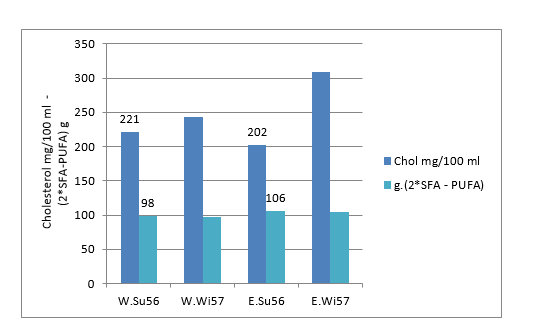
Figure 1: Shows the great variation in eastern cholesterol values and association of its low summer value with the highest value of cholesterogenic formula (2*SFA-PUFA).

Table 1.
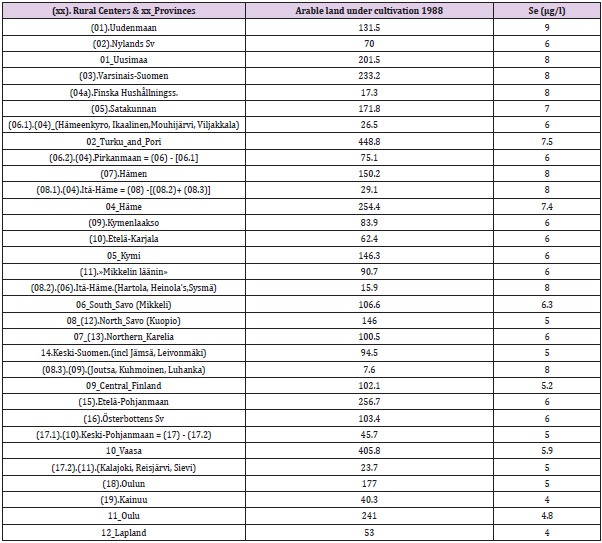
Table 2.
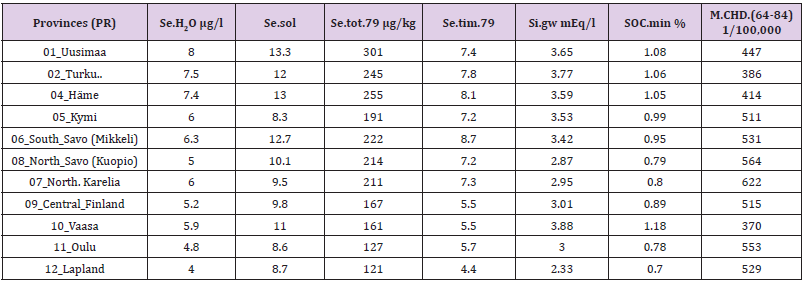
Table 3.
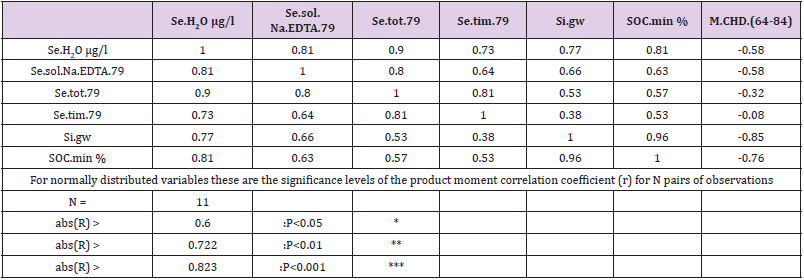
Table 4.



No comments:
Post a Comment
Note: Only a member of this blog may post a comment.